Iranian President Masoud Pezeshkian has told the UN that Tehran will not surrender to U.S. pressure but remains open to diplomacy, responding to Donald Trump’s threat to “annihilate” Iran.
Pezeshkian hits back at Trump
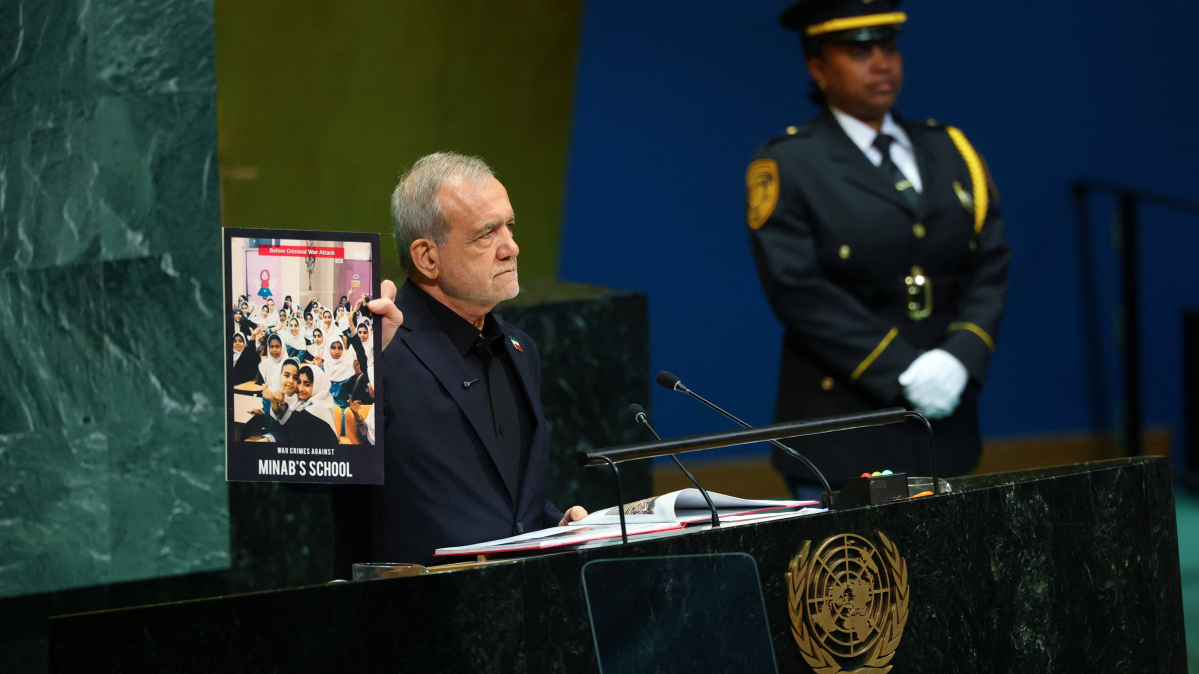
Speaking at the UN General Assembly in New York on Wednesday, Pezeshkian accused Washington of portraying Iran as an aggressor while ignoring the suffering inflicted on Iranian civilians during nearly seven months of war.
“I had prepared a speech to deliver to you, but yesterday the President of the United States described us as terrorists. Yet we have been the victims of terrorism,” Pezeshkian said.
He pointed to the killing of Iran’s former Supreme Leader Ali Khamenei and attacks that he said had killed scientists and civilians, including children.
“Those who are terrorists and train terrorists portray us as such, yet we have done nothing but defend ourselves. We are not terrorists,” he said.
Pezeshkian insisted Iran would resist military and economic pressure, saying: “We will never bow our heads or bring ourselves to our knees.”
His remarks came a day after Trump used his own UN address to threaten to “annihilate” Iran, highlighting the gulf between the two governments even as tentative diplomatic contacts resume.
Nuclear programme and regional war
Pezeshkian maintained that Iran does not seek nuclear weapons but rejected attempts to restrict its access to civilian nuclear technology.
“We say ‘no’ to nuclear weapons, but we also say ‘no’ to restrictions on nuclear technology,” he said, adding that Iran wanted nuclear energy for development rather than to threaten other countries.
The Iranian president also condemned the bloodshed in Gaza and argued that there could be no lasting peace in the region without justice for Palestinians.
His speech comes against the backdrop of a war launched by the U.S. alongside Israel in February, which has killed thousands, disrupted energy supplies and spread into other parts of the Middle East.
Diplomacy returns despite tensions
Despite the confrontational rhetoric, there were signs that diplomatic channels remain open.
Iranian Foreign Minister Abbas Araqchi and U.S. envoys Steve Witkoff and Jared Kushner communicated indirectly through mediators on the sidelines of the UN gathering on Tuesday, the first known such contact since a ceasefire collapsed in July.
Trump described the discussions as “very productive” and said there was “a lot of momentum” towards a possible agreement.
Iranian Foreign Ministry spokesperson Esmail Baghaei said Tehran had conveyed its conditions through a Qatari mediator, including an end to the war on all fronts and a halt to what Iran calls U.S. “acts of aggression”.
The contact has drawn criticism from Iranian hardliners, some of whom oppose renewed engagement with Washington. Iranian officials said the delegation had been instructed not to meet U.S. representatives face-to-face.
Pezeshkian nevertheless left the door open to negotiations, while making clear that Tehran would reject talks conducted under threat.
“Mr Trump and those who seek to harass us know that we are prepared to engage in dialogue without accepting the language of force.”












What is your opinion on this topic?
Leave the first comment