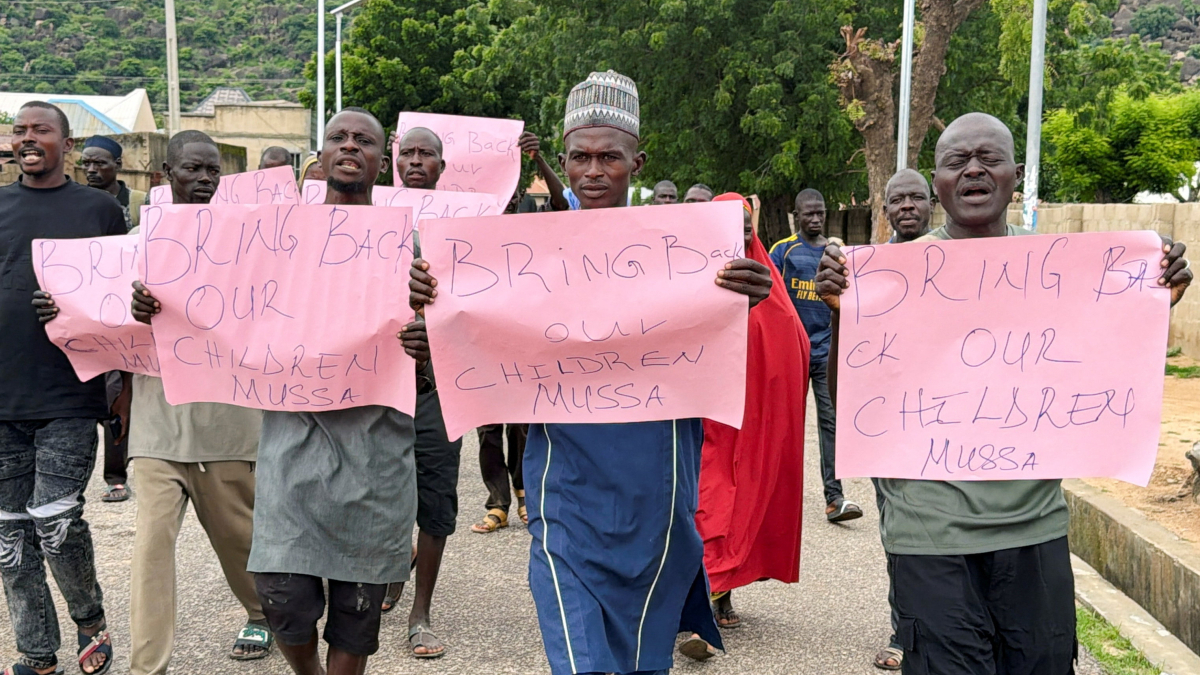
Nearly 100 days after dozens of children were abducted from a school in northeastern Nigeria's Borno State, parents have taken to the streets to demand urgent government action to bring them home.
The protest, held on Thursday in Uba town, highlighted growing frustration among families who say they have received little information about their children's whereabouts or condition since they were taken in May.
The children were kidnapped from their classrooms in Mussa, a community on the edge of the Sambisa Forest, an area long associated with insurgent groups including Boko Haram and its offshoot, Islamic State West Africa Province (ISWAP).
For parents, nearly 100 days without answers have brought mounting fear and uncertainty.
"We still have not seen them," said Chinda Buba, whose child was among those abducted. "We do not know where our children are. We don't know whether they are healthy or going through difficult conditions."
Families left waiting for answers
The demonstration underscored the emotional toll of the abductions on families across the region, with parents saying their daily lives have become consumed by worry as they wait for news.
Peace Nicolos, whose two children, aged three-and-a-half and eight-and-a-half, were among those taken, described the pain of not knowing whether they were safe.
"We worry every day and struggle to eat," she said. "We are pleading with the government to rescue them."
Community leaders say the effects reach far beyond the children's immediate families.
Orbet Lawan Yakubu, representing the traditional ruler of Mussa, said around 45 children remain unaccounted for.
"There is nothing more painful than separating very young children from their parents," he said. "The entire community is affected because almost every family is connected to those who were taken."
Persistent insecurity in northeastern Nigeria
The mass abduction is another stark reminder of the security challenges facing northeastern Nigeria, despite years of military operations against armed groups.
While Boko Haram and ISWAP have lost territory compared with the height of the insurgency, both organisations continue to stage attacks on villages, security installations and educational institutions across Borno and neighbouring states.
The kidnapping in Mussa was followed by another attack in nearby Lassa on 29 June, during which 36 students and a teacher were also taken captive. They remain missing.
School abductions have become one of the most disturbing features of Nigeria's long-running security crisis, with armed groups targeting educational facilities for ransom, propaganda and recruitment purposes.
Calls for stronger government response
Protesters are calling on authorities to step up efforts to locate and rescue the children.
A police spokesperson said security forces were addressing the situation but declined to provide further details, instead referring questions to the military. Military officials did not immediately comment.
The lack of updates has deepened concern among relatives, who say they have been left with little information about efforts to rescue the children.
Although Nigerian authorities have secured the release of some kidnapped students in other parts of the country in recent months, families in Borno say they fear their children's ordeal is being forgotten.
For parents gathered in Uba, the demand was clear: after nearly 100 days of waiting, they want answers — and they want their children home.

















What is your opinion on this topic?
Leave the first comment