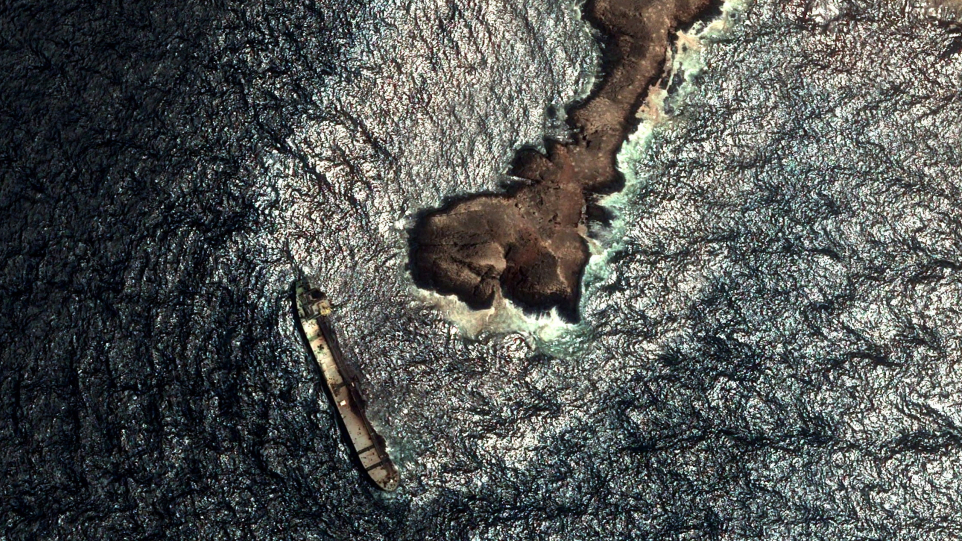
A growing oil spill from a stranded tanker carrying nearly one million barrels of Russian crude has raised environmental concerns off the coast of Oman, where authorities are racing to contain a slick that now covers hundreds of square kilometres near a protected marine reserve.
Oman's Environment Authority said the spill, linked to the grounded tanker Caroline Bezengi, currently stretches across around 390 square kilometres of sea near the Hallaniyat Islands, a biodiverse archipelago designated as a nature reserve last year by Sultan Haitham bin Tarik.
The slick extends northeast of the islands and has drifted to within seven kilometres of the coastline. While officials said there is currently no threat to water desalination plants or tourist facilities in the area, environmental experts warn that the impact on marine ecosystems could be severe if the oil reaches coastal waters.
Sensitive wildlife habitat at risk
The Hallaniyat Islands are one of Oman's most ecologically important marine areas, providing habitat for species including the endangered Arabian Sea humpback whale and large colonies of Socotra cormorants.
Scientists say preventing the oil from reaching shallow coastal zones is now critical.
Tony Gutierrez, a professor of environmental microbiology and biotechnology at Heriot-Watt University, said large-scale containment efforts are needed, including aerial spraying of dispersants and the deployment of booms to collect oil before it reaches shore.
"If this oil is kept offshore, the impact will be much less than if the oil reaches shallower waters and the actual coastline," he said.
Environmental damage from major spills can be long-lasting. Gutierrez noted that traces of oil from the 1989 Exxon Valdez disaster in Alaska were still being found years after the incident.
Questions over response efforts
The tanker first reported difficulties on 8 June while operating off the coast of Yemen. Maritime security sources said initial assessments suggested a blast may have occurred onboard, although no group has claimed responsibility and the cause remains unclear.
Satellite imagery analysed by Reuters and independent experts indicated the spill was still expanding at the end of last month.
John Amos, chief executive of environmental monitoring organisation SkyTruth, said publicly available satellite data showed little evidence of a significant recovery operation around the vessel.
"We haven't seen that on publicly available satellite imagery. We haven't seen that on satellite-collected AIS tracking data. And that's a concern," Amos said.
Part of Russia's shadow fleet
Shipping data shows the Caroline Bezengi loaded crude at Russia's Black Sea port of Novorossiysk in April before transiting the Suez Canal in May en route to Asia.
According to Reuters, the vessel, built in 2001, is part of a Russian fleet referred to as the "shadow fleet," made up of ageing tankers used to transport oil while avoiding Western restrictions. Such ships often operate under changing ownership structures and flags to obscure their origins.
The tanker was previously listed under the Cameroon flag, though it was among dozens of vessels removed from the country's registry in June. The ship is also subject to sanctions imposed by the European Union, the United Kingdom, Canada, Switzerland and Ukraine.
With hundreds of thousands of barrels of oil still believed to be aboard, environmental groups warn that unless the vessel is stabilised and its cargo removed, the incident could escalate into one of the most serious marine pollution events seen in the region in recent years.
Read more:













What is your opinion on this topic?
Leave the first comment