Türkiye has started restricting commercial ship traffic into the Black Sea due to the government's increasing concern about a surge in Russian and Ukrainian attacks on ships, Bloomberg News has reported, citing unnamed sources.
The country’s coastguard agency has told a number of ships bound for Russia’s Black Sea port of Novorossiysk, an important oil and grain export hub, that it isn’t issuing licences for such journeys via the Dardanelles Strait or needs extra time to review applications, sources told Bloomberg.
However, two Turkish officials told Reuters on Sunday that ships are passing smoothly through the straits to the Black Sea despite heightened concerns about safety.
The officials, who spoke on condition of anonymity, said Türkiye had implemented some temporary measures because it had been highly uncomfortable about security for some time, but that passage was clear under the conditions of the Montreux Convention.
Black Sea drone attacks
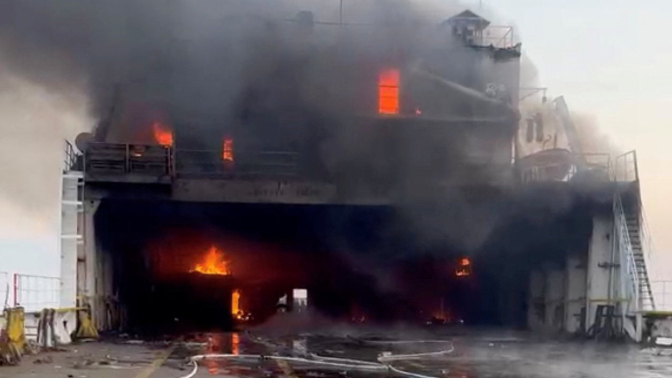
Türkiye’s decision follows a spate of strikes on civilian ships in the Black Sea. A German cargo ship was targeted by a Russian drone attack near the Ukrainian port of Odessa on 5 August, triggering a fire.
On 3 August, two Turkish-owned cargo vessels were struck after departing the Russian port of Novorossiysk.
Ukrainian officials have not commented on the pair of incidents. The attacks prompted Ankara to issue a statement calling on Moscow and Kyiv to ensure the safety of commercial vessels transiting the Black Sea.
In late July, Ukraine claimed to have struck three cargo ships and a tanker, while the Russian military said it had hit three commercial ships.
Turkish Foreign Minister Hakan Fidan on Saturday said Ankara had conveyed to Moscow and Kyiv they should declare a moratorium on their attacks in the Black Sea.
On Sunday, shiptracking data showed some vessels bound for a number of ports still heading northward towards the Dardanelles and Bosphorus straits.
Importance of Black Sea
The Black Sea straits are among the world’s busiest narrow shipping waterways. Under the 1936 Montreux Convention, Türkiye has control of the straits and can limit access to warships in times of war, but not merchant ships, provided it itself is not a belligerent.
Turkish Ministry of Finance figures released on 3 August show that 40,218 ships passed through the Dardanelles and Bosphorus in the first half of 2026, despite heightened security risks.
Kazakhstan's oil exports
The Black Sea straits are important for trade reasons for all the countries located on the inland body of water, most notably Kazakhstan which had no other seaborne export route for its oil. More than 80 per cent of Kazakhstan’s oil exports pass through the Caspian Pipeline Consortium terminal near Novorossiysk.
The Black Sea is bounded by Türkiye to the south, Bulgaria and Romania to the west, Ukraine to the north, Russia to the northeast and Georgia to the east.
Türkiye, which has NATO's second-largest army, has maintained cordial ties with both Kyiv and Moscow since Russia's full-scale invasion of Ukraine in 2022. It has refused to join Western sanctions on Russia, while providing military support, including from its own inventory, to Ukraine.
Read more from Türkiye:






















What is your opinion on this topic?
Leave the first comment