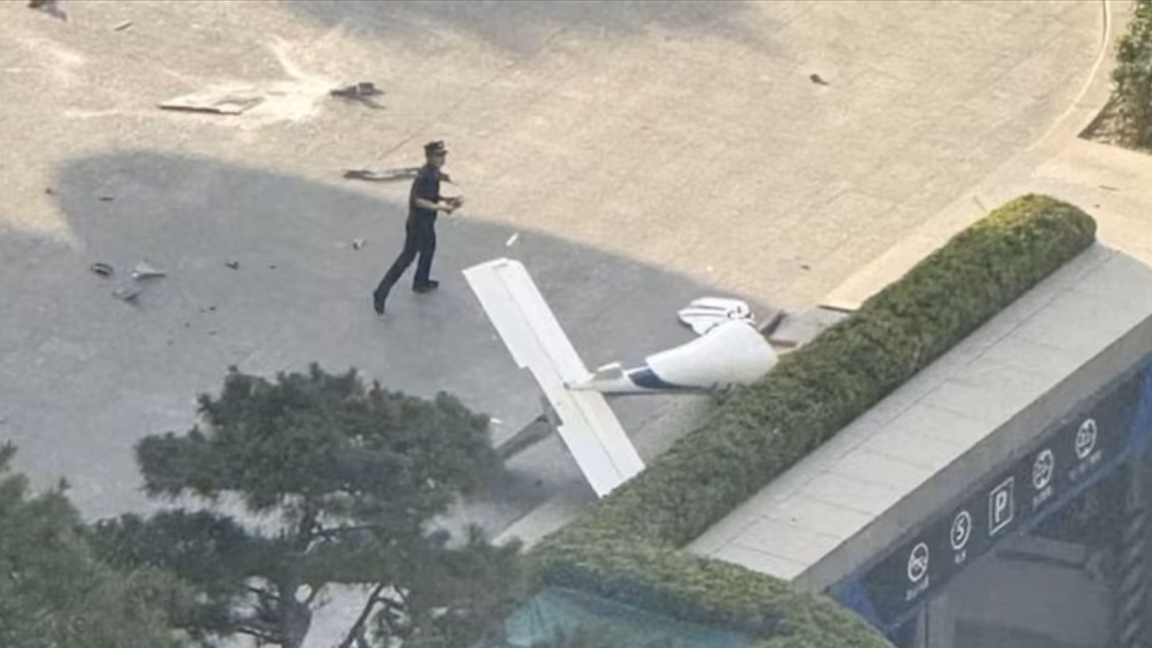
Authorities in Beijing have identified the pilot killed in last week's plane crash into the city's tallest building as a 66-year-old man surnamed Liu, as officials sought to address growing speculation over the rare incident.
Questions remain over security breach
The Chaoyang District Government said Liu had deviated from his approved flight path before losing contact with air traffic control and crashing into the 108-storey CITIC Tower, the headquarters of CITIC Group.
Officials said Liu, a Beijing native, had long suffered from insomnia and anxiety, adding that the crash was caused by "personal reasons".
The statement said Liu's diary contained repeated references to ending his life, suggesting investigators are treating the incident as a possible suicide.
The crash has raised fresh questions about aviation security in China, where strict airspace controls make such incidents extremely rare.
The aircraft reportedly entered an area near a permanent no-fly zone and crossed restricted airspace close to Beijing Capital International Airport before impact. The building is located just a few kilometres from Zhongnanhai, the leadership compound used by Chinese President Xi Jinping and other senior officials.
Chinese authorities have since confirmed that 13 people on the ground were injured in the crash. None of the injuries was life-threatening, and at least one person has already been discharged from hospital.
Investigators identified the aircraft as a two-seat Sunward SA60L operated by a Beijing-based general aviation company.
Flight-tracking data reviewed by Reuters showed the aircraft took off from Shifo Temple Airport in Pinggu District, flew several loops over the north-eastern outskirts of the city, then veered towards central Beijing before disappearing near the CITIC Tower.
The incident has intensified scrutiny of China's expanding "low-altitude economy" — a government-backed initiative to develop private aviation and drone industries — with analysts saying the breach could prompt tighter oversight of general aviation near politically sensitive areas.
Social media discussion scrubbed
The incident occurred just days before the Chinese Communist Party marked its 105th anniversary.
Online discussion of the crash has largely been removed from Chinese social media, although some users questioned how the aircraft was able to breach tightly controlled airspace.
Read more:











What is your opinion on this topic?
Leave the first comment