At least 21 people have been killed and thousands evacuated after torrential rain triggered flooding, landslides and transport disruption across southern and central China, with authorities warning that more heavy rainfall is expected along the Yangtze River.
Deaths and evacuations mount
Heavy rain continued across large parts of China on Tuesday and Wednesday, affecting provinces including Hunan, Hubei, Guizhou, Guangxi, Jiangxi, Anhui and Guangdong.
Chinese state media said at least 21 people had died in separate incidents linked to flooding and severe weather, while several others remained missing.
In Hunan province, five people were killed and 11 reported missing in Shimen county after intense rainfall battered the region, state broadcaster CCTV reported. More than 19,000 residents had been relocated by Tuesday evening, according to Xinhua news agency.
Xinhua said Shimen recorded 339 millimetres of rainfall within 24 hours ending early Monday, while one town received 240 millimetres within just a few hours, breaking historical records.
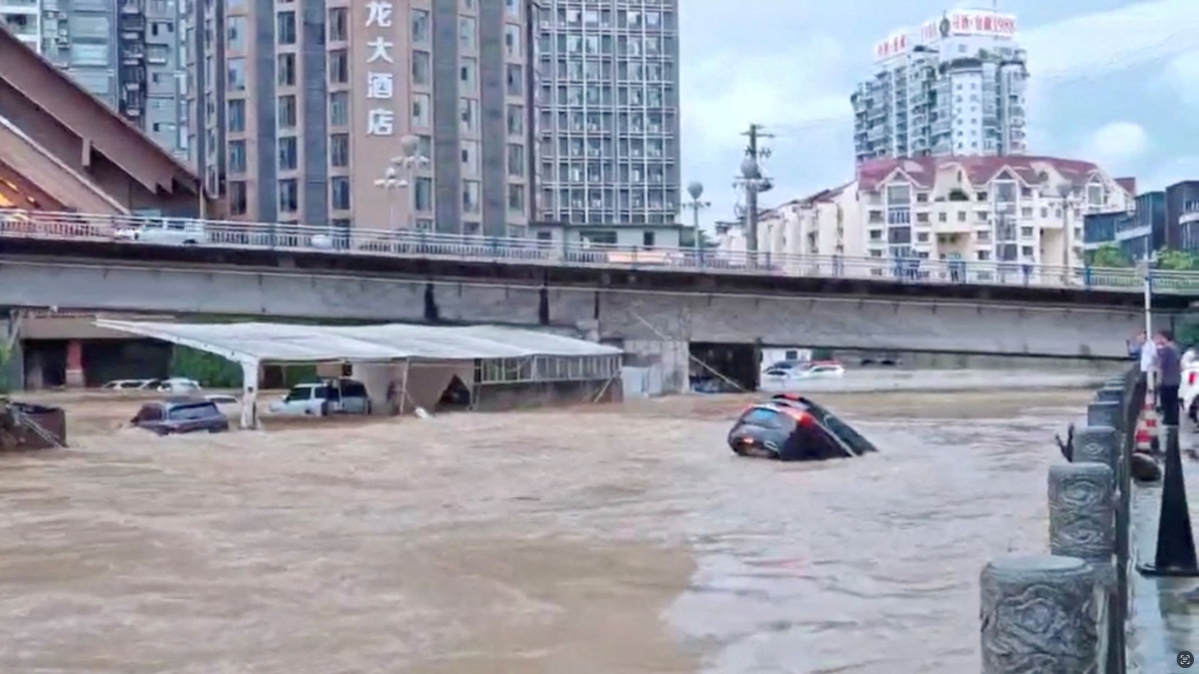
In neighbouring Hubei province, flooding turned streets into rivers, forcing rescuers to use inflatable boats to reach stranded residents. Three people were killed and four others were missing after flash floods struck low-lying areas in Xuan'en county in Enshi Tujia and Miao autonomous prefecture.
Guizhou province reported four deaths and five people missing after downpours triggered floods and landslides in Guiding county. More than 3,700 residents were relocated in one affected area, according to state media.
Separately, 10 people were killed after a pickup truck carrying farm workers plunged into a flooded river in Guangxi over the weekend.
Schools shut and infrastructure damaged
Authorities suspended schools, businesses and transport services in several affected areas, while emergency teams carried out evacuations, drainage operations and infrastructure repairs.
In Hubei, rescue teams said they drained nearly 20 million litres of floodwater and rescued or evacuated more than 300 residents between Sunday and Monday.
Images shared on Chinese social media showed residents wading through knee-deep water in the city of Jingzhou, where some vehicles were almost completely submerged.
Communications and power supplies were disrupted in parts of the flood-hit regions, while roads and bridges suffered extensive damage.
China's government said it had allocated 150 million yuan ($22 million) in disaster relief funding and launched emergency responses in multiple provinces.
More rain forecast
China's National Meteorological Centre warned that severe weather would gradually move east and south over the coming days, with the heaviest rainfall expected along the middle and lower reaches of the Yangtze River from Wednesday.
Meteorologists said the unusually broad band of rainfall, stretching more than 1,000 kilometres, was caused by moisture converging from the Bay of Bengal, the South China Sea and the Pacific Ocean.
On the southern island province of Hainan, authorities issued a geological disaster warning after a mountainside collapsed onto a highway in Lingshui, forcing road closures.
China experiences deadly flooding during its annual summer rainy season, with heavy rains last year killing dozens of people in Beijing.



















What is your opinion on this topic?
Leave the first comment