The leader of Taiwan's largest opposition party used her first full day in mainland China to publicly pledge reconciliation, invoking the spirit of her party's founder, Sun Yat-sen, to call for unity whilst surprisingly praising the communist mainland’s developmental achievements.
Cheng Li-wun, the Chairwoman of the Kuomintang (KMT), is undertaking a highly sensitive diplomatic mission at a time of acute cross-strait tension. Beijing, which views democratically governed Taiwan entirely as its own sovereign territory, has dramatically increased military pressure on the island.
Cheng's visit also coincides with a fierce domestic political battle in Taipei, where the KMT-dominated parliament is actively stalling a government plan to secure $40 billion in extra, emergency defence spending.
In a morning laden with deep historical symbolism, Cheng laid a wreath at Sun Yat-sen's monumental mausoleum in the eastern city of Nanjing. The location resonates on both sides of the strait; Nanjing served as the capital of the KMT-led Republic of China government before it was defeated in a brutal civil war by Mao Zedong's communist forces, prompting the KMT's flight to Taiwan in 1949.
"The core values of Sun Yat-sen's ideal that 'all under heaven are equal' have always been equality, inclusiveness, and unity," Cheng stated with her remarks carried live on Taiwanese television channels.
"We should work together to promote reconciliation and unity across the (Taiwan) Strait and create regional prosperity and peace," she said.
Shared, contested history
Sun Yat-sen occupies a unique, unifying position in the otherwise fractured history of modern China. Having overthrown the last imperial Qing dynasty to found the Republic of China in 1912, he died of cancer in 1925 before the civil war fully erupted. Consequently, he is still officially venerated in democratic Taiwan as the founding father of the Republic. Paradoxically, he is also revered in mainland China by the ruling Communist Party as a Chinese national hero, with Mao Zedong famously declaring him the "great revolutionary forerunner."
During her address, Cheng noted that the KMT had ultimately honoured Sun's founding democratic principles by transforming Taiwan into a free, multi-party society. However, she candidly acknowledged the dark chapters of the KMT's own history, specifically mentioning the "white terror" era during the 38 years of brutal martial law the island endured until 1987.
Pivoting to the present day, she offered a generous assessment of her hosts. "Likewise, on the mainland, we have also seen and witnessed progress and development that exceeded everyone's expectations and imagination," Cheng added.
While Taiwan boasts a vibrant, multi-party democracy, the Chinese Communist Party brooks no political dissent to its authoritarian rule.
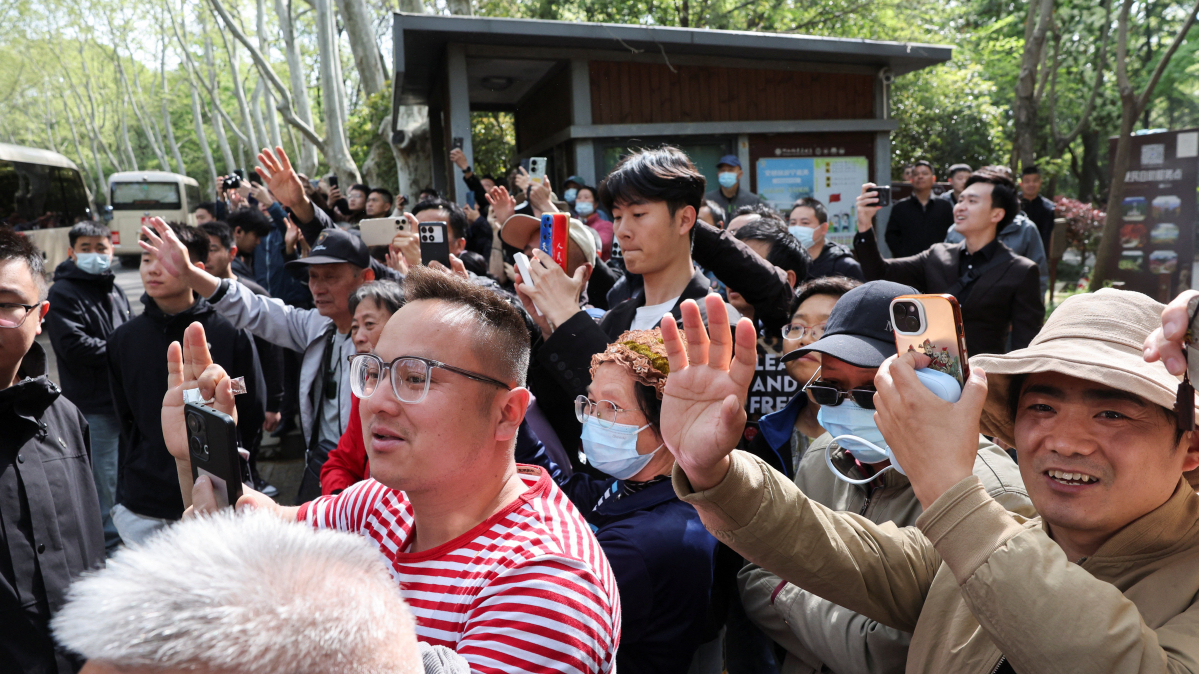
Security was tight for her visit to Nanjing, yet she drew curious crowds. "I think this is very important for peaceful exchanges between the two sides of the Taiwan Strait," remarked Yang Zihang, a 19-year-old student who had gathered with classmates to watch Cheng's motorcade pass.
Currently, the official channels of communication between Beijing and Taipei are completely frozen. The Chinese government refuses to speak to Taiwan's President Lai Ching-te, routinely deriding him as a dangerous "separatist."
Lai, conversely, maintains that only the Taiwanese people possess the right to decide their political future.
Neither government formally recognises the legitimacy of the other. Cheng defends her trip by insisting she is on a vital mission of peace, arguing that while she theoretically supports Taiwanese defence spending, it must be carefully balanced with active dialogue to prevent accidental conflict.
Warnings from Taipei over military intimidation
Cheng's rhetoric of reconciliation has been met with severe scepticism by the ruling administration in Taipei. Wu Cheng, a spokesperson for Taiwan's ruling Democratic Progressive Party (DPP), issued a blunt rebuke on Wednesday, stating that if the KMT genuinely desired stability across the strait, it should immediately cease blocking the urgent $40 billion defence spending package in parliament.
"Peace has never come from the charity of dictators; it must be safeguarded by Taiwan's own strength," Wu stated, reflecting the administration's view that Beijing only respects hard deterrence. Lai's government has publicly demanded that Cheng utilise her access to tell Chinese officials,including President Xi Jinping, should a meeting occur, to halt the daily military harassment of the island and respect the democratic rights of the Taiwanese populace.
Speaking to reporters at the national parliament in Taipei earlier on Wednesday, Tsai Ming-yen, Director-General of Taiwan's National Security Bureau, declined to comment specifically on partisan activities but warned of Beijing's sophisticated psychological warfare. China, he explained, uses a calculated "carrot-and-stick" approach to destabilise Taiwanese society from within.
By employing relentless military intimidation, China creates an atmosphere of rising military danger across the Taiwan Strait, Tsai noted.
"This is intended to make Taiwan's society and public feel the psychological pressure and anxiety of a possible conflict," he added.
The ultimate goal of this strategy is to "divide Taiwanese society internally, boosting the visibility of pro-China positions."
Tsai warned that this atmospheric pressure is actively designed to "further obstruct efforts to push forward U.S. arms procurement deals," a direct reference to the parliamentary deadlock currently being enforced by Cheng's KMT.












What is your opinion on this topic?
Leave the first comment