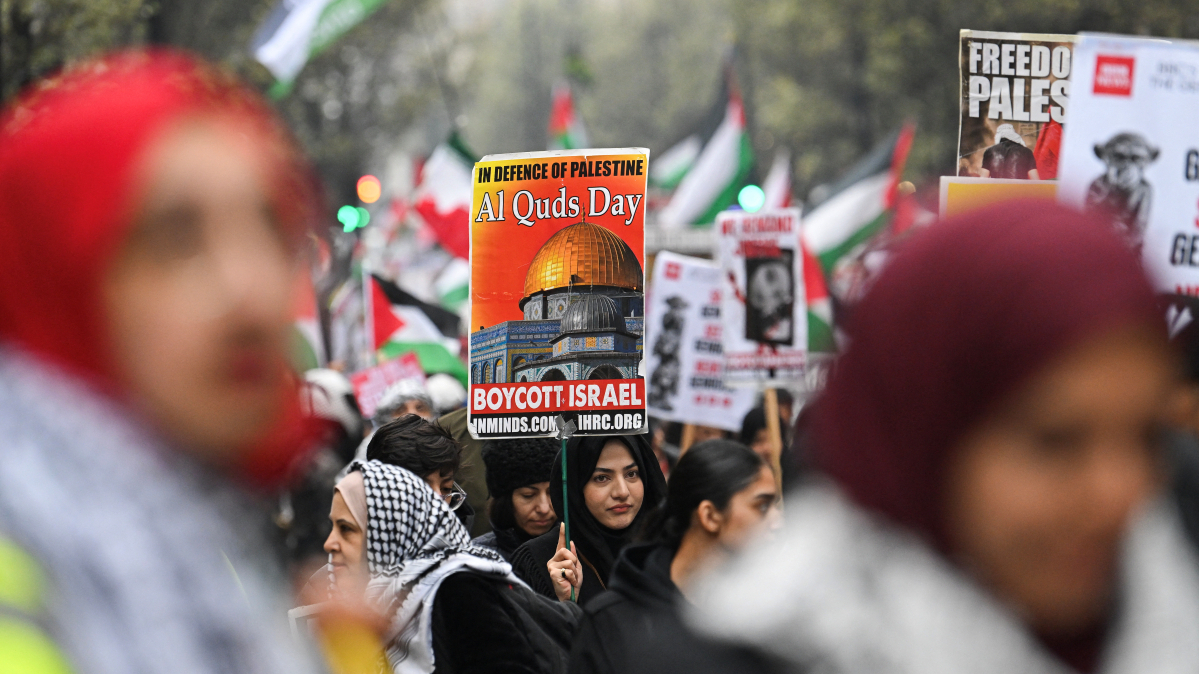
The annual pro-Palestinian al-Quds Day march in London, scheduled to take place on Sunday, has been banned by Home Secretary Shabana Mahmood following warnings from the Metropolitan Police about the risk of “serious public disorder.”
The demonstration, held for more than 40 years in support of Palestinian rights and opposition to Israel, has attracted controversy in recent years. Some participants in past marches have waved the flag of Hezbollah, the Iran-backed group banned in the UK, and chants against Israel and the U.S. have been reported.
Government cites security concerns
Announcing the decision, Mahmood said the ban was “necessary to prevent serious public disorder, due to the scale of the protest and multiple counter-protests, in the context of the ongoing conflict in the Middle East”.
She added that if a stationary protest were to go ahead, police would impose strict conditions and take action against anyone spreading hatred or division rather than exercising their right to protest peacefully.
Organisers condemn the ban
The march is organised by the UK al-Quds Committee, with the Islamic Human Rights Commission (IHRC) playing a central role.
The group has insisted the demonstration is peaceful and condemned the ban as “a politically charged decision” and “an attack on freedom of expression”.
The IHRC said it is seeking legal advice and confirmed that a static protest could still legally take place on Sunday.
Police say risks are unusually high
The Metropolitan Police said the decision followed a risk assessment of both the planned protest and potential counter-protests.
A spokesperson said: “The threshold to ban a protest is high and we do not take this decision lightly. The uniquely complex international situation and severe risks meant merely placing conditions on the protest would not have been sufficient to prevent serious public disorder.”
Calls to ban the march intensified after comments from Courts Minister Sarah Sackman, who said supporters of Iran’s regime and its proxies “have no place in our society” and should not be “calling for hate and hostility against this country.”
Previous incidents linked to the event
Previous al-Quds Day marches have been largely peaceful, though there have been isolated incidents.
In 2017, Darren Osborne, later convicted of terrorism, attempted to target attendees but was prevented by police safety cordons. He subsequently attacked worshippers outside Finsbury Park Mosque, killing one person and injuring 12 others.
First protest ban in London for more than a decade
The ban marks the first time a protest march has been prohibited in London since 2012.
While the IHRC and its supporters have criticised the move as an infringement of civil liberties, the Home Office and police maintain it is a necessary measure to protect public safety during a tense and highly charged political climate.













What is your opinion on this topic?
Leave the first comment