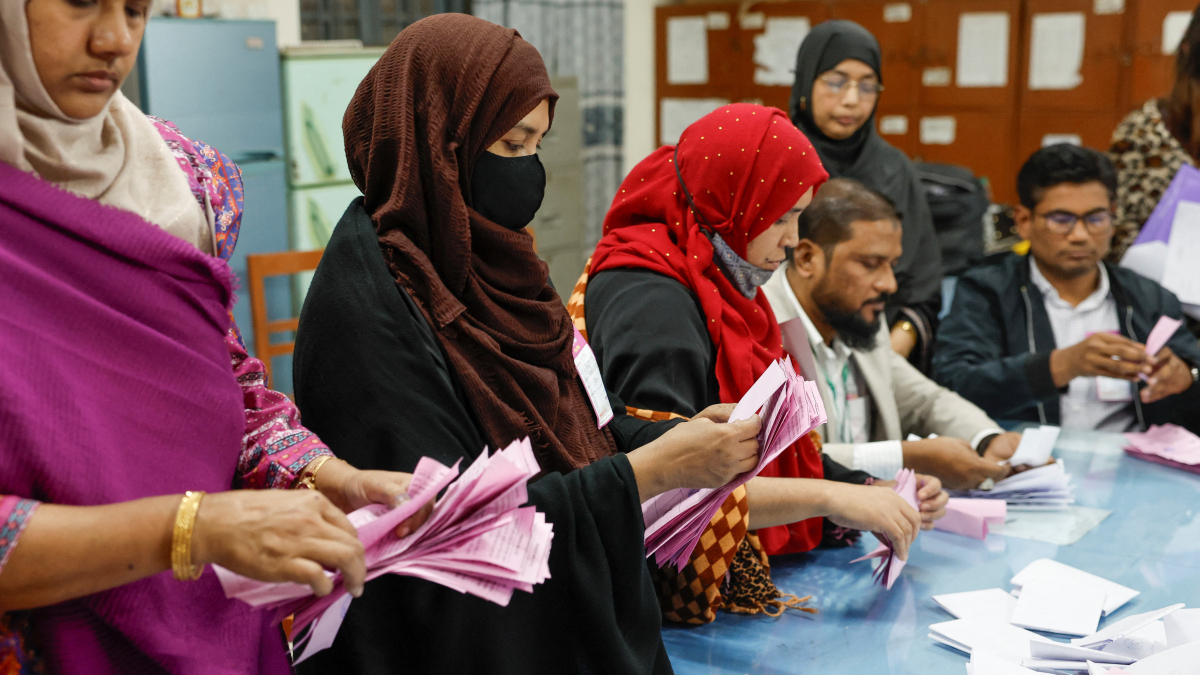
Polls have close in Bangladesh's first general election since the fall of Sheikh Hasina’s government, marking a pivotal moment in the country’s political transition. Turnout reached 47.91% by early afternoon, according to partial data from election authorities.
Counting began immediately after voting ended, with preliminary constituency results expected overnight and a clearer national picture likely by Friday, election officials said.
Turnout stood at 47.91% between 7:30am and 2:00pm, based on data received from 36,031 of the country’s 42,651 polling centres, according to the Bangladesh Election Commission. As of late afternoon, officials said they had yet to receive turnout figures from 6,620 centres.
The contest is widely seen as a direct race between the Bangladesh Nationalist Party, led by Tarique Rahman, and an 11-party alliance headed by Jamaat-e-Islami chief Shafiqur Rahman. The coalition includes the National Citizen Party, formed by figures who rose to prominence during the political upheaval of 2024.
Voters cast two ballots, one for parliamentary candidates and another in a referendum on the proposed July Charter, which would grant the next government authority to introduce significant constitutional changes. Officials said counting both ballots could extend the overall tallying process compared with previous elections.
Additional police forces
There were reports of sporadic violence and allegations of irregularities in several constituencies. In Chattogram’s Anwara area, at least six people, including two polling agents, were injured in a clash between rival supporters outside a polling centre, according to local media. Police said additional forces were deployed and the situation was later brought under control.
The Jamaat-led alliance submitted a written complaint to the Election Commission alleging irregularities in multiple constituencies and called for suspension of voting at specific centres.
Jamaat-e-Islami chief Shafiqur Rahman urged party supporters and voters to remain at polling stations until the complete election results are officially announced, calling for vigilance during the counting process.
Nearly one million police and military personnel were deployed nationwide to maintain order.
A pre-election survey conducted by the International Institute of Law and Diplomacy, based on responses from nearly 64,000 people across Bangladesh, found that 67% of participants identified tackling inflation as their top priority, followed by improving law and order and addressing corruption.
Bangladesh’s parliament, the Jatiya Sangsad, comprises 300 directly elected seats and 50 reserved seats for women allocated proportionally. The party or coalition that secures a majority will form the next government.
The election follows the events of 2024, when mass protests led to the removal of former prime minister Sheikh Hasina from office. The United Nations has said up to 1,400 people were killed during the unrest. Hasina has denied allegations that she directly ordered a crackdown on demonstrators.
Interim leader Muhammad Yunus voted in Dhaka and described the election as a significant moment for the country. Both Tarique Rahman and Shafiqur Rahman said they would accept the result if the process is conducted in a free and peaceful manner.













What is your opinion on this topic?
Leave the first comment