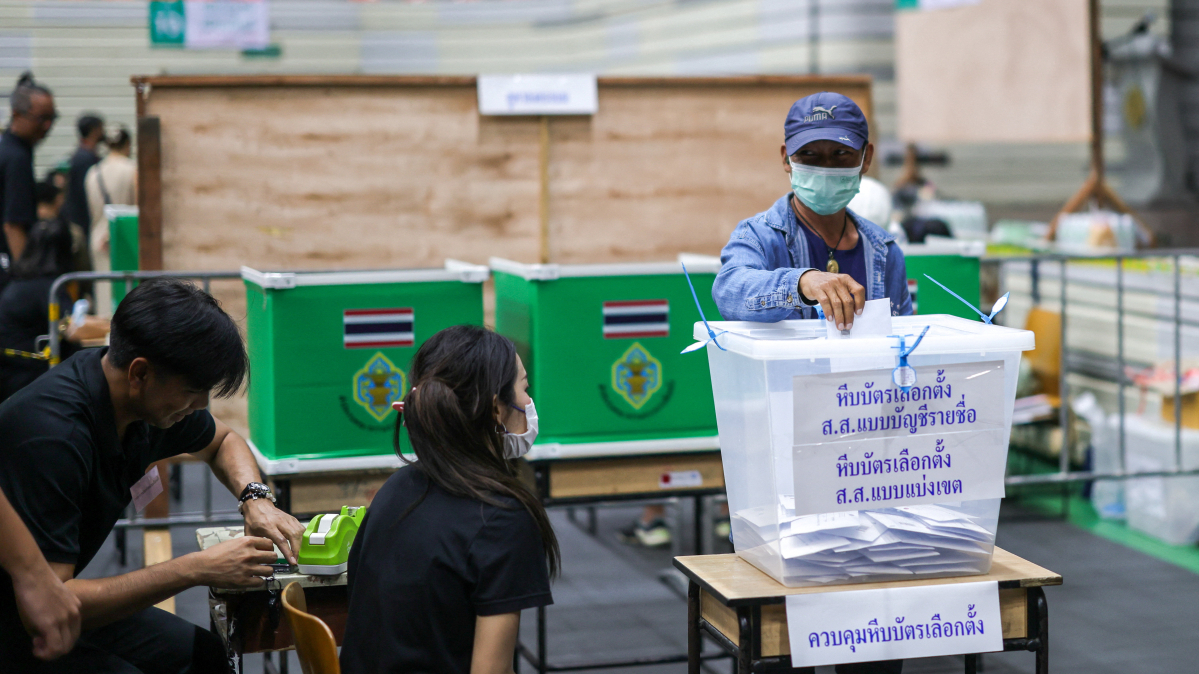
Early voting for Thailand’s parliamentary elections began on Sunday (1 February), with more than two million eligible voters casting ballots nationwide ahead of the 8 February general election, as authorities acknowledged errors and irregularities at some polling stations.
Polling opened at 8 AM local time (0100 GMT) across Bangkok and other provinces, with advance voting intended for citizens unable to vote on election day. The Election Commission of Thailand (ECT) said all ballots would be counted together after 8 February.
Authorities set up more than 860 polling stations nationwide. Bangkok recorded the highest turnout, with 844,672 people registered for advance voting. Overall, Thailand has 52.92 million registered voters, while the ECT said 2.41 million people signed up to vote early.
“I hope that we can get a leader that can develop communities that would then lead to a better society, not just the policies that will get them victory,” said Archakrit Kaowong, 33, after casting his ballot.
Another voter, Thatsanan Khumbanluang, 28, said she hoped the next government would “lead the country to a better future”.
The vote follows months of political turbulence.
Caretaker Prime Minister Anutin Charnvirakul called a snap election in December after less than 100 days in office, amid parliamentary turmoil and a looming no-confidence vote following the failure of a constitutional amendment bill.
The contest has narrowed into a three-way race between Anutin’s conservative Bhumjaithai Party, the reformist People’s Party, successor to the Move Forward Party, and the populist Pheu Thai Party, backed by the family of former prime minister Thaksin Shinawatra.
Opinion polls suggest no party is likely to secure an outright majority, raising the prospect of post-election coalition negotiations.
Reported errors
The early voting was overshadowed by public criticism of the ECT after reports of irregularities emerged from several provinces.
Voters and political candidates shared complaints on social media about incomplete or incorrect candidate lists, long delays, wrong electoral district codes and registration errors that prevented some people from voting.
In Phuket, voters reported that the name of a candidate who had already been revoked still appeared on information boards.
Other complaints included alleged violations of the ban on photography inside polling stations and reports of ballot papers being improperly handled.
The Office for Election Commission of Thailand (ECT) Secretary-General Sawaeng Boonmee issued a public apology, pledging that all mistakes would be addressed and that similar problems would not recur on election day.
He also confirmed that the commission was investigating a suspected case of vote-buying in Surat Thani province, though no details were released.
More than 90 candidates from 57 political parties are contesting the election. Official results must be announced by 9 April, after which the new parliament will convene to elect a speaker before voting to select Thailand’s next prime minister.















What is your opinion on this topic?
Leave the first comment