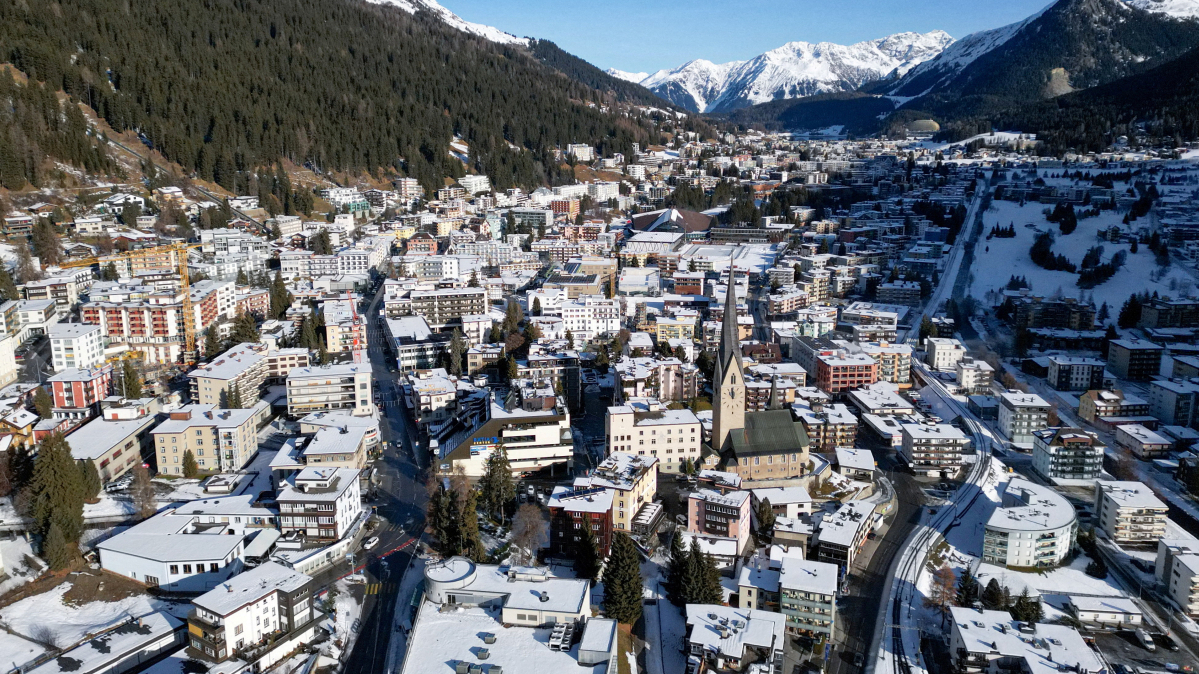
Business and political leaders are gathering in Davos for the World Economic Forum’s(WEF) annual meeting as uncertainty over the global economic and political order deepens, with U.S. President Donald Trump’s policies challenging long-standing international norms.
Global leaders confront mounting uncertainty over trade, security and international cooperation, amid growing strains on the rules-based global economic order.
U.S. President Donald Trump is expected to attend the meeting, highlighting the contrast between his “America First” agenda and the consensus-driven approach traditionally associated with the Davos forum. Trump’s policies have included the use of trade tariffs as leverage, military intervention in Venezuela, threats to take control of Greenland, and a retreat from multilateral cooperation on issues such as climate change and global health.
The Trump administration has also threatened U.S. Federal Reserve Chair Jerome Powell with a criminal indictment, prompting senior central bankers to issue a statement defending central bank independence.
The 56th edition of the forum, held under the theme “A Spirit of Dialogue,” comes at a time when geopolitical rivalry and economic nationalism are reshaping global relations.
WEF President and Chief Executive Officer Borge Brende said dialogue was essential amid current instability.
“Dialogue is not a luxury, it is a necessity,” Brende said.
However, some analysts have questioned the forum’s relevance in a world increasingly shaped by power politics. Former Swiss ambassador Daniel Woker said that if major powers focus solely on national interests, the case for a rules-based international system weakens.
The forum is also taking place amid leadership changes at the WEF following the departure of its founder Klaus Schwab as chair in April. The Geneva-based organisation said an internal investigation launched after a whistleblower complaint found no evidence of material wrongdoing. BlackRock CEO Larry Fink and Roche vice-chair Andre Hoffmann were appointed interim co-chairs.
The WEF said more than 3,000 participants from more than 130 countries are expected to attend, including 64 heads of state and government, particularly from emerging economies.
Discussions are expected to cover a wide range of issues, including artificial intelligence, global security, energy policy and the future of international cooperation. The meeting follows one of Switzerland’s deadliest modern tragedies, a fire at a ski resort bar that killed 40 people.
In pre-event briefings, the WEF highlighted how companies have adapted to the highest U.S. tariff levels since the Great Depression and pointed to easing trade tensions in late 2025. However, a recent WEF survey of executives showed that business conditions became more challenging in 2025, while cooperation on peace and security weakened.
Oil and gas executives are also expected to feature prominently at this year’s meeting, as Trump promotes an energy dominance agenda encouraging increased fossil fuel production. The chief executives of major energy companies including Exxon Mobil, Shell, TotalEnergies, Equinor and ENI are expected to attend.
China’s delegation is also expected to be large, led by Vice Premier He Lifeng, Brende said.











What is your opinion on this topic?
Leave the first comment