The death toll from Typhoon Kalmaegi that hit the central Philippines on Tuesday has risen to 39 on the island of Cebu, a local government official said.
The deaths were as a result of drowning and people being struck by debris, provincial information officer Ainjeliz Orong said in a phone message.
Officials had earlier in the day said that the Typhoon was now number four, as the powerful storm unleashed heavy rains and floods across the central Philippines, submerging homes and forcing thousands to evacuate.
Although Kalmaegi, locally named Tino, has weakened since making landfall early on Tuesday, it continued to lash the country with winds of 130 kph and gusts of 180 kph as it swept across the Visayas islands and northern Palawan towards the South China Sea.
Three people were confirmed dead and at least one person was reported missing in the central province of Cebu, provincial information officer Orong said. Two more deaths were still being verified.
"We weren't expecting this much flooding," Orong said by phone.
In neighbouring Bohol province, one person was killed after being struck by a falling tree, disaster official Anthony Damalerio told DZMM radio.
Tens of thousands of residents were evacuated across the Visayas region, including parts of southern Luzon and northern Mindanao, the national disaster agency reported.
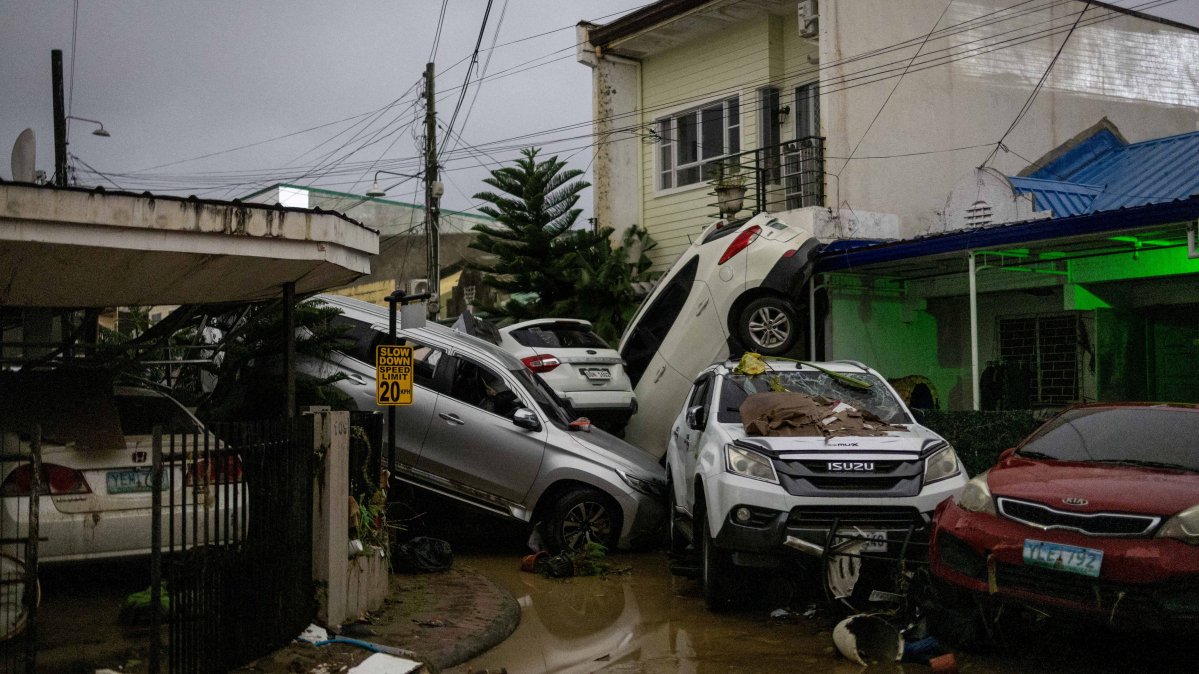
Photos and videos from the Philippine Red Cross showed rescue workers wading through knee-deep floodwaters in Cebu City, using boats to reach stranded residents. In Liloan town, on the northern outskirts of the city, homes were submerged, with only rooftops and top floors visible.
Similar scenes from other parts of Cebu City, with vehicles and streets under water, circulated on social media.
State weather agency PAGASA said the combination of Kalmaegi and a shear line had brought heavy rains and strong winds across the Visayas and nearby areas.
More than 180 flights to and from the affected areas were cancelled on Tuesday, while those at sea were advised to head to the nearest safe harbour immediately and to stay in port.
PAGASA warned of a high risk of "life-threatening and damaging storm surges" that could reach more than 3 metres (9.84 ft) high along coastal and low-lying communities in the central Philippines, including parts of Mindanao.
The Vietnamese government also said on Tuesday that it was preparing for the worst-case scenario as it braced for the impact of Kalmaegi.
The typhoon is forecast to make landfall on Thursday night in Vietnam's central regions, which have already suffered heavy floods that killed at least 40 people and left six others missing over the past week.
"This is a very strong typhoon, which continues to strengthen after entering the East Sea," the government said in a statement, referring to the South China Sea.
Kalmaegi comes as the Philippines, which is hit by an average of 20 tropical storms each year, recovers from a run of disasters including earthquakes and severe weather events in recent months.
In September, Super Typhoon Ragasa swept across northern Luzon, forcing government work and classes to shut down as it brought fierce winds and torrential rain.














What is your opinion on this topic?
Leave the first comment