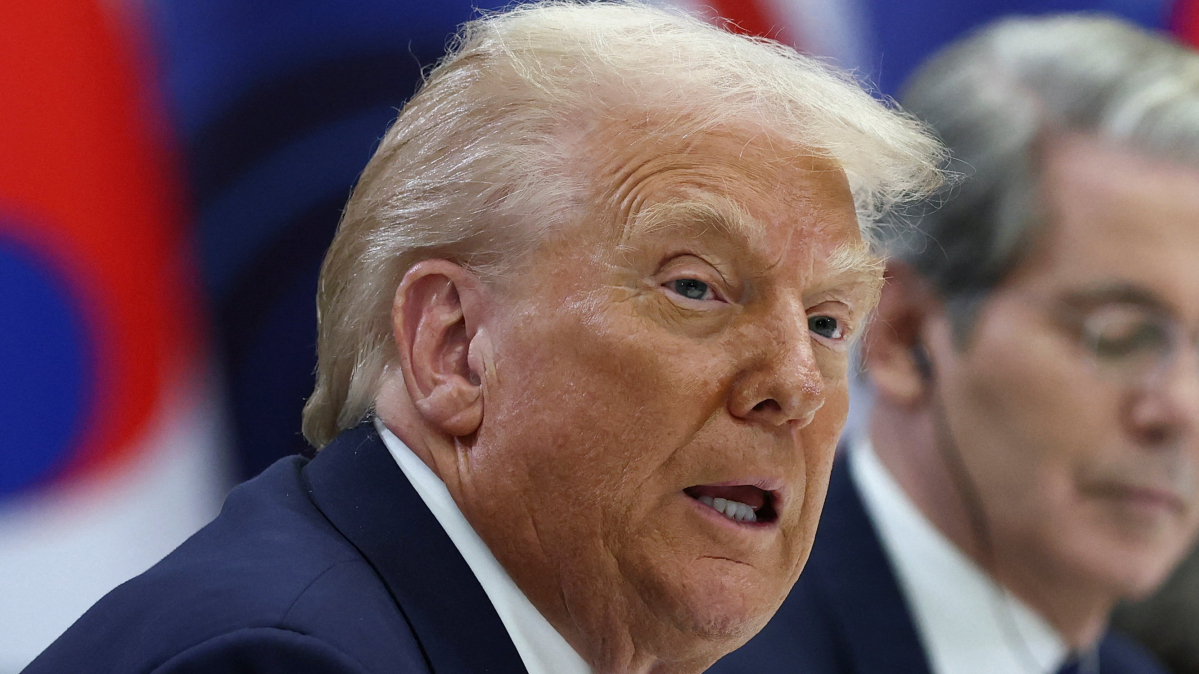
U.S. President Donald Trump on Thursday ordered the U.S. military to immediately resume testing nuclear weapons for the first time in 33 years, minutes before meeting Chinese President Xi Jinping in South Korea.Trump made the surprise announcement on Truth Social while aboard his Marine One helicopt
Trump made the surprise announcement on Truth Social while aboard his Marine One helicopter en route to Busan, where he and Xi were due to hold trade talks. He said he was instructing the Pentagon to test the U.S. nuclear arsenal on an "equal basis" with other powers.
"Because of other countries' testing programs, I have instructed the Department of War to start testing our nuclear weapons on an equal basis. That process will begin immediately," Trump posted.
"Russia is second, and China is a distant third, but will be even within five years," he added.
He did not elaborate and did not answer a reporter's question about his post after greeting Xi. It was unclear whether he meant nuclear-explosive testing, which would fall under the National Nuclear Safety Administration, or flight testing of nuclear-capable missiles.
Trump’s decision follows renewed weapons testing by Russia and a rapid expansion of China’s nuclear arsenal. Russian President Vladimir Putin said on Wednesday that Russia had successfully tested the Poseidon nuclear-powered torpedo, which analysts say could devastate coastal regions by triggering vast radioactive ocean swells.
As Trump has toughened his stance on Moscow, Putin has showcased Russia’s nuclear capabilities with recent tests of the Burevestnik cruise missile and nuclear launch drills.
According to the Center for Strategic and International Studies, Beijing has more than doubled the size of its nuclear stockpile in the past five years to an estimated 600 weapons and could exceed 1,000 by 2030.
The Arms Control Association estimates the United States holds about 5,200 nuclear warheads, compared with roughly 5,600 for Russia.
Reaction to Trump’s announcement was swift. Representative Dina Titus, a Democrat from Nevada, said she would introduce legislation to block the move. Daryl Kimball, director of the Arms Control Association, said it could take up to three years to resume underground nuclear testing in Nevada and warned the move could “trigger a chain reaction of nuclear testing by U.S. adversaries.”
Kimball said the U.S. had no technical or military reason to resume explosive testing, calling Trump “misinformed and out of touch.”
Trump has previously said he wanted new arms-control discussions with Putin and Xi, though Beijing called such proposals “unrealistic” given its smaller arsenal.
The United States last tested a nuclear weapon in 1992. Most major nuclear powers stopped explosive testing in the 1990s; North Korea’s last test was in 2017, Russia’s in 1990 and China’s in 1996.
The nuclear age began in July 1945 when the United States detonated a 20-kiloton atomic bomb at Alamogordo, New Mexico, followed by the atomic bombings of Hiroshima and Nagasaki that ended World War Two.














What is your opinion on this topic?
Leave the first comment