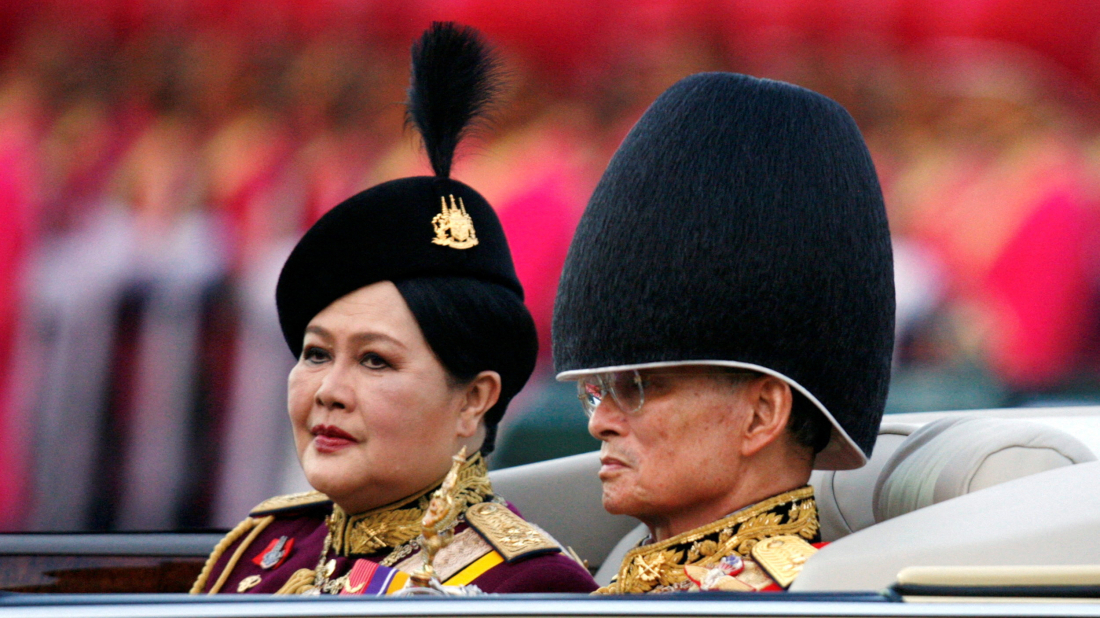
Thailand’s Queen Mother Sirikit, a global style icon and patron of Thai silk who helped revive the monarchy’s standing after World War II and later occasionally stepped into politics, has died aged 93, the Royal Household Bureau said on Saturday.
Sirikit had largely withdrawn from public life after a stroke in 2012. Married to King Bhumibol Adulyadej, Thailand’s longest-reigning monarch, she was a constant presence through much of his 70-year reign from 1946, winning affection at home through extensive charity and development work.
Abroad, she drew the attention of the international press for elegance and poise. During a 1960 visit to the United States that included a White House state dinner, Time magazine described her as “svelte” and “archfeminist,” while France’s L’Aurore called her “ravishing.” Always stylish, she collaborated with French couturier Pierre Balmain and championed Thai silk, helping to preserve traditional weaving and revitalise a national industry.
Born in 1932, the year Thailand transitioned from an absolute to a constitutional monarchy, Sirikit Kitiyakara was the daughter of Thailand’s ambassador to France. She met Bhumibol while studying music and languages in Paris. “It was hate at first sight,” she once recalled in a BBC documentary, later adding that it soon became love. They were engaged in 1949 and married in 1950, when she was 17.
For more than four decades, she frequently accompanied the king to remote villages, promoting rural development projects that were documented on the nightly Royal Bulletin. In 1956, she briefly served as regent while the king entered a temple for a two-week Buddhist rite of passage. In 1976, her birthday, 12 August, was designated Thailand’s Mother’s Day and a national holiday.
Although the monarchy is officially above politics, Sirikit at times took positions seen as political. In 1998, her birthday address urged unity behind then Prime Minister Chuan Leekpai, undermining an opposition push for a no-confidence debate. A decade later, she was associated with the royalist People’s Alliance for Democracy, whose protests helped bring down governments linked to former prime minister Thaksin Shinawatra. In 2008, she attended the funeral of a PAD protester killed in clashes, a gesture widely read as support for the movement.
Following King Bhumibol’s death in 2016, their only son, Maha Vajiralongkorn, became King Rama X, and upon his coronation in 2019, Sirikit’s formal title became the Queen Mother. Her death will be marked with reverence in a country with strict lese-majeste laws that criminalise insults to the royal family, including those who have died.













What is your opinion on this topic?
Leave the first comment