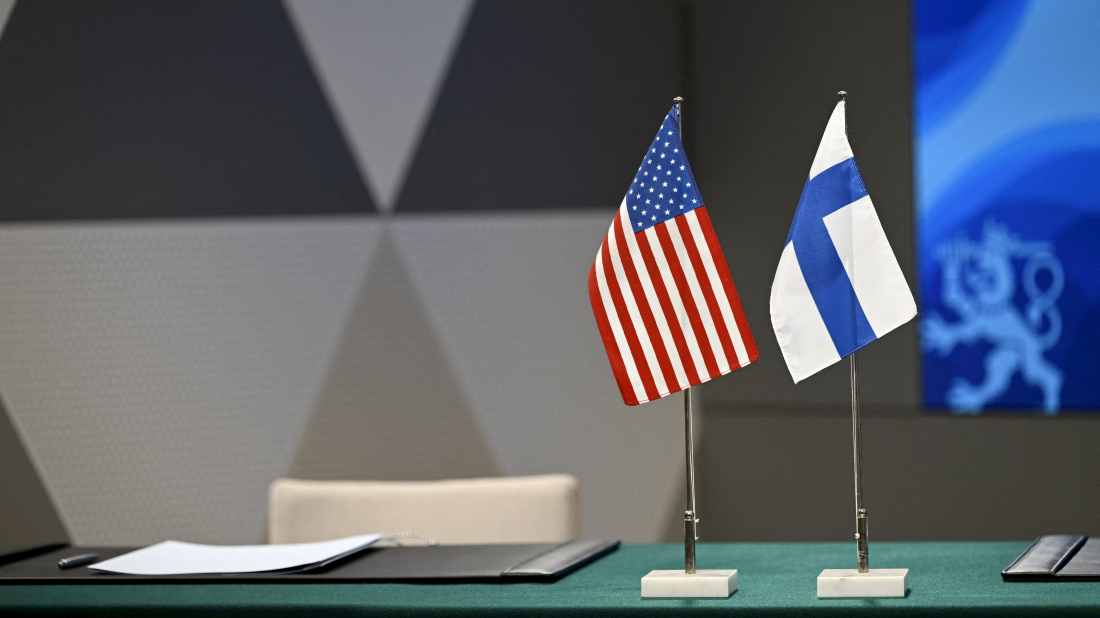
U.S. President Donald Trump and Finnish counterpart Alexander Stubb finalised an agreement on Thursday, for the U.S. Coast Guard to acquire up to 11 icebreaker ships, enhancing U.S. national security in the Arctic.
The two leaders, who have forged friendly ties since Trump's return to power in January, met in March at Trump's Mar-a-Lago club in Florida and even played a round of golf together.
The agreement includes a memorandum of understanding on icebreaker cooperation, designed to lay the groundwork for commercial agreements between the U.S. Coast Guard and Finnish companies. Under the deal, Finland will build four "Arctic security cutters" at its shipyards, while the U.S. will leverage Finnish expertise to construct up to seven new cutters at U.S. shipyards.
"We’re buying the finest icebreakers in the world, and Finland is known for making them," Trump said during a meeting in the Oval Office with Stubb by his side.
Stubb described the agreement as a "huge strategic decision," noting that the Arctic is of increasing strategic importance. The 11 new medium icebreakers for the U.S. Coast Guard are expected to cost around $6.1 billion.
Trump also reiterated that the United States would defend Finland, a NATO ally, in the event of an attack from Russia. However, he added, "I don’t think he’s going to do that," referring to Russian President Vladimir Putin.
Stubb downplayed the short-term Russian threat, telling Reuters that Moscow is not an "imminent military threat" to Finland.
Trump has long advocated for the U.S. to acquire as many as 40 new icebreakers to bolster national security in the Arctic and counter the growing influence of China and Russia. Currently, Russia possesses around 40 icebreakers, giving it a significant advantage in the region.
The U.S. Coast Guard’s current polar fleet includes only two operational Arctic security cutters. As part of the agreement, three of the 11 new ships will be constructed by international shipbuilder Davie in Galveston, Texas, and four will be built by Bollinger Shipyards in Houma, Louisiana. The first icebreaker is expected to be delivered by 2028, with the deal set to create billions of dollars in new investment in the U.S. maritime industry and thousands of skilled trade jobs.
Trump and Stubb also discussed Russia’s ongoing invasion of Ukraine, with Stubb acting as an intermediary between Trump and Ukrainian President Volodymyr Zelenskyy. Trump, who initially sought to improve relations with Putin, has recently adopted a tougher stance on Russia. Stubb remarked that Trump had shifted from using incentives to applying pressure on Russia, stating, "Obviously we have seen that he has moved with Russia from carrot to stick."
The two leaders also touched on NATO’s plans to provide security guarantees for Ukraine in the aftermath of the war, with political consensus still needed to formalise the plans.
Stubb, who serves as Finland’s representative on NATO matters, also commented on concerns about the potential movement of U.S. troops out of Europe, reassuring that Trump remains committed to the region. He played down concerns over a possible Russian invasion of NATO countries, suggesting that people "need to be a little bit more Finnish" in their approach to such assessments.
Finland, the world's leading producer of icebreakers, designs about 80% of existing ships and builds around 60% of them at its shipyards. Finnish leaders have long advocated for icebreaker deals with the U.S., although previous efforts were hindered by the strict interpretation of the Jones Act. A 2021 report, however, concluded that the Jones Act did not apply to icebreakers, allowing the president to authorise exceptions to restrictions on building ships in foreign shipyards.


















What is your opinion on this topic?
Leave the first comment