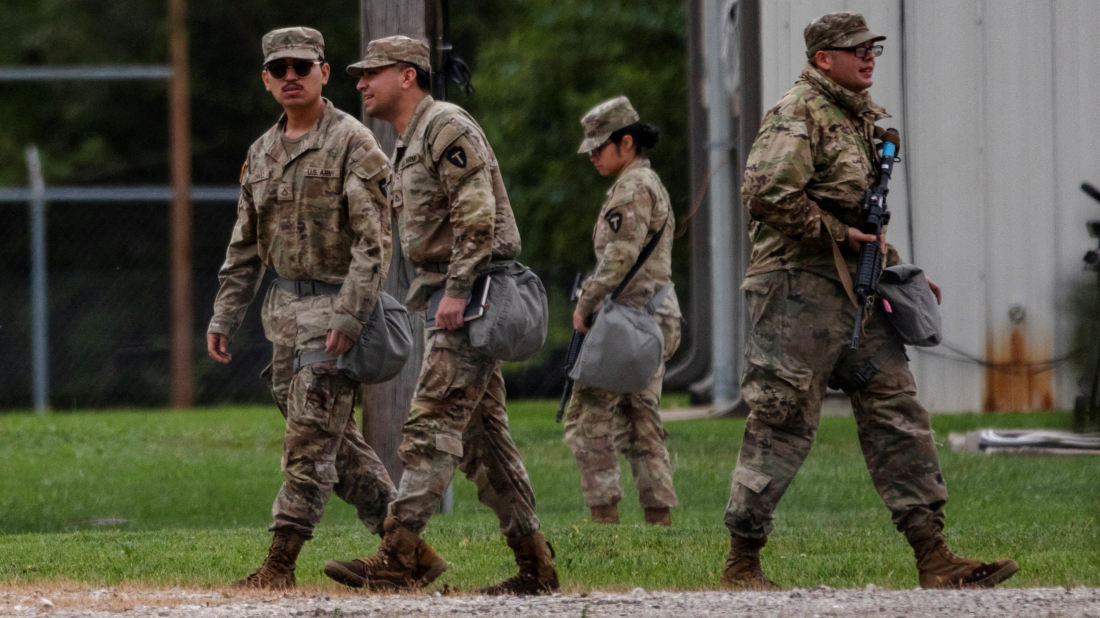
Hundreds of Texas National Guard soldiers gathered on Tuesday at an Army facility outside Chicago, as Donald Trump's threat to invoke an anti-insurrection law and deploy troops to more U.S. cities intensified the battle over the limits to his authority.
The Republican president on Tuesday again left open the possibility that he might use the centuries-old Insurrection Act to sidestep any court rulings blocking the dispatch of Guard troops into Democratic-led cities, over the objections of local and state officials.
A federal judge has temporarily barred Guard troops from heading to Portland, Oregon, though a separate judge has allowed for now a deployment to proceed in Chicago, where federal agents have embarked on a sweeping crackdown on illegal immigration.
"Well, it's been invoked before," Trump told reporters in the Oval Office.
He has claimed troops are needed to protect federal property and personnel in carrying out their duties, as well as assisting an overall drive to suppress crime.
"If you look at Chicago, Chicago is a great city where there's a lot of crime, and if the governor can't do the job, we'll do the job. It's all very simple," he said.
Insurrection law not used since 1992
The law, which gives the president authority to deploy the military to quell unrest in an emergency, has typically been used only in extreme cases, and almost always at the invitation of state governors. The act was last invoked by President George H.W. Bush during the Los Angeles riots of 1992.
Under federal law, National Guard and other military troops are generally prohibited from conducting civilian law enforcement. But the Insurrection Act allows for an exception, giving troops the power to directly police and arrest people.
Using the act would represent a significant escalation of Trump's effort to deploy the military to Democratic cities. Since his second term as president began in January, he has shown little hesitation in seeking to wield governmental authority against his political opponents, as he pushes to expand the powers of the presidency in ways that have tested the limits of the law.
Trump: 'Training grounds'
Last week, in a speech to top military commanders, Trump suggested using U.S. cities as "training grounds" for the armed forces, alarming Democrats and civil liberties groups.
Randy Manner, a retired Army major general who served as acting vice chief of the National Guard Bureau, said using the Insurrection Act in the way Trump appears to be contemplating has no real precedent.
"It's an extremely dangerous slope, because it essentially says the president can just do about whatever he chooses," said Manner, who served under both Republican and Democratic administrations before retiring in 2012.
"It's absolutely, absolutely the definition of dictatorship and fascism," Manner added.
Trump targets Chicago and Portland
Trump has ordered Guard troops to Chicago, the third-largest U.S. city, and Portland, Oregon, following his earlier deployments to Los Angeles and Washington, D.C.
In each case, he has defied staunch opposition from Democratic mayors and governors, who say Trump's claims of lawlessness and violence do not reflect reality.
Texas Guard troops were seen on Tuesday assembling at the Army Reserve Training Center in Elwood, 80 km (about 50 miles) southwest of Chicago. It was not immediately clear when they plan to begin operations in the city itself.
Protests against immigration policies
In Chicago and Portland, protests over Trump's immigration policies had been largely peaceful and limited in size, according to local officials, far from the "war zone" conditions described by Trump.
Since the surge of federal agents to the Chicago area last month, the demonstrations have done little to upset life in a city where violent crime has fallen sharply. Restaurants and theatres are as busy as ever, and crowds have flocked to lake front beaches to enjoy an unusual stretch of warm weather.
The most regular demonstration has taken place outside an immigration processing facility in suburban Broadview. Several dozen people have engaged in increasingly violent standoffs with federal officers, who have fired tear gas and rubber bullets at them.
Several people, including at least one reporter, have been arrested, and dozens of people have been injured.
Governor alleges Trump using guard as props
Illinois Governor JB Pritzker, a Democrat, accused Trump of intentionally trying to foment violence to justify further militarisation.
"Donald Trump is using our service members as political props and as pawns in his illegal effort to militarise our nation's cities," Pritzker said on Monday.
Texas Guard troops were already on their way to Illinois on Monday
Illinois and Chicago sued the Trump administration on Monday, seeking to block orders to federalise 300 Illinois Guard troops and send 400 Texas Guard troops to Chicago. During a hearing, Justice Department lawyers told a federal judge that Texas Guard troops were already in transit to Illinois.
The judge, April Perry, permitted the deployment to proceed for now but ordered the U.S. government to file a response by Wednesday.
Oregon federal judge temporarily blocked troops to Portland on Sunday
Separately, a federal judge in Oregon on Sunday temporarily blocked the administration from sending any troops to police Portland, the state's largest city.
National Guard troops are state-based militia who normally answer to the governors of their states and are often deployed in response to natural disasters.
During Trump's deployments to various cities, the Guard has been limited to protecting federal agents and property, although the Defense Department has said troops have the authority to detain people temporarily.
Possible legal challenges
Any effort by Trump to invoke the Insurrection Act would likely face legal challenges.
While the law has rarely been interpreted by the courts, the Supreme Court has ruled that the president alone can determine if the act's conditions have been met.
Those conditions include when the U.S. government's authority is facing "unlawful obstructions, combinations or assemblages or rebellion."














What is your opinion on this topic?
Leave the first comment