Trump sends second U.S. aircraft carrier to Middle East as Iran nuclear talks stall
“Respected and feared globally,” U.S. President Donald Trump told troops at Fort Bragg on Friday (13 February), framing America’s renewed streng...
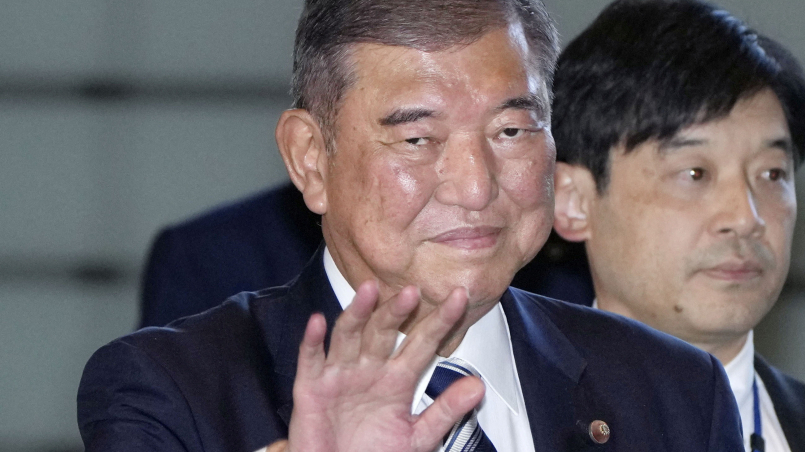
Japanese Prime Minister Shigeru Ishiba has decided to resign to avoid a split within the ruling Liberal Democratic Party, public broadcaster NHK said on Sunday.
Japanese Prime Minister Shigeru Ishiba announced his reignation on Sunday in a press conference adding that he would continue his duties until a successor is elected.
Thus triggering the start of a long period of policy paralysis at a shaky moment for the world's fourth-largest economy.
Ishiba, 68, instructed his Liberal Democratic Party - which has governed Japan for almost all of the post-war era - to hold an emergency leadership race.
Since coming to power less than a year ago, Ishiba has overseen his ruling coalition lose its majorities in elections for both houses of parliament amid voter anger over rising living costs.
Until Sunday, he had refused calls to step down following the latest of those losses in July's upper house vote.
He had focused instead on ironing out details of a trade deal with the United States on President Donald Trump's tariffs, which have roiled Japan's critical automotive industry and cast a shadow over weak growth.
"With Japan having signed the trade agreement and the president having signed the executive order, we have passed a key hurdle," Ishiba said, his voice seeming to catch with emotion. "I would like to pass the baton to the next generation."
Concern over political uncertainty led to a sell-off in Japan's yen currency and its government bonds last week, with the yield on the 30-year bond hitting a record high on Wednesday.
Speculation over Ishiba's fate was stoked by the LDP's decision to schedule a vote for Monday on whether to hold an extraordinary leadership election.
Following the country’s growing political instability, the prime minister has faced calls to resign from mostly right-wing opponents within his party, who urged him to take responsibility for the results of a July’s vote.
Reports suggested that Japan’s agricultural minister and a former prime minister met with Ishiba on Saturday evening to persuade him to resign.

Europe heads into the Munich Security Conference, on Friday (13 February), amid deepening unease over U.S. policy, as President Donald Trump’s hard-line stance on defence, trade and territory fuels doubts about Washington’s long-term commitment to transatlantic security.
American figure skating star Ilia Malinin endured a dramatic collapse in the men’s free skate on Friday night, falling twice and tumbling out of medal contention at the Milan Cortina Winter Olympics as Kazakhstan’s Mikhail Shaidorov surged to a surprise gold medal.
“Respected and feared globally,” U.S. President Donald Trump told troops at Fort Bragg on Friday (13 February), framing America’s renewed strength against to mounting pressure on Iran amid stalled nuclear talks.
Dubai-based global ports operator DP World said on Friday that its long-serving chairman and chief executive, Sultan Ahmed Bin Sulayem, has stepped down following mounting pressure linked to alleged ties to disgraced financier Jeffrey Epstein.
Speaking at Munich Security Conference, Ukrainian foreign minister Andrii Sybiha calls for decisive steps ahead of expected Geneva talks
The U.S. Department of Homeland Security (DHS) has partially shut down after Congress failed to reach agreement on immigration enforcement changes, deepening a political standoff between the White House and Senate Democrats.
Israeli army chief Eyal Zamir said on Friday (13 February) that Israel remains committed to the complete demilitarization of the Gaza Strip and the disarmament of Hamas, calling for intensified operations to destroy tunnel networks and control access along the ceasefire line.
“Real security guarantees are needed before the war ends,” Ukrainian President Volodymyr Zelenskyy said at the Munich Security Conference on Saturday (14 February), warning that Russian aggression shows no sign of relenting.
Start your day informed with AnewZ Morning Brief: here are the top news stories for the 14th of February, covering the latest developments you need to know.
New Zealand declared a state of emergency in Otorohanga on Saturday (14 February) after torrential rain caused severe flooding, power outages and evacuations.
You can download the AnewZ application from Play Store and the App Store.
What is your opinion on this topic?
Leave the first comment