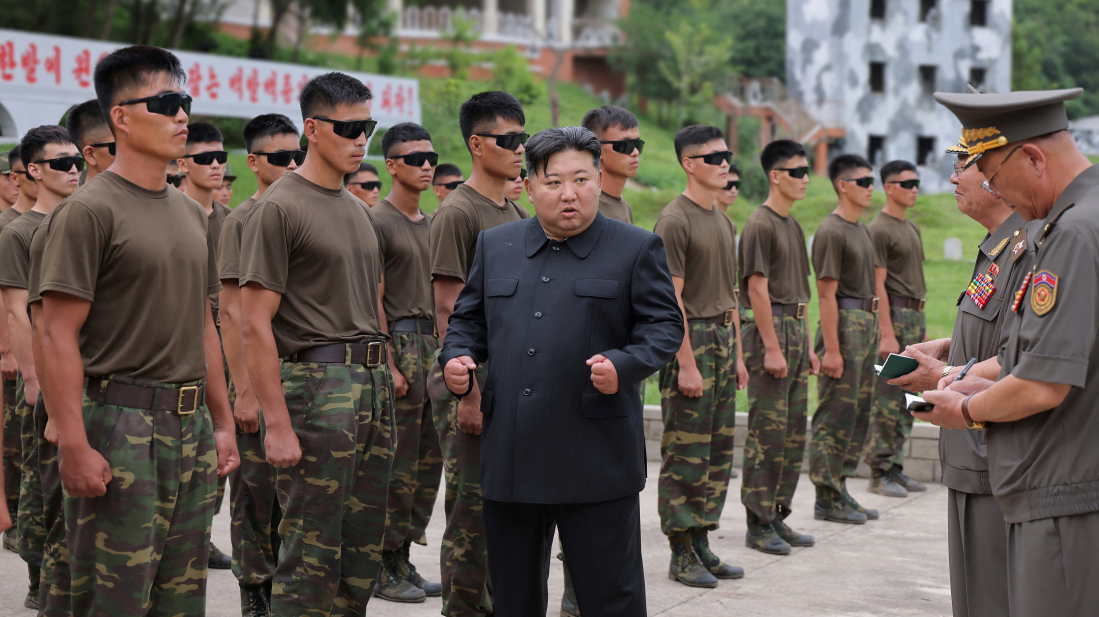
North Korean leader Kim Jong Un and Russian President Vladimir Putin will attend a military parade in Beijing next week, marking their first public appearance alongside Chinese President Xi Jinping in a display of collective defiance amid Western pressure.
According to China’s foreign ministry, no Western leaders are expected among the 26 foreign heads of state and government attending the parade, except for Slovakia’s Prime Minister Robert Fico, representing a European Union member state.
The event, held on 3 September to mark the formal surrender of Japan in World War II, will highlight China’s growing military capabilities. Analysts say the presence of Xi, Putin, and Kim signals a show of solidarity not only between China and the Global South but also with Russia and North Korea, both heavily targeted by international sanctions.
Russia, Beijing’s strategic partner, has faced multiple rounds of Western sanctions since its 2022 invasion of Ukraine, leaving its economy close to recession. Putin, wanted by the International Criminal Court, last travelled to China in 2024.
North Korea, a formal treaty ally of China, has been under United Nations Security Council sanctions since 2006 over its nuclear and ballistic missile programmes.
Kim’s last visit to China was in January 2019.
Other attendees at the parade will include Belarusian President Aleksandr Lukashenko, Iranian President Masoud Pezashkian, Indonesian President Prabowo Subianto, and South Korea’s National Assembly Speaker Woo Won-shik.
Serbia’s President Aleksandar Vucic will also be present.
The United Nations will be represented by Under-Secretary-General Li Junhua, a former Chinese ambassador to Italy, San Marino, and Myanmar.
On the day of the parade, President Xi Jinping will review tens of thousands of troops at Tiananmen Square alongside the foreign dignitaries and senior Chinese officials. The event, one of China’s largest military parades in recent years, will feature advanced hardware, including fighter jets, missile defence systems, and hypersonic weapons.
According to analysts at the Council on Foreign Relations, Kim's presence alongside Xi and Putin projects a united front against Western pressure, particularly from the U.S., South Korea, and Japan.
The event also highlights closer military and economic ties between Pyongyang and Moscow.
North Korea has reportedly supplied arms and personnel to support Russia’s war in Ukraine, while Russia and China continue to strengthen their strategic partnership, according to the International Crisis Group.











What is your opinion on this topic?
Leave the first comment