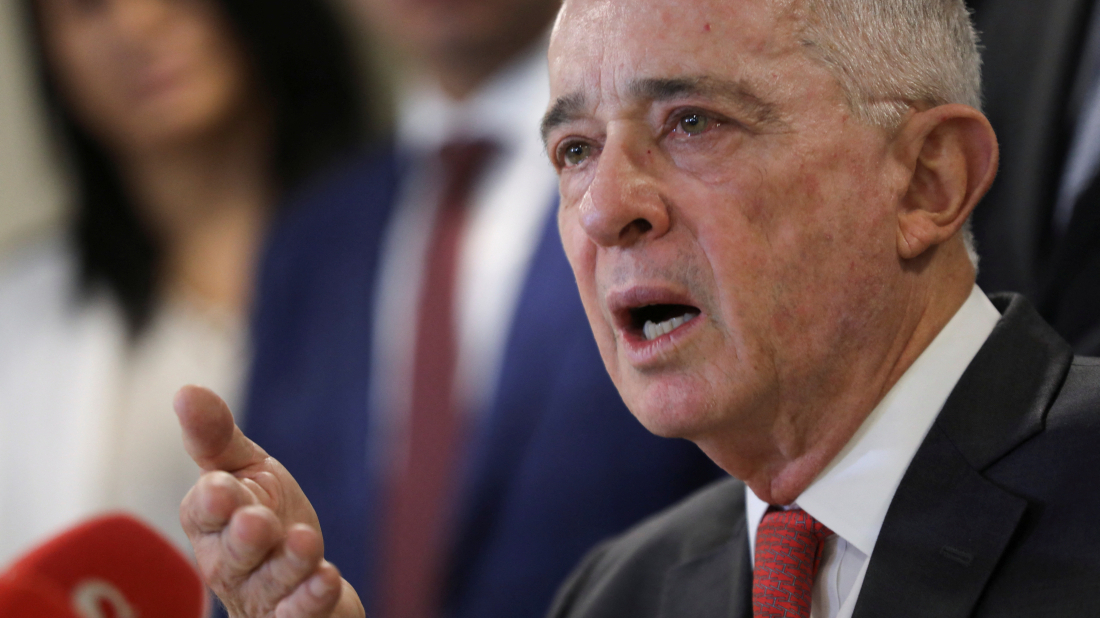
Former Colombian President Álvaro Uribe has been sentenced to 12 years of house arrest for witness tampering and bribery, marking the country’s first-ever conviction of a former president.
A sentencing document obtained by Reuters and confirmed by local media shows that Judge Sandra Liliana Heredia imposed the sentence on Friday evening, following Uribe’s conviction earlier this week. The 73-year-old was also fined $578,000 and banned from holding public office for more than eight years.
Uribe, who led Colombia from 2002 to 2010, is expected to appeal the ruling. His legal team says he will report to authorities in his hometown of Rionegro, Antioquia, before beginning house arrest.
The charges stem from a 13-year-long legal battle in which Uribe was found guilty of attempting to bribe imprisoned former paramilitaries to discredit testimony linking him to right-wing armed groups. He has denied the allegations, calling the case a political vendetta.
The case was sparked by leftist Senator Iván Cepeda, who had gathered testimonies from ex-paramilitaries claiming Uribe supported their operations in Antioquia, where he had once served as governor. Colombia’s Supreme Court later ruled that Cepeda had not manipulated the witnesses — but that Uribe and his allies had.
Two jailed paramilitaries testified that Uribe’s former lawyer, Diego Cadena, offered them money to speak in Uribe’s defence. Cadena has denied wrongdoing and is facing separate charges.
The conviction could strain Colombia’s ties with the United States. U.S. Secretary of State Marco Rubio described the ruling as “a weaponisation of Colombia’s judicial branch by radical judges.” Some analysts suggest Washington could now reconsider parts of its aid to Bogotá.
Uribe’s sentencing lands less than a year before Colombia’s 2026 presidential election, where several of his political allies are running. As founder and longtime head of the right-wing Democratic Center party, Uribe remains an influential figure in national politics.
While his supporters see the case as unjust persecution, critics call it long-overdue accountability for a man accused for decades of links to paramilitary violence.
Colombia’s Truth Commission estimates that paramilitary groups — which demobilised under Uribe’s presidency — were responsible for more than 205,000 deaths during the country’s armed conflict.
With Friday’s ruling, Uribe joins a growing list of Latin American leaders convicted in court, including Brazil’s Lula da Silva, Peru’s Alberto Fujimori, Argentina’s Cristina Fernández, Ecuador’s Rafael Correa, and Panama’s Ricardo Martinelli.

















What is your opinion on this topic?
Leave the first comment