Türkiye intercepts fourth missile amid Middle East tensions, Azerbaijan shows solidarity
Azerbaijan has voiced strong support for Türkiye following the interception of a fourth ballistic missile ...
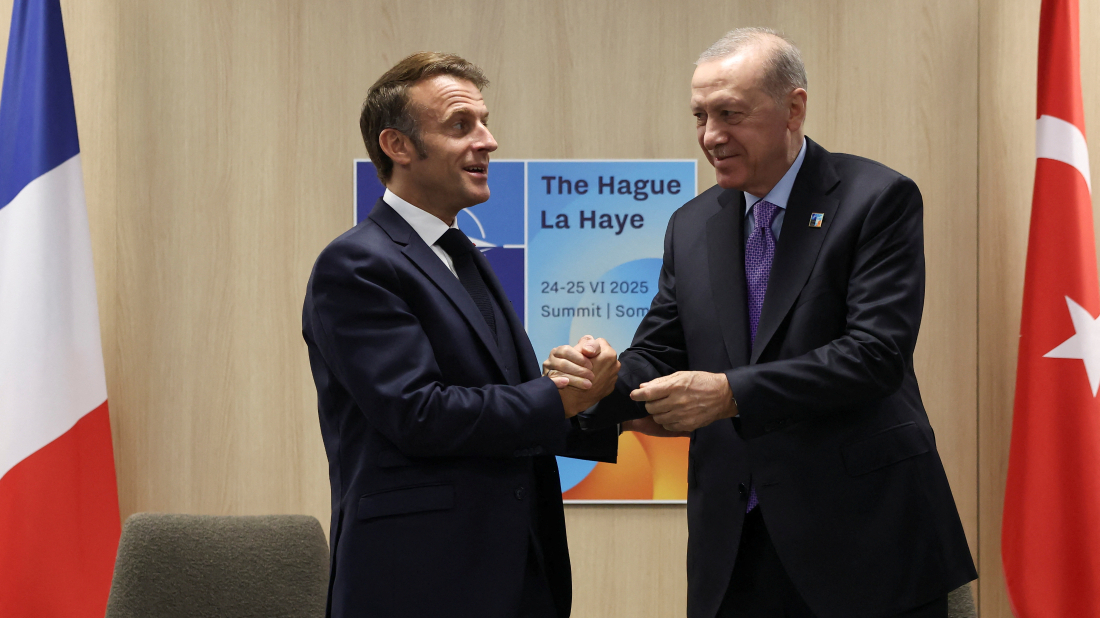
Turkish President Recep Tayyip Erdogan has warned of a deepening humanitarian crisis in Gaza and stressed the need for global intervention, during a call with French President Emmanuel Macron on Sunday.
Türkiye’s President Recep Tayyip Erdogan and French President Emmanuel Macron held a phone call on Sunday to discuss the deteriorating humanitarian situation in Gaza and possible paths to peace in the region, the Turkish Presidency said in a statement.
Erdogan highlighted the urgent need for global action, warning that the humanitarian conditions in Gaza were rapidly worsening. “The international community must take action toward an immediate solution,” he said.
Calling for a sustainable resolution to the conflict, Erdogan underlined the importance of a two-state solution. “The conflict between Israel and Palestine must come to an end,” he said, describing a two-state solution as “essential for lasting peace in the region.”
The Turkish president also welcomed France’s recent decision to recognise Palestine as a state, congratulating Macron for what he described as a “principled step” amid mounting pressure for international recognition. France’s move has been supported by several pro-Palestinian groups and countries advocating for a peaceful solution based on statehood.

U.S. President Donald Trump has said that the U.S is in talks with the new Iranian regime. He said this in a post on his Truth Social account but warned that the U.S. will "Obliterate" Iran's electric and oil facilities if no deal is reached, especially regarding the Strait of Hormuz closure.
The Iran-U.S.-Israel conflict is intensifying, with fresh strikes near Tehran, European calls for restraint, and Iran threatening to target U.S. firms in the region, raising fears of a broader escalation across the Middle East.
The war in Iran has rapidly upended regional security, triggering spillover across the Middle East and raising fears of wider economic disruption that could threaten globalisation.
Japan’s growing interest in Caspian crude reflects a pragmatic response to uncertainty in global energy markets and its continued reliance on the Middle East for more than 90% of its oil imports.
Russia has expelled a British diplomat, accusing him of economic espionage in a move that further strains already tense relations between Moscow and London. The United Kingdom described the action as intimidation and rejected the allegations outright, Reuters reports.
Start your day informed with the AnewZ Morning Brief. Here are the top stories for 1 April, covering the latest developments you need to know.
The European Union's top diplomat Kaja Kallas and several EU foreign ministers voiced their support for Ukraine's demand for accountability over Russian atrocities committed in Bucha, as they visited the small town on Tuesday (31 March) on the fourth anniversary of a massacre there.
The UK will pay France £16.2 million to continue beach patrols for two months, as both sides race to agree a new deal to curb small boat crossings across the Channel amid rising migrant numbers and political pressure.
A Russian military An-26 aircraft has crashed in Crimea, killing all 30 people on board, Russia’s Defence Ministry has confirmed.
A U.S. judge has blocked President Donald Trump from moving ahead with plans to build a $400 million ballroom on the site of the demolished East Wing of the White House, pausing one of the most high-profile efforts to reshape the presidential complex.
You can download the AnewZ application from Play Store and the App Store.
What is your opinion on this topic?
Leave the first comment