The United States and Armenia have signed a strategic partnership charter, enhancing bilateral cooperation in defense, security, democracy, and nuclear energy.
The United States on Tuesday declared expanding “strategic partnership” with Armenia, marking “significant milestone in bilateral relationship”, and said they will deepen further in the coming years.
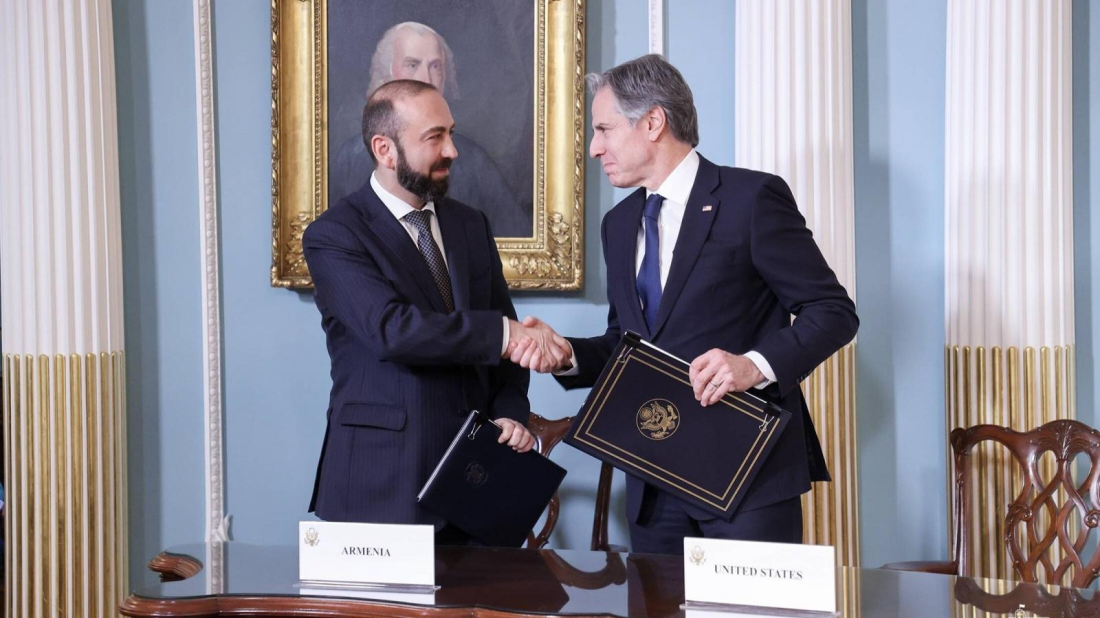
According to the US Secretary of State, this charter will contribute to a more resilient, more peaceful, more secure, and more independent South Caucasus. “We are establishing our U.S.-Armenia Strategic Partnership Commission,” outgoing U.S. Secretary of States Antony Blinken announced before signing the commission’s charter with Armenian Foreign Minister Ararat Mirzoyan in Washington.
“This commission gives us a framework to expand our bilateral cooperation in a number of key areas: economic matters, security and defence, democracy, justice, inclusion and people-to-people exchanges,” he said.
“It really lays the foundation for even deeper cooperation and builds on our shared principles. We are increasingly strong partners, and I think that is for the good of both of our countries as well as the region and beyond,” Blinken added during the signing ceremony.
The United States and Armenia will begin negotiations on a civil nuclear cooperation agreement, known as a 123 Agreement, which, once concluded, will provide Armenia a platform for enhanced nuclear energy cooperation with the United States.
Blinken emphasized expanding defence engagements with Armenia to “support their efforts to secure their independence. Among concrete measures, he said the US would send a team to Armenia in February to provide expertise on strengthening border security, as well as strengthening security cooperation through enhancing Armenia’s peacekeeping capabilities.
“I am very pleased to announce that Armenia is intent to join the Global Coalition to Defeat ISIS, joining 87 other members to work together for greater stability in the Middle East and well beyond,” Blinken said.
For his part, Mirzoyan described the charter as “a road map for a future” and added: “Our relations, based on shared values and mutual interests, have witnessed remarkable growth in recent years. They have matured to a point where upgrading them to a Strategic Partnership is not only fitting but essential for navigating the complex geopolitical landscape.”
“We deeply value the unwavering U.S. support for Armenia’s independence, sovereignty and territorial integrity,” he said.
Mirzoyan reaffirmed Armenia’s commitment to “peace agenda and its implementation” and noted that a stable and prosperous South Caucasus is in the interest of all regional actors.
Blinken gave no indications that Washington will provide Armenia with weapons or other significant military support.
According to the US State of Department, the United States has provided $27 million in funding to support Armenia’s efforts to develop its border security capabilities, in collaboration with State’s Export Control and Border Security program and U.S. Customs and Border Protection.
The United States is supporting Armenia’s defence sector reforms and has provided the Armenian Ministry of Defence with approximately $18 million in Foreign Military Financing to support the purchase of armoured ambulances, the development of a Cyber Defence Operations Centre, and improving National Training Centre capabilities.
Armenia joined the International Counter Ransomware Initiative in December 2024 and the United States is also collaborating with Armenia as it develops its national cybersecurity strategy, including the establishment of a National Computer Incident Response Team.











What is your opinion on this topic?
Leave the first comment