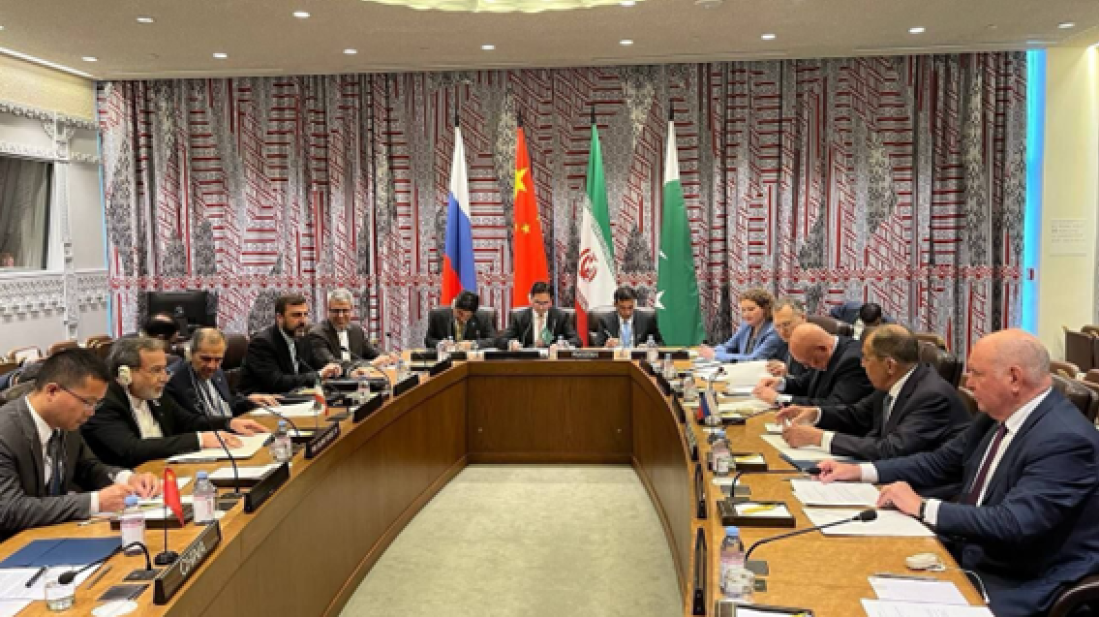
The foreign ministers of Pakistan, China, Russia and Iran held a quadrilateral meeting on the side-lines of the 80th United Nations General Assembly in New York. This meeting was held at the invitation of the Russian Federation.
In a statement issued by the group after the meeting, Russia’s Ministry of Foreign Affairs said, “The participants reviewed the current situation in Afghanistan and underscored their aspiration for the country to emerge as an independent, peaceful state – free from terrorism, war, and drugs.
They emphasised the pressing need for enhanced constructive and pragmatic engagement by the international community with Kabul to foster the consolidation of Afghan statehood and reinforce regional and global stability.”
According to Iran’s Islamic Republic News Agency (IRNA), the ministers reaffirmed support for a stable Afghanistan, free from terrorism, war and drugs.
The representatives backed effective regional initiatives to strengthen Afghanistan’s economy and underlined the importance of sustained economic engagement to improve the humanitarian situation.
They also said they are ready to expand co-operation with Afghanistan on the economy, regional connectivity and trade.
They called for avoiding “politicisation and double standards”, particularly on travel-ban exemptions for Taliban-listed individuals, which they say are important for advancing an inclusive approach.
Last month, the United Nations Security Council refused a travel exemption for Amir Khan Muttaqi, Afghanistan’s foreign minister, for trips to Pakistan and India.
The ministers emphasised the importance of humanitarian aid and called on the international community to provide more assistance.
The statement noted security threats from groups such as Tehreek-e-Taliban Pakistan (TTP), Islamic State-affiliated militants, the East Turkistan Islamic Movement (ETIM) and others.
They commended Afghanistan’s efforts to ban opium cultivation and urged comprehensive counternarcotics measures.
The statement also held NATO members accountable for the current crisis and called on them to create opportunities for Afghanistan’s economic recovery and development.
It demanded the immediate lifting of unilateral sanctions, the release of Afghanistan’s frozen assets, and opposed any redeployment of foreign military bases inside or around Afghanistan, calling such moves detrimental to regional peace and security.
The foreign ministers voiced support for diplomatic efforts toward a political settlement and said they are ready to work with the international community, especially the United Nations.
They underlined the role of regional platforms, including the Moscow Format, the Meeting of Afghanistan’s Neighbouring Countries, and the Shanghai Cooperation Organisation.
This meeting came a day after the Organisation of Islamic Cooperation (OIC) held its first Contact Group meeting on Afghanistan, also on the sidelines of the UN general assembly in New York.
Anewz tried to reach Afghanistan’s Ministry of Foreign Affairs for comment on the meetings but has not to hear back.
Taliban officials have previously said they support such meetings, saying they may enhance international co-operation with Afghanistan.











What is your opinion on this topic?
Leave the first comment