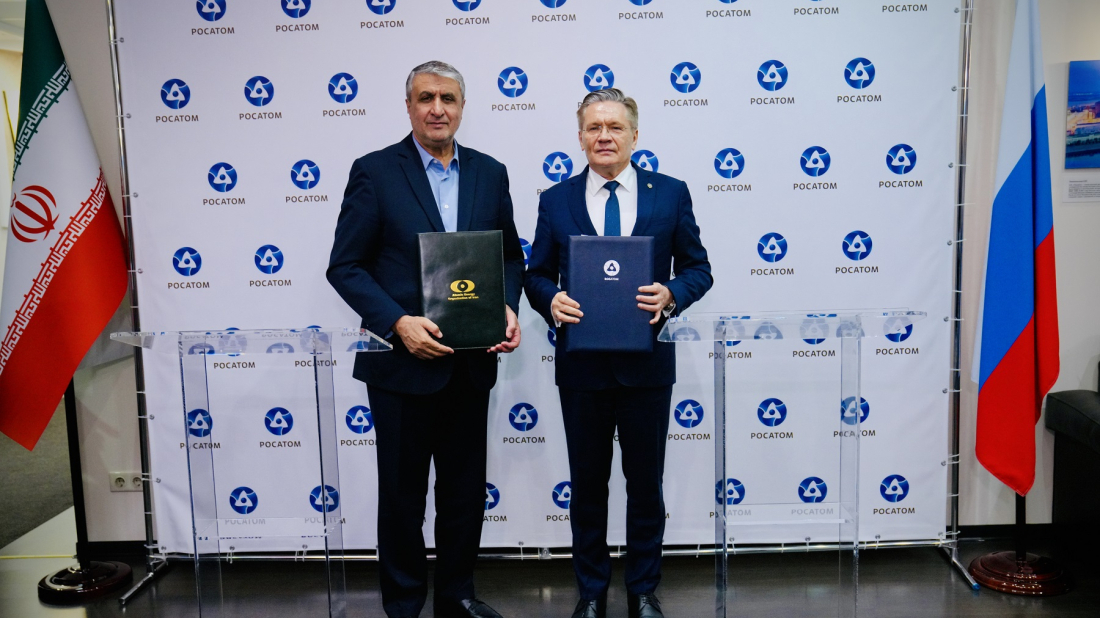
Iran and Russia have signed a memorandum of understanding (MoU) to build nuclear Small Modular Reactors (SMR) capable of generating maximum electrical power of 300 Megawatts electric (MWe) to be installed at the planned Iran Hormuz nuclear power plant site with a 5,000 MWe capacity.
President of the Atomic Energy Organization of Iran (AEOI) Mohammad Eslami and Director General of the Russia’s State Atomic Energy Corporation Rosatom Alexey Likhachev signed the MoU in Moscow during World Atomic Week at ATOMEXPO.
“These reactors will play an important role in the development of nuclear technical knowledge and technology and industries related to the manufacturing of power plant equipment and devices in the country,” the AEOI Public Relations Office said in a news release.
“In addition, the achievement of Small Modular Reactors technology can provide new capacity to supply power to large industries and create balance in the country's electricity grid,” read the press release available on the AEOI website.
Eslami said that contracts on constructing the small-size reactors will be signed accordingly to launch the major Iran Hormuz nuclear power plant site in the southern Hormuzgan Province along the Persian Gulf and Oman Sea.
“5,000 MW of nuclear power will be generated at the Iran Hormuzugan site,” he added.
Bushehr's first 1000-Megawatt nuclear power plant
Iran’s Persian Gulf province of Bushehr is hosting its first ever 1000-Megawatt nuclear power plant which was built and connected to the national grid in 2012 based on an agreement with Rosatom.
The Russian company took over the project after the German Siemens company withdrew from its 1974 contract with Iran following the Islamic Revolution which ousted the pro-west shah monarchy in 1979.
Sanctions
In the meantime, Tehran and the European powers are at loggerheads at the United Nations Security Council over a possible return of the nuclear sanctions if they fail to reach an agreement by 28 September.
The European troika of France, Germany and the UK have laid down the three conditions of resumption of nuclear talks with the U.S., return of the inspectors of the International Atomic Energy Agency (IAEA), and access to the stockpiled enriched uranium in return for a limited suspension of the sanctions.
Iran cut off the mediated nuclear negotiations with the United States and suspended the ties with the UN nuclear watchdog after its major civilian nuclear sites were bombed by Israel and U.S. last June.
In Tehran, the Chairman of the Parliamentary Commission on National Security and Foreign Policy Ebrahmi Azizi ruled out direct talks with Washington saying that remarks by the U.S. nuclear negotiator, Steve Witkoff, regarding talks with Tehran are a “lie”.
Witkoff said at the Concordia Annual Summit that the U.S. is interested in negotiating with Iran and added, "We're talking to them (Iran) ... Why wouldn't we?"
The Iranian lawmaker also warned that if the snapback mechanism of UN nuclear sanctions is activated, the Iran-IAEA cooperation deal signed this month in Egypt will be null and void.
The Iranian President Masoud Pezeshkian and Foreign Minister Abbas Araghchi are in New York to take part at the 80th General Assembly of the United Nations with a crucial last-minute working agenda to prevent re-imposition of the UN nuclear sanctions.
Iran’s Parliament is set to discuss withdrawing from the Non-Proliferation Treaty (NPT) on Sunday coinciding the date the pre-2015 sanctions could be re-instated.










What is your opinion on this topic?
Leave the first comment