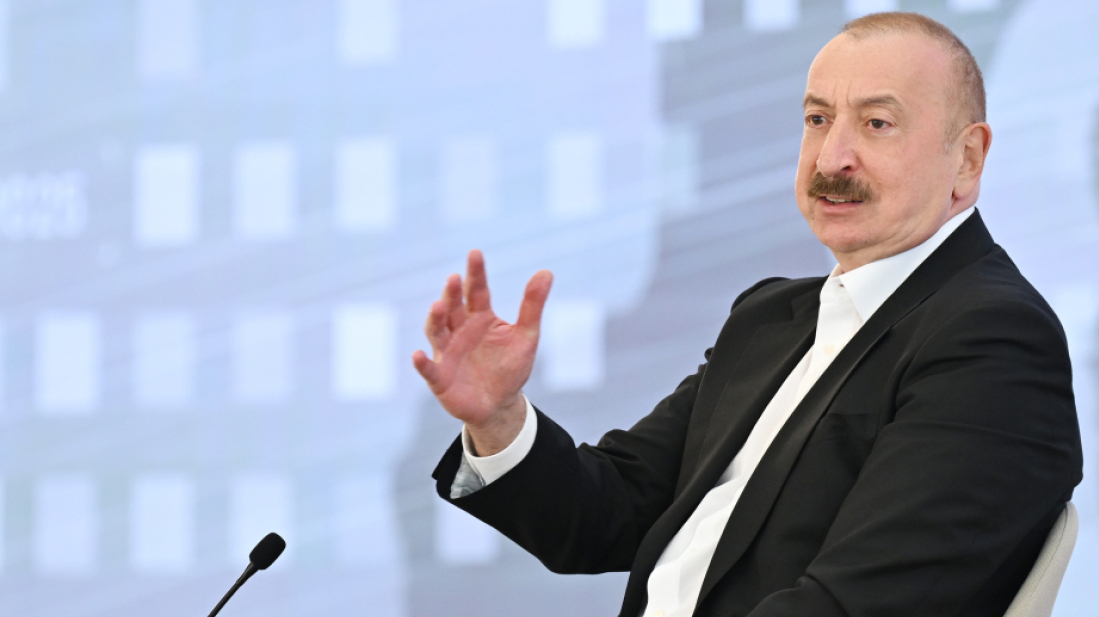
On July 19, Ukrainian media provided extensive coverage of Azerbaijani President Ilham Aliyev’s speech and responses to journalists’ questions during the 3rd Shusha Global Media Forum, held in Khankendi under the theme “Digital Pathways".
According to AZERTAC, major Ukrainian outlets such as Ukrinform, RBK-Ukraine, Interfax-Ukraine, UNIAN, Radio Svoboda's Ukrainian service, Gordon, Korrespondent, Tsensor.net, and various news portals published reports featuring key remarks made by the Azerbaijani leader.
The reports highlighted President Aliyev’s statements on the Armenia-Azerbaijan conflict, the Russia-Ukraine war, and Azerbaijan’s response to the downing of an AZAL aircraft over Russian territory. He noted that Azerbaijan has not received a clear response from Russia for seven months. Despite repeated inquiries from the Azerbaijani Prosecutor General to Russia’s Investigative Committee, the only answer has been that “the investigation is ongoing.” President Aliyev stressed that Azerbaijan is prepared to appeal to the international justice system. He also recalled that the investigation into the downing of the Malaysian Boeing aircraft has continued for over a decade, adding that Azerbaijan is ready to wait as long as necessary—but demands accountability, punishment for those responsible, compensation to the victims’ families, and reparations for damages to AZAL.
Ukrainian media also reported on President Aliyev’s comments regarding the liberation of Azerbaijan’s occupied territories through military means and his advice to Ukraine not to accept occupation.
"My answer now would not differ from what I said back then. And I believe this reflects the will of the Ukrainian people—never to come to terms with occupation. That is the key advice. That is what we did. Or rather, how we envisioned this process," Ukrainian outlets quoted the President as saying.
The reports further highlighted President Aliyev’s remarks on the devastating toll of the First Karabakh War, describing it as a deeply traumatic and tragic period for Azerbaijan, marked by numerous casualties.
"The post-conflict period was no less difficult—morally and economically. Nearly one million of our citizens were deprived of their homes. Around 700,000 were from the Karabakh region, and 250,000 were Azerbaijanis deported from Armenia. At the time, Azerbaijan’s population was around 8 million, meaning one of the highest refugee-per-capita ratios in the world.
There was no money, the treasury was empty, and we had virtually no international support. The economy was in ruins, inflation reached a thousand percent, and unemployment and poverty were almost total. That was the reality of Azerbaijan.
...The geopolitical landscape and terrain were not in our favour. All three co-chairs of the OSCE Minsk Group supported Armenia for personal reasons and tried to maintain the status quo indefinitely. Even when we managed, after enormous diplomatic efforts, to get a statement issued on behalf of the co-chairs, it was often retracted shortly afterward.
...We began creating new realities during the 44-day war in 2020,” Ukrainian media quoted President Aliyev as saying.











What is your opinion on this topic?
Leave the first comment