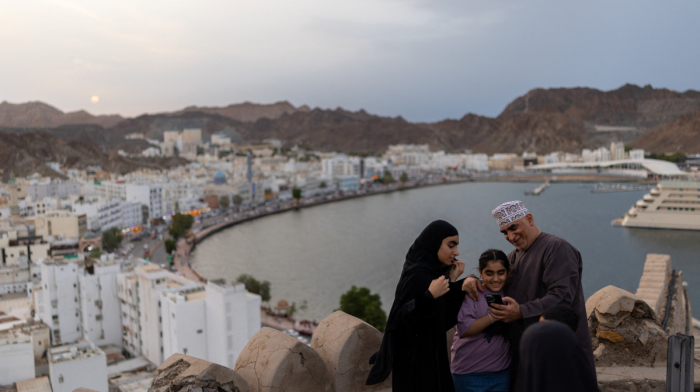
While the economies of several major Gulf countries have contracted in 2026 amid the fallout from the Iran war, Oman is on course to grow by 4.1 per cent this year, according to projections from the International Monetary Fund (IMF).
Despite sharing a maritime border with Iran and facing attacks since the U.S.-Iran conflict began, the small sultanate has emerged as one of the region’s rare economic bright spots. How has it managed to defy the downturn?
Maya Senussi, lead Middle East economist at forecasting firm Oxford Economics, told AnewZ that higher energy output and stronger exports were driving the country's growth.
“Oman’s economy has been boosted by higher energy sector output, rising export volumes, and improving regional connectivity. GDP data for Q2 show growth expanded 5.2 per cent y/y, [year on year] the strongest pace since 2022, driven by a 14.7 per cent surge in petroleum activity.”
Neutral stance
Senussi said Oman had also benefited from its relatively limited exposure to security threats and continued domestic investment.
“The risks to Oman’s economy from the ongoing U.S.-Iran conflict appear contained, reflecting its lower security exposure, while the domestic investment momentum remains strong,” she said.
Omani ports were reportedly targeted in several attacks in March, although Tehran distanced itself from the incidents. Nevertheless, Oman has avoided the scale of attacks experienced by Gulf neighbours such as the United Arab Emirates (UAE) and Qatar.
Unlike the UAE and Qatar, Oman hosts neither U.S. military bases nor permanently stationed U.S. soldiers. Many Iranian attacks on neighbouring countries since the war began have targeted U.S. military bases or infrastructure linked directly or indirectly to American military operations.
Throughout the conflict, Oman has maintained its role as a neutral mediator, criticising U.S.-Israeli attacks on Iran while condemning Iranian strikes against other countries in the region.
In March, Ebrahim Zolfaghari, a spokesperson for Iran’s top military command, described Oman as a “brotherly and friendly country,” saying Iran respected its national sovereignty.
Geographical advantage
Restrictions on shipping through the Strait of Hormuz following Iranian attacks, coupled with the continuing U.S. naval blockade of Iranian ports, have increased the strategic importance of Oman's ports. Those in the south, further from Iran and the strait, are particularly well placed to benefit.
In October, Oman signed 28 investment agreements worth more than $790 million for commercial and industrial projects in special economic zones, including three centred on the ports of Duqm, Sohar and Salalah.
In a further sign of growing investor interest, Bloomberg News reported that French logistics firm CMA CGM had signed a $400 million agreement in June to develop and operate a terminal at Sohar Port.
However, the economic gains have been uneven. Non-energy growth slowed to just 0.7 per cent in the second quarter of 2026, its weakest pace in three years, Senussi said.
The slowdown was driven “by declines in construction and hospitality-related sectors,” she added.
Economic reforms laid the groundwork
While the Iran war has brought Oman's economic resilience into sharper focus, the foundations of its recovery were laid more than a decade ago.
Faced with a budget deficit of more than $11 billion in 2015, Oman's government launched sweeping spending cuts, reducing subsidies and public expenditure.
Following Sultan Haitham bin Tariq Al Said's accession to the throne in 2020, the country accelerated its reform programme, introducing value-added tax (VAT), seeking to reduce its dependence on hydrocarbons and attracting foreign investment.
Non-oil revenues now account for more than 30 per cent of GDP, while logistics and manufacturing exports have expanded.
The shift towards a more diversified economy is also reflected in major tourism investments, including the $500 million Trump International Oman hotel and golf complex, scheduled to open in Muscat in December 2028, alongside other projects worth hundreds of millions of dollars.
Can Oman sustain its economic lead?
Despite its strong performance, questions remain over whether Oman can maintain its momentum as the regional conflict continues.
Oman is the only Gulf Cooperation Council (GCC) economy forecast to avoid a recession this year, but Senussi warned that its advantage over Saudi Arabia and the UAE would not last long.
“The outperformance will be brief, with its GDP growth slowing to 2.1 per cent next year, as energy sector activity normalises,” she told AnewZ.
Nevertheless, she expects a gradual recovery in sectors that have struggled this year.
“We expect momentum in sectors currently facing pressure will recover gradually, supporting a more than doubling in non-energy sector growth to 3.4 per cent in 2027,” she said.
For all its economic resilience, Oman's future growth remains vulnerable to forces beyond its control. Whether it can sustain the gains made during the Iran war may ultimately depend less on decisions taken in Muscat than on those made in Washington and Tehran.
Read more from Oman:










What is your opinion on this topic?
Leave the first comment