Israeli political and military leaders have strongly condemned the actions of a soldier accused of desecrating a Christian crucifix in southern Lebanon, as the army confirmed a formal investigation is under way.
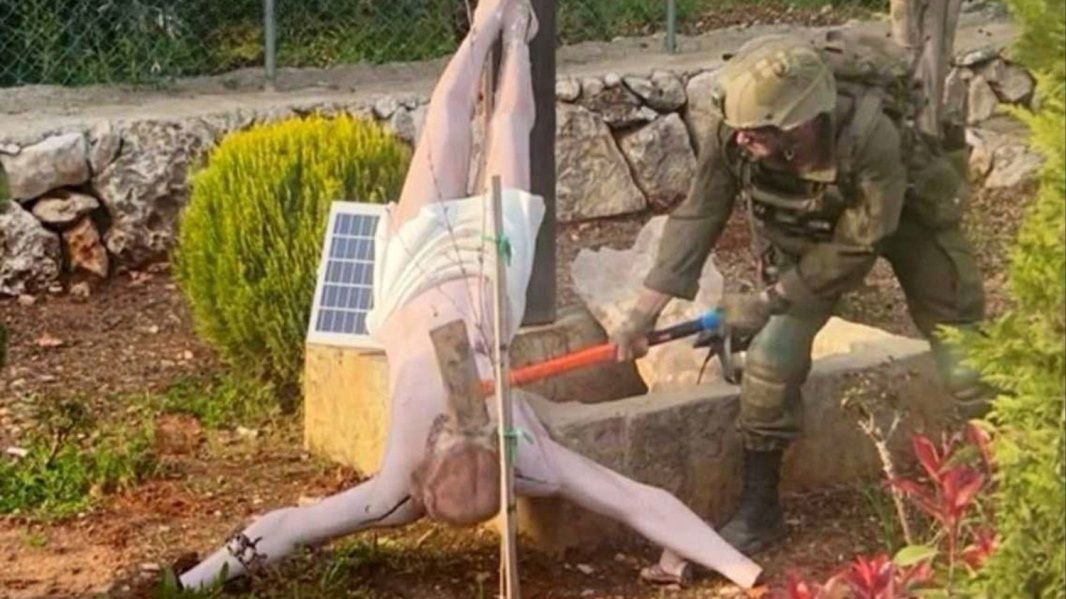
The incident came to light after a photograph circulated on social media over the weekend. The image appears to show a soldier striking a fallen statue of Jesus on the cross with a blunt instrument.
It was shared by Younis Tirawi, who describes himself as a Palestinian reporter and has previously published images alleging misconduct by Israeli forces.
Reuters said it had verified the image’s location as Debel, a predominantly Christian village near the Israeli border. The area has remained under Israeli military presence following an escalation in hostilities with Hezbollah, which began in early March after the group launched rockets towards Israel.
The crucifix was part of a small shrine located in the garden of a family home on the outskirts of the village, according to local priest Fadi Falfel.
"One of the Israeli soldiers broke the cross and did this horrible thing, this desecration of our holy symbols," he said.
Residents of Debel are among the few civilians who have remained in their homes during weeks of conflict. Much of southern Lebanon has seen displacement and damage as Israeli forces carried out air strikes and ground operations in response to Hezbollah activity.
Israeli leaders condemn act as army launches inquiry
Israel’s Prime Minister Benjamin Netanyahu said the soldier’s actions were in direct conflict with the country’s values.
"I was stunned and saddened to learn that an IDF soldier damaged a Catholic religious icon in southern Lebanon. I condemn the act in the strongest terms," he wrote on X.
Foreign Minister Gideon Saar also issued a public apology, describing the act as unacceptable.
"We apologise for this incident and to every Christian whose feelings were hurt," he said, adding that he was confident "necessary severe measures" would be taken.
The Israel Defense Forces (IDF) confirmed that it had authenticated the photograph and was treating the case with urgency.
"The IDF views the incident with great severity and emphasises that the soldier's conduct is wholly inconsistent with the values expected of its troops," the military said.
It added that the investigation is being handled by its Northern Command and will proceed through the chain of command.
The army said it would take "appropriate measures" against those involved, though it did not provide further details.
Military officials also said they were working with the local community to restore the damaged statue to its original position.
Hardship continues despite ceasefire in southern Lebanon
Debel is one of dozens of villages in southern Lebanon currently under effective Israeli control.
Despite a U.S.-brokered ceasefire agreed last week between Israel and Hezbollah, Israeli troops have remained in parts of the south.
Movement in and out of the village is restricted, and access to certain areas has been limited.
"We have every kind of crisis," Falfel said. "We thought the ceasefire would bring us some relief, but we’re still surrounded, unable to travel to and from the town. There are some houses on the edge of town that we’re barred from accessing."
Israeli military officials say they are coordinating with aid agencies to support civilians in Debel and other affected communities, including efforts to address shortages of essential supplies.
The incident has drawn attention to the broader impact of the conflict on religious sites and civilian areas, as investigations continue into the conduct of troops operating in the region.














What is your opinion on this topic?
Leave the first comment