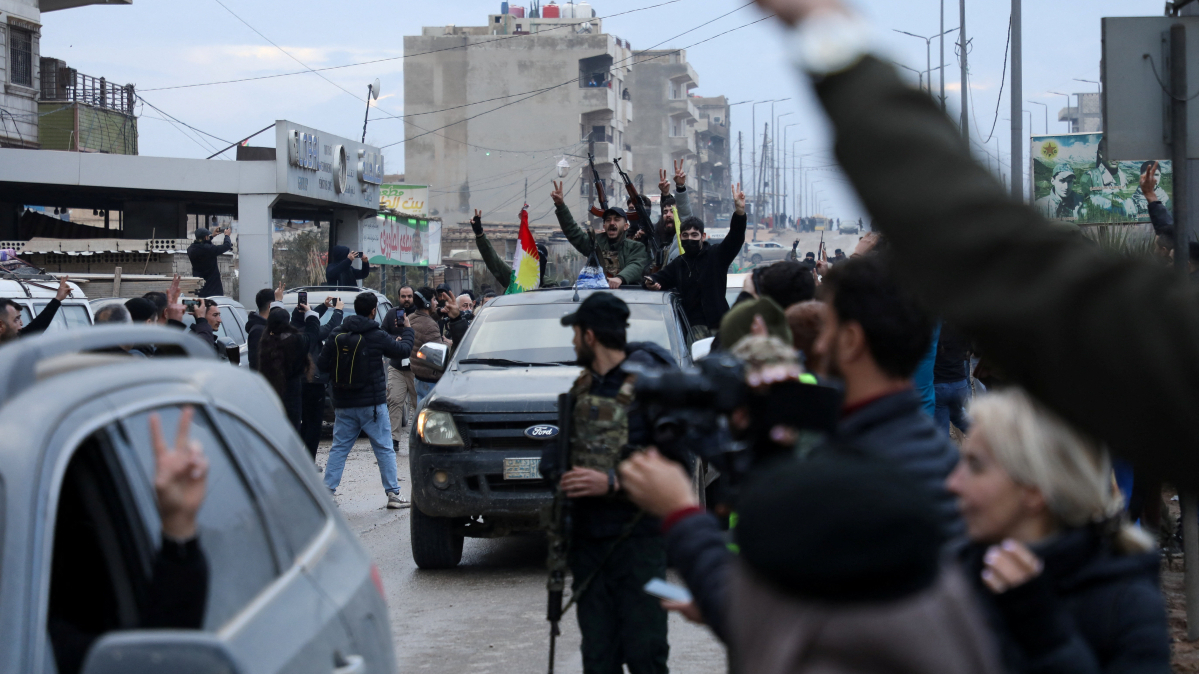
Syrian government security forces entered the Kurdish-controlled northeastern city of Qamishli on Tuesday (3 February), security sources and witnesses said.
The move implements a U.S.-backed deal aimed at bringing Kurdish-run regions back under central government control.
The accord, declared on Friday (30 January), staved off the risk of more conflict between Syrian President Ahmed al-Sharaa's government and the Kurdish-led Syrian Democratic Forces (SDF).
Reuters journalists said the convoy headed straight to a security zone inside Qamishli for talks with senior Kurdish officials at the de facto political centre of the Kurdish-led administration that took shape during Syria's 14-year civil war.
The internal security forces were handed control of the security buildings of the Kurdish Asayish security forces and would deploy alongside the Asayish to maintain security in the city, according to Interior Ministry spokesman Nur Din al‑Baba in Qamishli.
“Today the Syrian people won ... and we begin a new chapter away from revenge, hate speech and divisions,” he said.
Meanwhile, Interior Ministry vehicles entered the city of Hasakah on Monday (2 February), about 80 km (47 miles) south of Qamishli.
U.S. sidelines SDF
The 30 January accord foresees a phased integration of Kurdish fighters with Damascus forces. The U.S. has hailed the agreement as a milestone towards unity and reconciliation after the war that fractured the country into rebel fiefdoms.
The SDF were once Washington's main Syrian ally, playing a vital part in the fight against Islamic State militants.
But its position took a major hit as U.S. President Donald Trump cultivated relations with al-Sharaa, a former al Qaeda commander who has now brought almost all of Syria back under the authority of Damascus.
Many Arab towns and villages in Hasakah province have welcomed the end of SDF control over their areas, saying the Kurdish-led authorities had deprived their communities and marginalised them during their rule.
Trouble in Hasakah
However, Qamishli was under curfew for a second day on Tuesday, part of measures the Kurdish-led authorities imposed on Hasakah and on Kobani, or Ain al-Arab, along the Turkish border, residents said.
Trouble broke out in several neighbourhoods of Hasakah on Monday between SDF forces and local Arab residents.
The Kurdish-led forces blamed Islamist militants, while Arab residents said the SDF had fired at demonstrators in a clampdown on public celebrations over the end of SDF rule.
Arab grievances about Kurdish-led rule are dismissed by the SDF leadership. The Kurds were an oppressed minority under the Assad family’s 54‑year rule and established de facto autonomy during the civil war in a largely Arab‑populated region.
The SDF, which controlled Syria’s main oil fields and a basket of key commodities during its rule, says it sought to redress injustices by creating a system of governance that represented all ethnic groups and minorities.










What is your opinion on this topic?
Leave the first comment