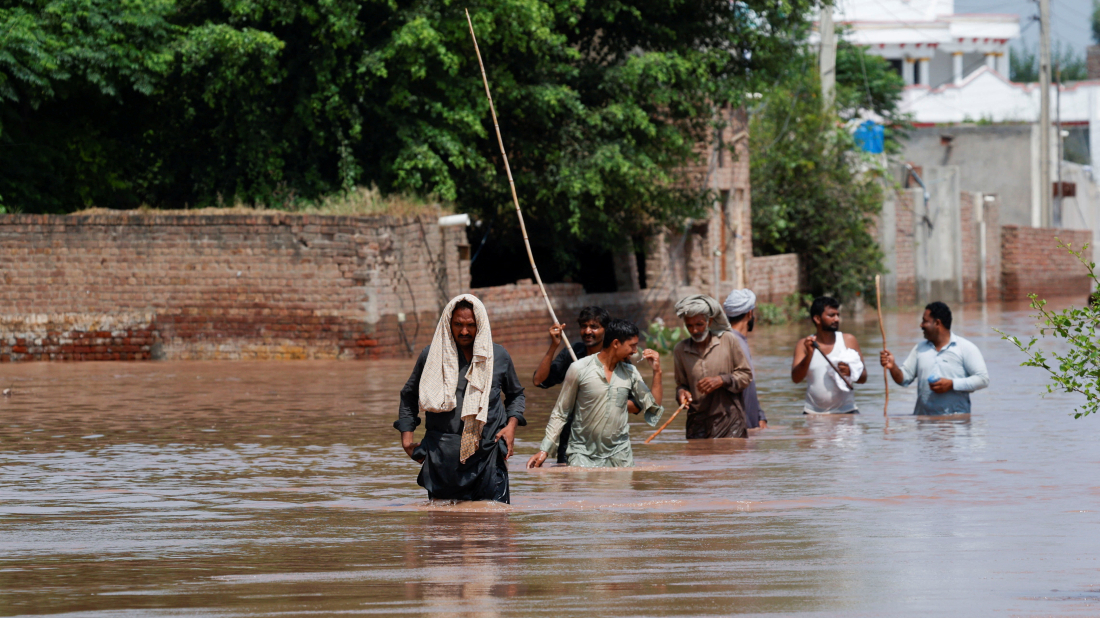
Pakistan’s eastern towns of Chiniot and Hafizabad are at risk of devastating floods if an irrigation barrage on a major upstream river collapses after torrential rains pushed it beyond capacity, officials warned on Thursday.
Pakistan and its nuclear-armed neighbour India are struggling with severe monsoon rains that have triggered flash floods, swollen rivers and filled reservoirs. In Indian-administered Kashmir, 60 people have died this month, while Pakistan’s death toll since late June has risen to 805.
Any flooding linked to India could further strain relations between the two rivals, who remain in a tense stand-off following their worst fighting in decades during a brief conflict in May.
In Punjab province, waters from the Chenab river threatened to overwhelm the 1,000-metre-long concrete barrage at Qadirabad, which channels flows into a vast irrigation network.
“It is a crisis situation,” said a technical expert at Pakistan’s National Disaster Management Authority, warning that the failure of the structure could submerge the two towns, home to more than 2.8 million people.
Although officials said the water level had begun to recede under close monitoring, it remained dangerously high.
The threat was compounded by India’s release of excess water from dams this week, swelling rivers that flow downstream into Pakistan’s Punjab, the country’s agricultural heartland and home to half its 240 million population.
Authorities said more than 210,000 people had been evacuated from villages near the Ravi, Sutlej and Chenab rivers. In India’s Jammu region, heavy rainfall has killed 60 people this month.
India typically releases water from overflowing dams, describing the measures as humanitarian and issuing warnings to Pakistan in advance. Pakistani officials confirmed India had sent three flood alerts since Sunday-two for the Ravi and one for the Sutlej. New Delhi’s water resources ministry did not immediately respond to requests for comment.
According to Punjab’s disaster management authority, more than 900,000 cusecs of water surged through the Qadirabad distribution point on the Chenab, exceeding its capacity by 100,000 cusecs. (One cusec equals one cubic foot, or 28 litres, per second.)
On Wednesday, part of the riverbank was deliberately blown up to divert water before it reached the barrage.
Provincial minister Marriyum Aurangzeb said twelve people had died this week in Punjab, but urged calm.
“As one nation, we will face this challenge together,” she said on the banks of the swollen Ravi.
The eastern rivers eventually merge with those from northern Punjab to join the Indus, which flows through Sindh province before reaching the sea.
Across the border in India, water levels in Himalayan rivers began to fall after days of intense downpours that had triggered floods and landslides. Forecasters expect the rains to ease from Thursday.





















What is your opinion on this topic?
Leave the first comment