As fuel prices surge nearly 37 per cent and protests over living costs turn violent, French President Emmanuel Macron is seeking fresh energy supplies and partnerships in the Gulf. But can diplomacy abroad ease mounting pressure at home?
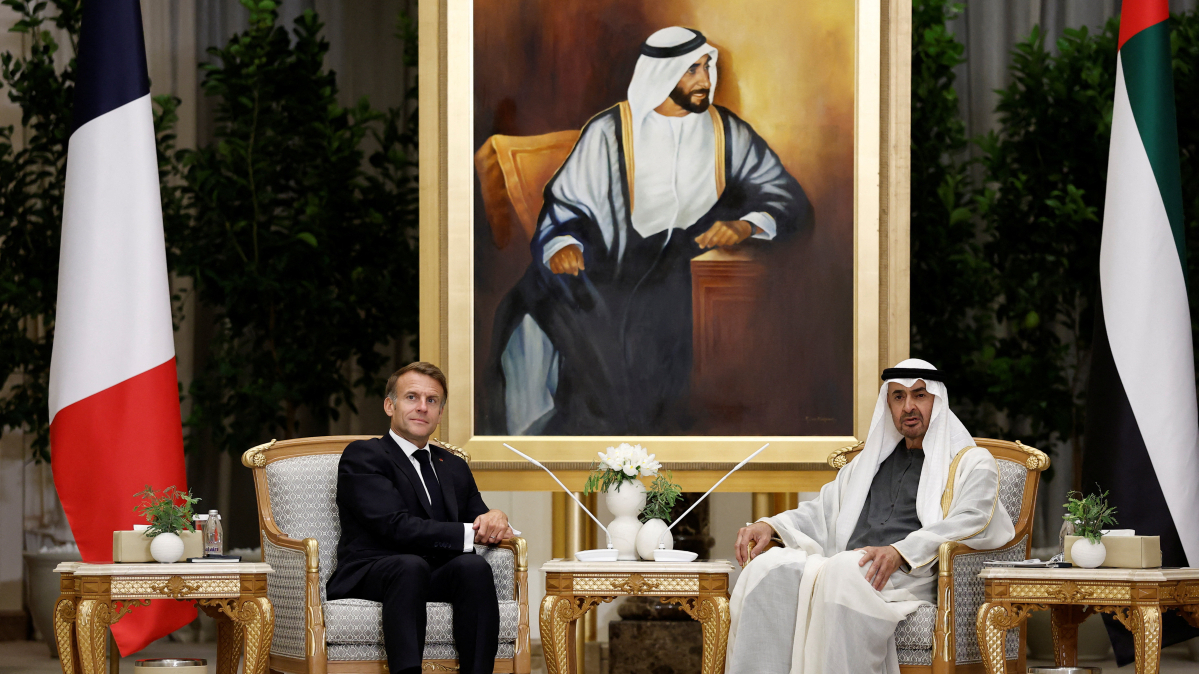
French President Emmanuel Macron held talks with United Arab Emirates President Sheikh Mohamed bin Zayed Al Nahyan in Abu Dhabi on Monday, 19 October, as rising fuel prices and violent protests over living costs intensified pressure on his government.
The talks covered maritime security, global energy supplies, investment and artificial intelligence, according to the Abu Dhabi Media Office.
Macron's three-day Gulf tour, which began in Kuwait and also takes in Bahrain and Qatar, follows a weekend of violent unrest across France. More than 2,500 people were arrested, according to Le Monde, after protests over living costs descended into clashes, looting and property damage.
Beyond restoring public order, Macron faces another urgent challenge: securing energy supplies as the war between the U.S. and Iran disrupts one of the world's most important oil shipping routes.
Official French figures reveal the scale of the economic pressure facing his government.
France's fuel prices surge as household pressure grows
Petroleum product prices in metropolitan France surged 36.8 per cent in September compared with a year earlier, according to the National Institute of Statistics and Economic Studies (INSEE).
Overall energy prices climbed 21.4 per cent year-on-year, while consumer prices excluding energy rose by just 1.6 per cent.
The figures highlight how energy costs are rising far faster than prices elsewhere in the economy.
France's annual inflation rate rose to 3.1 per cent in September, from 0.9 per cent in February, according to INSEE.
The reversal in fuel prices has been particularly stark. Petroleum products fell 2 per cent year-on-year in February, before rising 18.9 per cent in March and surging 36.8 per cent in September.
The strain on household finances, however, extends well beyond the petrol pump.
According to Eurostat, 28.8 per cent of people in France lived in households that could not cover an unexpected expense without borrowing or financial assistance in 2025.
Meanwhile, 41.1 per cent reported at least some difficulty making ends meet.
Although the figures predate the latest unrest, they underline the financial pressures facing households already struggling with higher energy bills.
Why Macron is turning to the Gulf for oil
Macron's visit is partly aimed at securing commitments for additional oil and diesel supplies, according to the French presidency.
The president departed for Kuwait just hours after addressing the nation following the weekend's violence.
He acknowledged failures in maintaining security and condemned the destruction, but insisted the Gulf trip was necessary to safeguard France's energy supplies.
Senior executives from French energy giants TotalEnergies and Engie accompanied him, underscoring the commercial importance of the mission.
France is looking for additional supplies and alternative transport routes as disruption in the Strait of Hormuz continues to unsettle global energy markets.
But even if Macron secures new agreements, relief for French consumers is unlikely to be immediate.
Whether fuel prices fall will depend on the quantities secured, delivery arrangements and wider conditions in international energy markets.
Strait of Hormuz disruption raises global energy risks
The Strait of Hormuz, which connects the Persian Gulf with the Gulf of Oman, is one of the world's most strategically important shipping routes and a vital passage for Gulf oil and gas exports.
The war between the U.S. and Iran, which began in February, has severely disrupted shipping through the waterway, while attacks on energy facilities and vessels elsewhere in the region have intensified supply concerns.
France and Britain have proposed an international maritime mission to help reopen the strait, including through demining operations, once Washington and Tehran reach a political agreement.
So far, no such agreement has been reached.
Macron's talks with Gulf leaders are therefore focused on two priorities: securing energy shipments and finding alternative ways to transport supplies while established routes remain disrupted.
The effort forms part of a wider international push to stabilise energy markets.
According to Le Monde, G7 countries agreed in early October on plans to release up to 100 million barrels of oil from strategic reserves to ease supply pressures.
The proposed collective release is separate from any oil supplies Macron hopes to secure during his Gulf tour.
What France and the UAE agreed in Abu Dhabi
During Monday's meeting, Macron and Sheikh Mohamed discussed expanding cooperation in trade, investment, energy, advanced technology and artificial intelligence.
The Abu Dhabi Media Office said the leaders also examined regional developments and efforts to contain their impact on maritime security and global energy supplies.
Both sides reaffirmed their commitment to closer coordination on regional security and stability.
The discussions build on rapidly expanding economic ties between France and the UAE.
French Treasury figures show that bilateral merchandise trade reached €10.8 billion in 2025, up from €8.5 billion in 2024 and €7.4 billion in 2023.
That represents growth of approximately 27 per cent in a year and 46 per cent over two years.
The UAE was also France's largest export market in the Gulf in 2025, according to the French Treasury.
However, the figures point to an important distinction between the countries' growing commercial relationship and France's immediate energy needs.
The French Treasury notes that the UAE has historically accounted for only a limited share of France's direct energy imports.
Macron's visit is therefore about more than securing Emirati oil. It also aims to strengthen regional energy security, investment and infrastructure links, while deepening cooperation with companies active in global energy markets.
New energy and AI agreements signed
The diplomatic push gathered commercial momentum on Tuesday, 20 October, when Macron and Abu Dhabi Crown Prince Sheikh Khaled bin Mohamed bin Zayed Al Nahyan attended a UAE–France Business Dialogue at Qasr Al Watan.
According to the Abu Dhabi Media Office, French and Emirati companies signed contracts and memoranda of understanding spanning energy, artificial intelligence and advanced technology.
Among the energy agreements, ADNOC Gas and Schneider Electric signed a memorandum of understanding to explore new technologies and operational improvements.
ADNOC Refining and Technip Energies also signed two contracts covering a project to increase refining capacity and another involving sustainable aviation fuel.
In the technology sector, Mohamed bin Zayed University of Artificial Intelligence, G42 and Analog each signed separate memoranda of understanding with AMI Labs.
Talks also addressed France's Campus AI initiative, which involves investment partners from the UAE and other countries.
The agreements demonstrate how Macron's Gulf tour is expanding beyond immediate energy concerns into longer-term industrial and technological cooperation.
Will Macron's Gulf visit ease pressure at home?
Macron's Gulf tour comes at a politically sensitive moment, with France grappling with some of its worst civil unrest in years and the next presidential election due in 2027.
Securing additional energy supplies and alternative shipping routes remains the immediate priority. Yet much depends on developments beyond Paris's control, particularly the U.S.-Iran conflict and restrictions on shipping through the Strait of Hormuz.
The visit has already delivered new energy and technology agreements, reinforcing France's economic partnerships with Gulf states.
But for French households struggling with soaring fuel costs, the real test will be whether Macron can turn diplomatic agreements into more reliable energy supplies and, ultimately, lower prices.










What is your opinion on this topic?
Leave the first comment