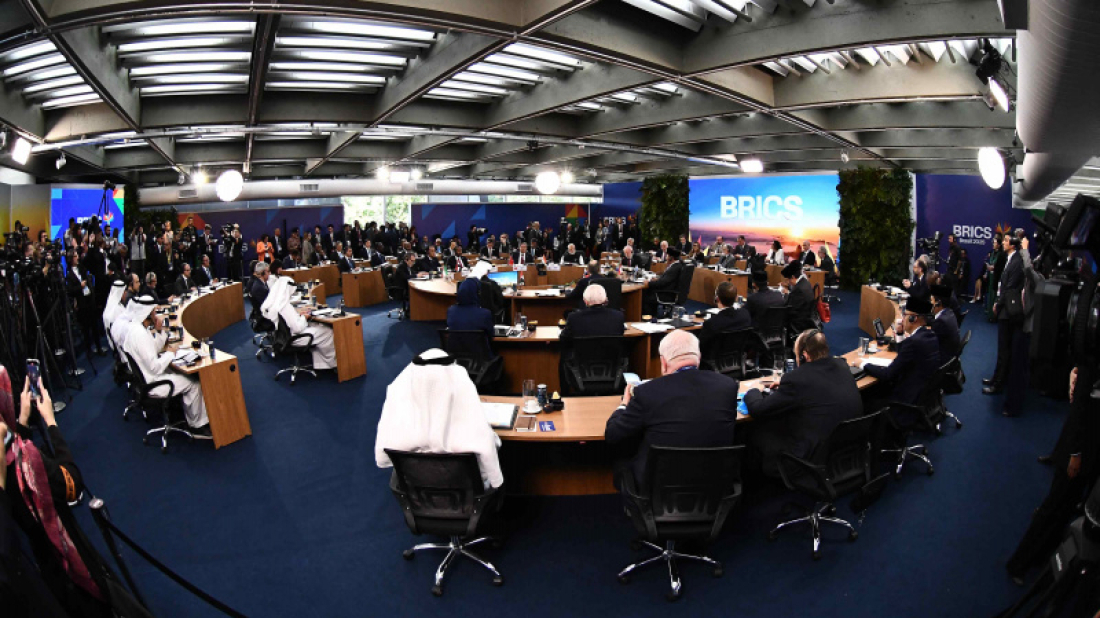
President Donald Trump said the U.S. will impose an additional 10% tariff on any countries aligning themselves with the "Anti-American policies" of the BRICS group of developing nations, whose leaders kicked off a summit in Brazil on Sunday.
With forums such as the G7 and G20 groups of major economies hamstrung by divisions and the disruptive "America First" approach of the U.S. president, BRICS is presenting itself as a haven for multilateral diplomacy amid violent conflicts and trade wars.
In opening remarks to the BRICS summit in Rio de Janeiro, Brazil's President Luiz Inacio Lula da Silva drew a parallel with the Cold War's Non-Aligned Movement, a group of developing nations that resisted joining either side of a polarized global order.
"BRICS is the heir to the Non-Aligned Movement," Lula told leaders. "With multilateralism under attack, our autonomy is in check once again."
In a joint statement released on Sunday afternoon, the group warned the rise in tariffs threatened global trade, continuing its veiled criticism of Trump's tariff policies.
Hours later, Trump warned he would punish countries seeking to join with the group.
"Any Country aligning themselves with the Anti-American policies of BRICS, will be charged an ADDITIONAL 10% Tariff. There will be no exceptions to this policy. Thank you for your attention to this matter!" Trump said in a post on Truth Social.
Trump did not clarify or expand on the "Anti-American policies" reference in his post.
Trump's administration is seeking to finalize dozens of trade deals with a wide range of countries before his July 9 deadline for the imposition of significant "retaliatory tariffs". India’s foreign ministry did not immediately respond to a request for comment.
BRICS nations now represent more than half the world's population and 40% of its economic output, Lula noted in remarks on Saturday to business leaders, warning of rising protectionism.
The original BRICS group gathered leaders from Brazil, Russia, India and China at its first summit in 2009. The bloc later added South Africa and last year included Egypt, Ethiopia, Indonesia, Iran, and the United Arab Emirates as members. Saudi Arabia has held off formally joining, according to sources.
More than 30 nations have expressed interest in participating in the BRICS, either as full members or partners.
GROWING CLOUT, COMPLEXITY
Expansion of the bloc has added diplomatic weight to the gathering, which aspires to speak for developing nations across the Global South, strengthening calls for reforming global institutions such as the United Nations Security Council and the International Monetary Fund.
"If international governance does not reflect the new multipolar reality of the 21st century, it is up to BRICS to help bring it up to date," Lula said in his remarks, which highlighted the failure of U.S.-led wars in the Middle East.
Urging the BRICS to take the lead on reforms, Lula reflected on the G20 summit hosted in the same locale last November:
"In a short period of time, the international scene has deteriorated to the point that some of the initiatives we approved then would no longer be possible now," said Lula.
Stealing some thunder from this year's summit, Chinese President Xi Jinping chose to send his premier in his place. Russian President Vladimir Putin is attending online due to an arrest warrant from the International Criminal Court related to his war in Ukraine.
Still, several heads of state were gathered for discussions at Rio's Museum of Modern Art on Sunday and Monday, including Indian Prime Minister Narendra Modi and South African President Cyril Ramaphosa.
However, there are questions about the shared goals of an increasingly heterogeneous BRICS group, which has grown to include regional rivals along with major emerging economies.
In the joint statement, the leaders called attacks against Iran's "civilian infrastructure and peaceful nuclear facilities" a "violation of international law."
The group expressed "grave concern" for the Palestinian people over Israeli attacks on Gaza, and condemned what the joint statement called a "terrorist attack" in India-administered Kashmir.
The group voiced its support for Ethiopia and Iran to join the World Trade Organization, while calling to urgently restore its ability to resolve trade disputes.
The leaders' joint statement backed plans to pilot a BRICS Multilateral Guarantees initiative within the group's New Development Bank to lower financing costs and boost investment in member states, as first reported by Reuters last week.
In a separate statement following a discussion of artificial intelligence, the leaders called for protections against unauthorized use of Artificial Intelligence to avoid excessive data collection and allow mechanisms for fair payment.
Brazil, which also hosts the United Nations climate summit in November, has seized on both gatherings to highlight how seriously developing nations are tackling climate change, while Trump has slammed the brakes on U.S. climate initiatives.
China and the UAE signaled in meetings with Brazilian Finance Minister Fernando Haddad in Rio that they plan to invest in a proposed Tropical Forests Forever Facility, according to two sources with knowledge of the discussions about funding conservation of endangered forests around the world.














What is your opinion on this topic?
Leave the first comment