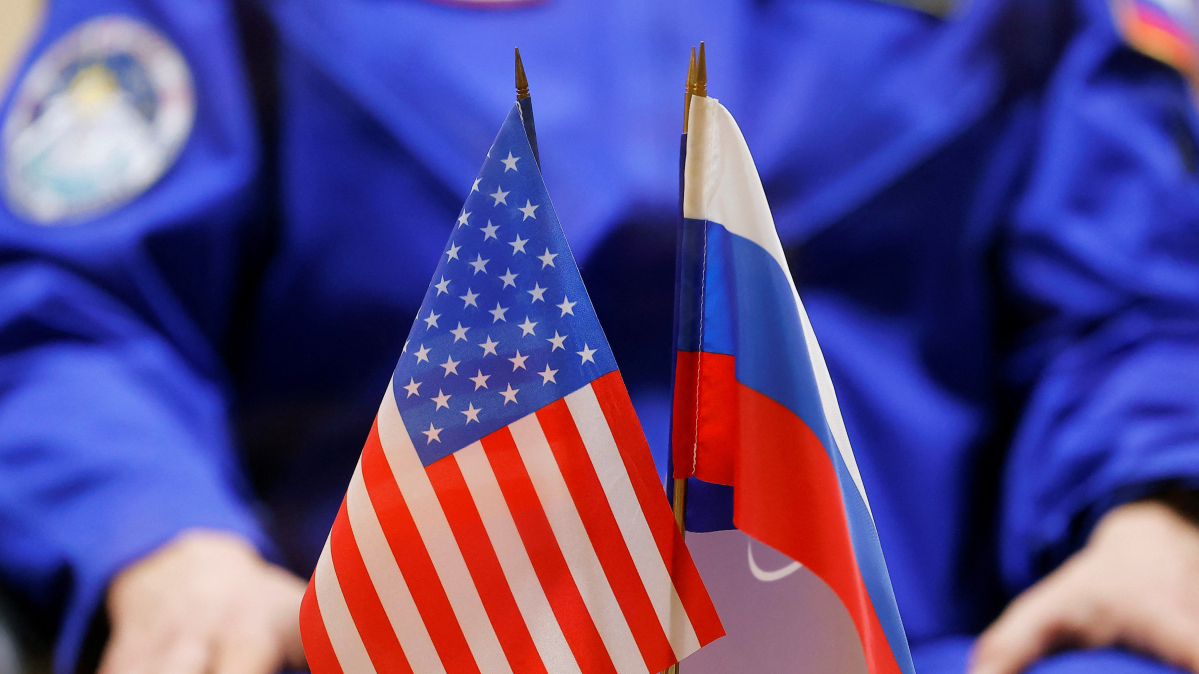
A Russian Soyuz spacecraft carrying two Russian cosmonauts and one U.S. astronaut successfully docked with the International Space Station (ISS) on Tuesday, highlighting continued U.S.-Russian cooperation in space despite wider geopolitical tensions.
NASA astronaut Anil Menon and Russian cosmonauts Pyotr Dubrov and Anna Kikina lifted off from the Baikonur Cosmodrome in Kazakhstan aboard the Soyuz MS-29 spacecraft. The trio arrived at the orbiting laboratory just over three hours later, joining the seven crew members already on board.
The mission marks Menon's first journey into space. The 49-year-old physician, pilot and former military officer will spend about eight months aboard the ISS as part of Expedition 75.
Rare NASA and Roscosmos meeting
The launch was notable not only for its international crew but also for the presence of NASA Administrator Jared Isaacman, who travelled to Baikonur to watch the mission and meet Roscosmos chief Dmitry Bakanov.
It was the first visit by a NASA administrator to the Russian launch facility since 2018, highlighting the enduring importance of space cooperation between the two countries even as political relations remain strained.
After the launch, Isaacman praised Menon's achievement, describing him as someone who had spent years preparing for the mission.
The flight is also the second space mission for both Dubrov and Kikina. Kikina remains the only woman among Russia's active corps of cosmonauts and became the first Russian to fly aboard SpaceX's Crew Dragon spacecraft in 2022.
A history of U.S.-Russian cooperation in space
Despite decades of political rivalry, the United States and Russia have worked together on several landmark space missions that laid the foundation for today's International Space Station partnership.
- Apollo-Soyuz Test Project (1975): The first joint crewed mission between the United States and the Soviet Union saw an American Apollo spacecraft dock with a Soviet Soyuz capsule in orbit. The mission became a symbol of Cold War-era cooperation and demonstrated that spacecraft from different countries could operate together in space.
- Shuttle-Mir programme (1994–1998): NASA and Russia collaborated on a series of missions involving the Russian space station Mir. Seven American astronauts spent nearly 1,000 days aboard Mir, while U.S. space shuttles docked with the station 10 times. NASA says the programme helped prepare both countries for the International Space Station.
- International Space Station (ISS) partnership (since 1998): The ISS is jointly operated by NASA, Roscosmos, the European Space Agency, Japan's JAXA and the Canadian Space Agency. Russia launched the station's first module, Zarya, in 1998, while the U.S. supplied key modules and power systems. The station has been continuously occupied since 2000.
- Cross-flights and seat-swap agreements: NASA astronauts have regularly flown aboard Russian Soyuz spacecraft, while Russian cosmonauts have travelled on U.S. spacecraft, including SpaceX Crew Dragon missions. These arrangements ensure that at least one American and one Russian remain aboard the ISS at all times.
- ISS cooperation despite geopolitical tensions: Space collaboration has continued despite disputes over Crimea, Russia's war in Ukraine and broader tensions between Washington and Moscow. The ISS remains one of the few areas where the two countries continue to work closely together.
ISS partnership survives political tensions
The International Space Station remains one of the few areas where the United States and Russia continue to work closely together.
The partnership has endured despite Russia's war in Ukraine and wider tensions between Moscow and Washington. The two countries remain dependent on one another to operate the station, with U.S. systems providing power while Russian modules help maintain its orbit.
However, the ageing outpost has faced growing technical challenges in recent years. Air leaks in parts of the station have repeatedly tested relations between NASA and Roscosmos, with engineers from both agencies at times disagreeing over the best methods of repair.
The condition of the ISS, which is expected to be retired shortly after 2030, is likely to remain a key issue in discussions between U.S. and Russian space officials.
Tuesday's launch also marked the return of crewed missions from Baikonur's Site 31 launch pad following extensive repairs. The facility, Russia's only crew-capable launch site, was damaged during a previous launch and had been out of service for months before operations resumed earlier this year.


















What is your opinion on this topic?
Leave the first comment