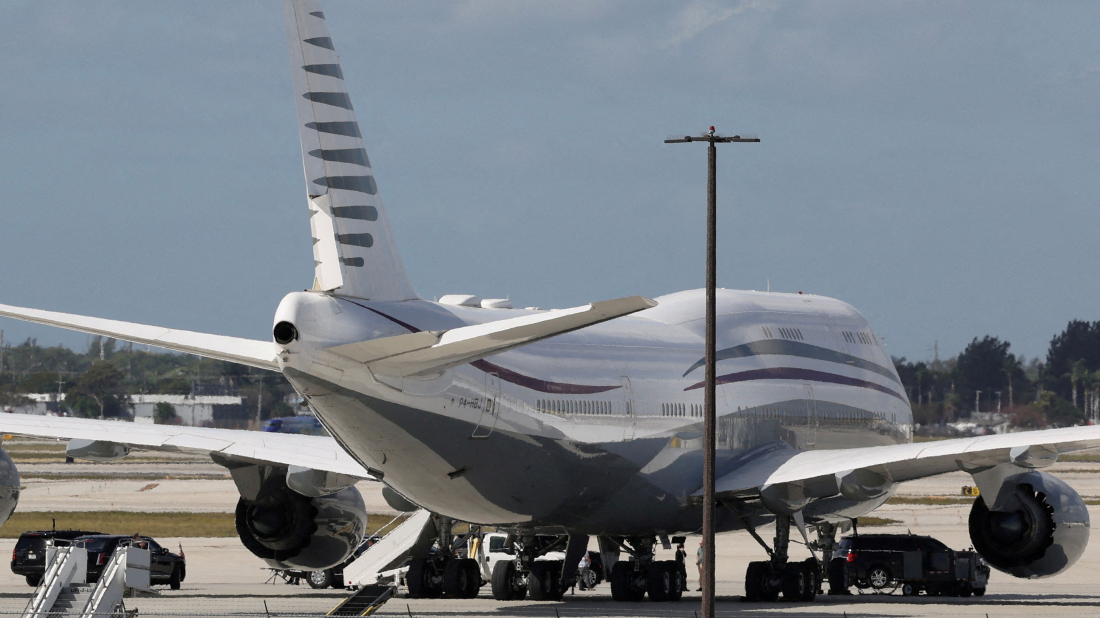
The Trump administration has formally accepted a Boeing 747 jet gifted by Qatar, instructing the Air Force to evaluate how quickly the plane can be upgraded for possible use as the next Air Force One.
The aircraft, valued at about $200 million, was confirmed by a Pentagon spokesperson.
The acceptance of the jet has triggered bipartisan criticism and raised suspicions about Qatar’s motives, especially coming after Trump’s recent visit to the country to negotiate US business deals.
Sean Parnell, chief Pentagon spokesperson, said in a statement:
"The secretary of defense has accepted a Boeing 747 from Qatar in accordance with all federal rules and regulations. The Department of Defense will work to ensure proper security measures and functional-mission requirements are considered for an aircraft used to transport the president of the United States."
The plane will require significant upgrades to meet presidential security standards, such as missile defense systems, secure communication capabilities, and protection against electromagnetic pulses. Pentagon officials confirmed the jet is not currently suitable for presidential use without these major modifications.
Concerns have surfaced in Congress about potential pressure on the Air Force to speed up the upgrade process, possibly compromising critical safety features. Lawmakers across party lines have also questioned Qatar’s intentions, suggesting the gift could be aimed at gaining influence or might even include hidden surveillance devices.
Democratic Senator Chris Murphy criticized the gift, tying it to Trump’s recent trip to the Middle East. He said:
"Why did he choose these three countries for his first major foreign trip? It’s not because these are our most important allies or countries. It’s because these are the three countries willing to pay him off. Every one of these countries is giving Trump money — the plane from Qatar, investments in his cryptocurrency scheme from the UAE — and they want national security favors in return."
Murphy added:
"This is corruption. Foreign governments putting money in the president’s pocket, then the US gives them national security concessions that hurt our own security."
Qatar’s Prime Minister Sheikh Mohammed bin Abdulrahman Al Thani rejected any suggestion of political influence, saying the gift was made with full government approval and was simply a routine exchange between allies. At the Qatar Economic Forum, he said:
"I don’t know why people think this is bribery. It’s a mutually beneficial partnership between Qatar and the United States."
During his first presidency, Trump had criticized Qatar, labeling it a major funder of terrorism in 2017 and supporting a blockade against the country led by Saudi Arabia and the UAE. Yet on his recent visit, he said he was “treated like royalty” by Qatar’s leadership and has defended accepting the jet.













What is your opinion on this topic?
Leave the first comment