India has fired a series of missiles into Pakistani-controlled territory, in what it has described as “Operation Sindoor”
India’s armed forces have confirmed a cross-border missile operation into Pakistan-administered territory early Wednesday, naming the campaign “Sindoor”—a symbolic reference to the vermillion worn by married Hindu women, echoing the grief of women whose husbands were killed in a recent attack in Indian-controlled Kashmir.
According to the Indian military, the strikes targeted “terrorist infrastructure” in response to last month’s deadly assault in Indian-administered Kashmir that left 26 Indian tourists dead. New Delhi has blamed Pakistan-based militants for the attack, although no public evidence has been presented to support the allegation.
Indian officials stressed that “no Pakistani military facilities were targeted” and said the operation was conducted with “credible intelligence” and “surgical precision.” However, Pakistan strongly refuted India’s version of events.
Islamabad said the missiles struck at least three locations, including in Pakistan-administered Kashmir and the eastern Punjab province, causing widespread damage and civilian casualties. A missile hit a mosque in Bahawalpur, killing 19 people—including women and children—and injuring several others. Another strike reportedly damaged a mosque in Muridke near Lahore, next to a former Lashkar-e-Taiba site.
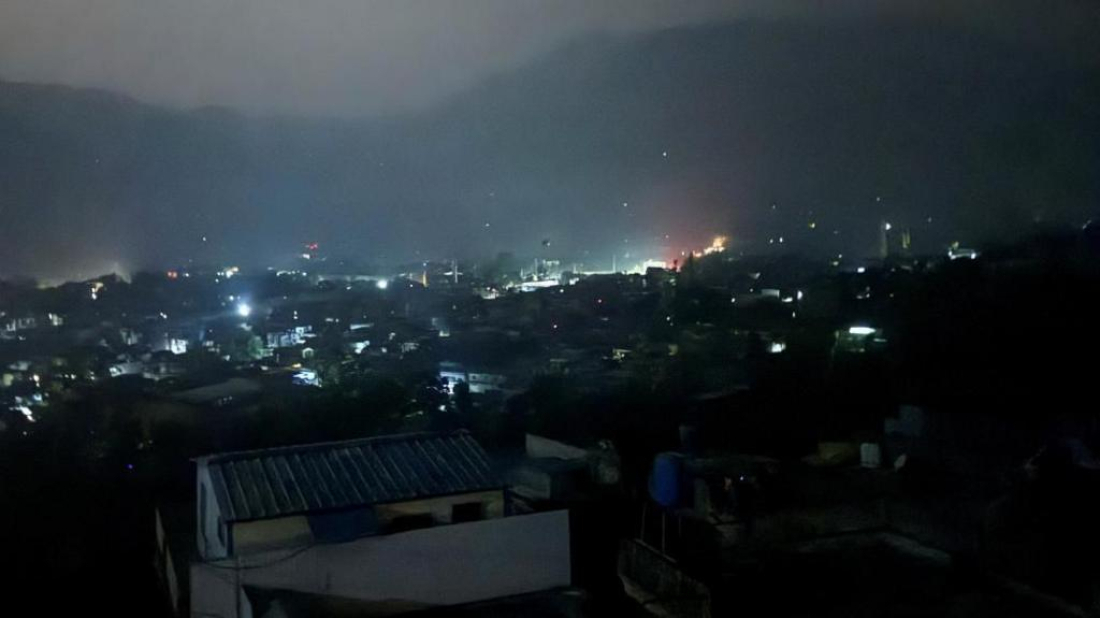
Pakistan’s Prime Minister Muhammad Shehbaz Sharif denounced the Indian action as an “act of war” and warned that Pakistan “reserves the right to respond with full strength.” Emergency sirens were activated across border towns, and electricity was cut in Muzaffarabad following loud explosions. Pakistan has closed its airspace for 48 hours and placed its armed forces on high alert.
In retaliation, Pakistan’s air force reportedly downed two Indian jets, though India has not confirmed these losses. Meanwhile, the Indian army reported that three civilians were killed in Pakistani shelling into Indian-controlled Kashmir. Schools have been shut across several regions, and the main airport in Srinagar has suspended civilian flights under air force directives.
Tragically, chaos has also unfolded within Indian territory. An unidentified aircraft crashed into a school building on the outskirts of Srinagar, igniting a massive fire. Hours later, villagers near Akhnoor reported another aircraft crash, with two injured pilots recovered by Indian forces.
Pakistan’s military spokesman, Lieutenant General Ahmad Sharif, accused India of “targeting innocent civilians under the cover of darkness.” Pakistan’s foreign ministry has formally notified the UN Security Council, asserting that India’s actions threaten international peace and that Islamabad “reserves the right to respond appropriately at a time and place of its choosing.”
With both countries possessing nuclear arsenals, the latest escalation has drawn alarm from global observers, renewing concerns that the volatile Kashmir region could once again push the subcontinent to the brink of war.




















What is your opinion on this topic?
Leave the first comment