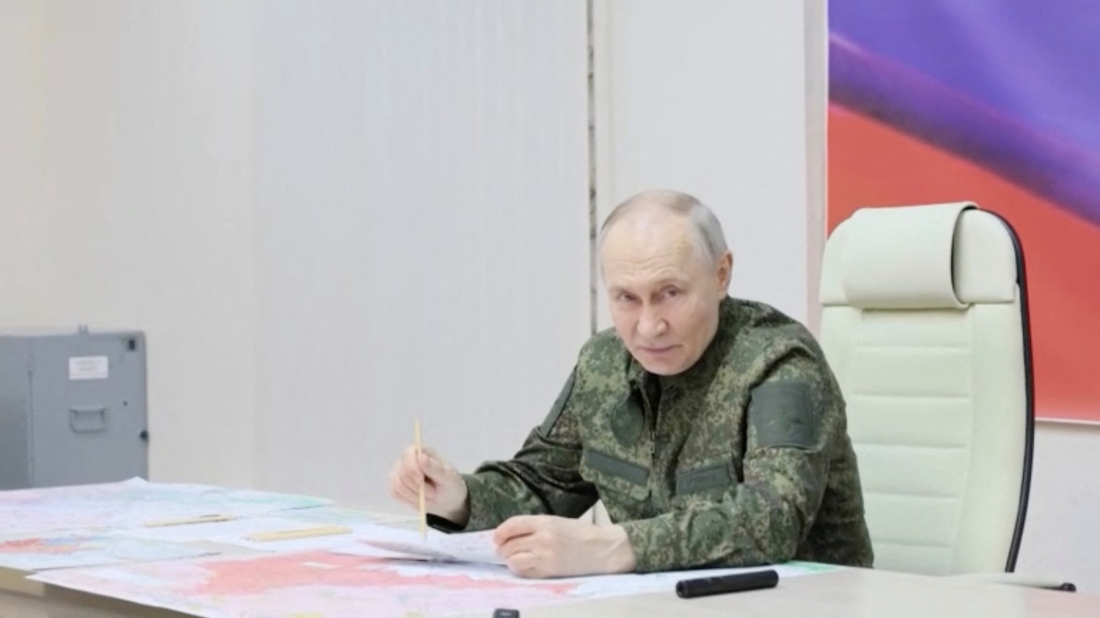
Russian President Vladimir Putin made a surprise visit to troops in the western Kursk region on Wednesday, donning military fatigues and ordering forces to press forward with their advance to fully reclaim the area from Ukrainian control.
The visit came after Washington presented Moscow with a U.S.-backed 30-day ceasefire proposal that Ukraine has already agreed to. Meanwhile, Russian troops pushed deeper into the region, forcing Ukrainian units to retreat and cede control of Sudzha, a strategic border town.
Putin said Moscow was considering establishing a new security buffer in Ukraine’s Sumy region to prevent future incursions by Ukrainian forces. He also declared that foreign fighters captured in Kursk would not be granted Geneva Convention protections and that Ukrainian prisoners would be treated as "terrorists."
'Decisive defeat' ordered
"Our task in the near future, in the shortest possible timeframe, is to decisively defeat the enemy entrenched in the Kursk region and still fighting here," Putin said during his visit. "We must fully liberate the territory and restore security along the state border."
Russia's top military officer, General Valery Gerasimov, reported that 86% of the territory Ukraine seized in Kursk last year had been reclaimed, amounting to around 1,100 square kilometers. He added that Russian forces had retaken 24 settlements in the past five days, capturing over 400 Ukrainian troops in the process.
Ukrainian forces, which had crossed into Kursk in August last year in a surprise offensive, now face an increasingly untenable position, with major supply lines severed. Deep State, a Ukrainian military tracking site, confirmed that Russian troops had entered Sudzha but noted that fighting continued on the outskirts.
Ukraine signals withdrawal
Ukraine's top military commander stated that troops would remain in Kursk "as long as necessary," but some military bloggers suggested that a full withdrawal was imminent. "There will be no Ukrainian soldier there by Friday," wrote the pro-Ukrainian Skadovskyi Defender channel.
Despite Russian gains, Ukraine has continued to strike back, launching drone and artillery attacks on Russian positions in Sudzha. Meanwhile, Kyiv has remained silent on whether it will accept the proposed ceasefire terms being offered to Moscow.
The Kremlin has yet to formally respond to the U.S. proposal, but senior Russian officials indicated any agreement would need to reflect Moscow’s battlefield gains and security demands.
The fighting in Kursk underscores the shifting momentum in the war and the challenges facing any potential peace deal. With both sides doubling down on their military strategies, the conflict remains poised at a critical juncture.











What is your opinion on this topic?
Leave the first comment