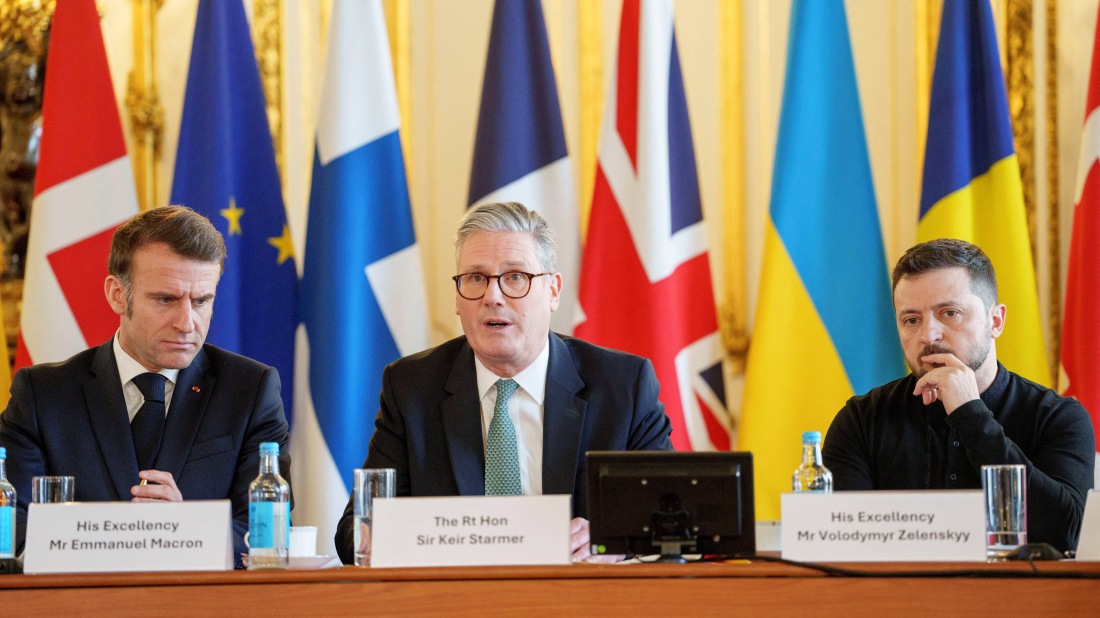
France and Britain are proposing a partial one-month truce between Russia and Ukraine that would cover air, sea and energy infrastructure attacks but not include ground fighting, French President Emmanuel Macron and his foreign minister said.
The comments came amid a flurry of European diplomacy designed to shore up Western support for Ukraine following a meeting between President Volodymyr Zelenskiy and U.S. President Donald Trump in the Oval Office on Friday.
"Such a truce on air, sea and energy infrastructure would allow us to determine whether Russian President Vladimir Putin is acting in good faith when he commits to a truce. And that's when real peace negotiations could start," French Foreign Minister Jean-Noel Barrot said on Monday.
Under the Anglo-French proposal, European ground troops would only be deployed to Ukraine in a second phase, Macron said in an interview published in Le Figaro late on Sunday.
"There will be no European troops on Ukrainian soil in the coming weeks," Le Figaro quoted Macron as saying as he flew to London for a meeting of European leaders, convened by British Prime Minister Keir Starmer to advance efforts at drawing up a Ukraine peace plan.
"The question is how we use this time to try to obtain a truce, with negotiations that will take several weeks and then, once peace is signed, a (troop) deployment," Macron said.
The French president did not elaborate on how air, sea and energy infrastructure could be monitored.
"In my eyes that can only be possible with NATO or at least NATO command and then Patriot systems, long-range missiles and aviation, which Ukraine does not have," said a European diplomat. "And you have to negotiate with Russia so that it doesn't carry out the massive attacks."
The Kremlin, which has rejected the idea of Western troops being deployed to Ukraine, said on Monday the Oval Office clash between Trump and Zelenskyy showed how difficult it would be to reach a settlement on the conflict in Ukraine.
'DIFFERENT OPTIONS'
Zelenskyy, asked if he was aware of the plan mentioned by Macron, told reporters in London: "I'm aware of everything."
On Monday, however, UK armed forces minister Luke Pollard declined to confirm the ideas aired by Macron and Barrot, saying: "That's not a plan that we currently recognise."
"Certainly there are a number of different options being discussed privately between the UK, France and our allies at the moment. It's probably not right for me at the moment to comment on each individual option as they occur," Pollard told the BBC.
Starmer said on Sunday that European leaders had agreed to draw up a Ukraine peace plan to present to the United States, without going into details.
Meanwhile, the parties in talks to form Germany's new government are considering quickly setting up two special funds potentially worth hundreds of billions of euros, one for defence and a second for infrastructure, three people with knowledge of the matter told Reuters.
Economists advising the parties that will likely form a new government coalition estimate around 400 billion euros ($415 billion) are needed for the defence fund, the people said.
Friday's heated White House exchange between Zelenskyy and Trump has increased a sense of urgency in Berlin to act faster on spending for Germany's own defence and for Ukraine, they said.
European Union leaders will meet for an extraordinary summit on March 6 to discuss additional support for Ukraine, European security guarantees and how to pay for European defence needs.











What is your opinion on this topic?
Leave the first comment