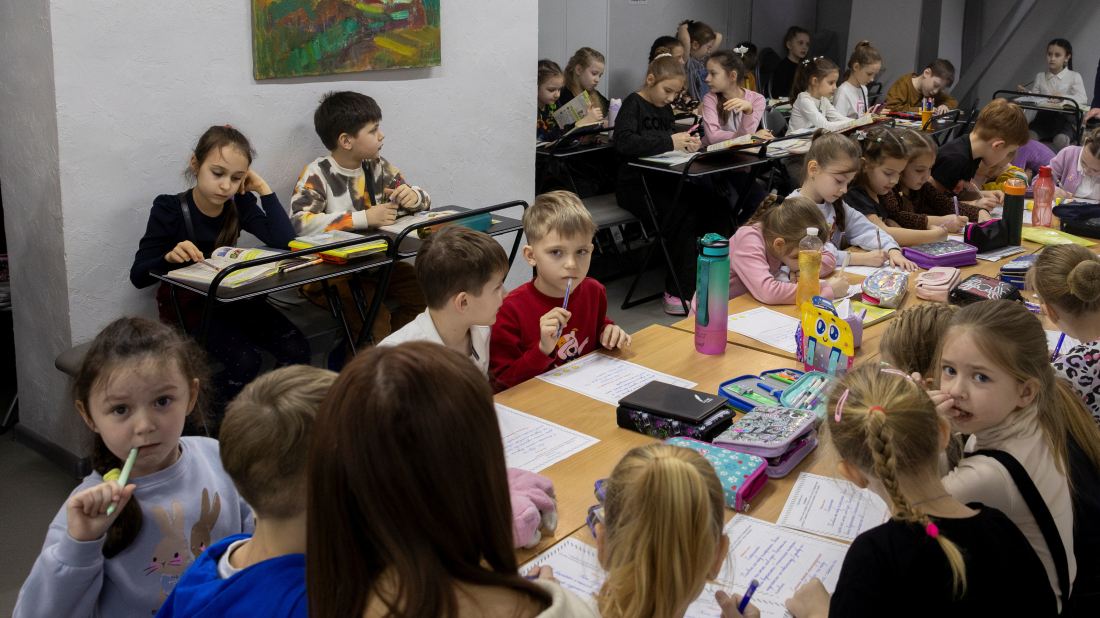
At school in Kyiv, it has become common to hear air raid sirens instead of the ringing of the school bell. Dozens of eight-year-olds descend into the basement, clutching pencils and books, determined to continue their lessons despite the threat above.
"It's the war that has made them mature," said Liudmyla Yaroslavtseva, head teacher at Kyiv's Art Lyceum "Zmina." She recalls how children used to panic when the sirens first began three years ago. Now, they sit quietly, focusing on their studies as if this underground classroom is the new normal. "We try to protect them, but we can't fully shield them from everything."
In Kharkiv, classrooms have been set up in metro stations for safety. Children paint, study, and try to maintain a sense of normalcy in these makeshift shelters. “It’s not normal,” one teacher remarks, “but we have to keep going.”
Art as a Window into Emotions
Art teacher Valentyna Maruniak has observed a transformation in her pupils’ drawings since 2022. "They used to paint mainly tanks, planes, bombings. Now, they draw rainbows, flowers, and the sun. They want victory, joy, spring, and calm."
When asked to depict the most memorable moments of the war, some children drew tanks and soldiers. Others painted memories of trips, peaceful times, or places they’ve lost. Eight-year-old Solomiia Karanda painted the landscape of a village where her grandmother once lived. “A missile struck a home close to my grandma’s, but now it is getting rebuilt,” she said.
When asked to depict the most memorable moments of the war, some children drew tanks and soldiers. Others painted memories of trips, peaceful times, or places they’ve lost. Eight-year-old Solomiia Karanda painted the landscape of a village where her grandmother once lived. “A missile struck a home close to my grandma’s, but now it is getting rebuilt,” she said.
Seeking Shelter in a Time of Fear
Many children have developed routines to cope with the fear of missile attacks. Karanda describes curling up in bed with her toys to feel less scared. Her classmate, Nikita Bondarenko, has learned to hide behind thick walls with his younger sister, covering her with blankets for protection. "I tell her, 'Masha, missiles and bombs are flying.'"
The Price of Resilience
The war has taken a significant toll on mental health. According to Ukraine’s Ministry of Education and Science, over 50,000 children sought professional help with mental health issues in the first nine months of 2024—three times more than in 2023.
A survey conducted by Plan International found that nearly one in five Ukrainian youths have missed between one and two years of education due to the war. More than 3 million children have been displaced, and around 4.6 million face barriers to learning. Nearly a third of the country’s educational facilities have been damaged, with over 365 schools completely destroyed.
Hopes for Peace
Despite the challenges, hope remains. “If you had a magic wand, what would you ask for?” Yaroslavtseva asked her students. “For peace to come quickly,” 90% of the children answered.
They no longer dream of toys or trivial wishes. Instead, they dream of a future where the ringing of the school bell will be louder than the sirens, and the fear of war will be replaced with the sounds of peace and childhood.













What is your opinion on this topic?
Leave the first comment