Poland's long-running conflict over judicial independence and control of the Constitutional Tribunal intensified on Friday after the head of the country's top court was suspended, prompting President Karol Nawrocki to cut short an overseas trip and return to Warsaw amid mounting political tensions.
The latest confrontation centres on the Constitutional Tribunal, an institution that has been at the heart of a decade-long struggle between Poland's pro-European government and the conservative political forces that previously controlled the country.
The crisis escalated when the tribunal announced that its longest-serving judge, Anna Korwin-Piotrowska, had suspended tribunal president Bogdan Święczkowski and assumed temporary leadership of the court. Święczkowski, a former deputy justice minister, is widely seen as an ally of the nationalist Law and Justice Party (PiS).
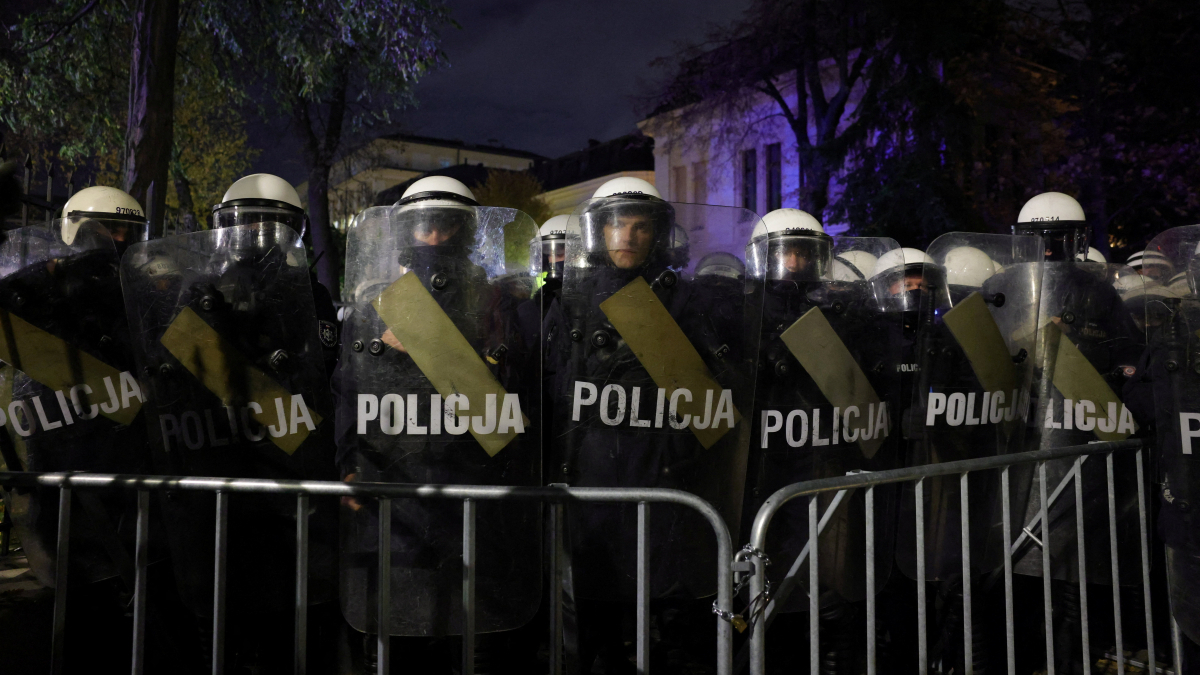
The dispute triggered immediate political fallout. Hundreds of demonstrators gathered outside the tribunal building in Warsaw while riot police were deployed to secure the area and prevent protesters from entering the court premises.
President returns to Warsaw
President Nawrocki, who is backed by PiS, abandoned a planned visit to Senegal and ordered his aircraft to return to Poland.
“At a moment like this, the president must be in Poland. I am cutting short my flight to Senegal. I am returning,” Nawrocki wrote on social media.
The move highlighted the growing seriousness of the dispute, which has become one of the most significant constitutional confrontations since Prime Minister Donald Tusk's coalition returned to power in 2023.
Government seeks prosecutions
Earlier on Friday, Justice Minister Waldemar Żurek said he had requested the removal of legal immunity protections for both Święczkowski and tribunal vice-president Bartłomiej Sochański in order to pursue criminal charges against them.
The government has not publicly outlined the full details of the proposed charges, but the move forms part of its wider effort to reverse changes made to Poland's judicial system under PiS governments.
Tusk defended the government's approach, arguing that decisive measures were necessary to restore judicial independence after years of controversy.
“Restoring the rule of law is our duty. After years of Law and Justice's lawlessness, this is a difficult, sometimes painful process that requires decisive action. There is no other way,” he wrote on X.
Court accuses government of “coup”
The tribunal responded forcefully.
In a statement posted on social media, the court insisted that Święczkowski and Sochański remained the lawful leaders of the institution and accused the government of unlawfully interfering in its operations.
“All persons participating in these actions are committing the crime of a coup d'etat,” the Constitutional Tribunal said.
The allegation was repeated by opposition politicians who addressed supporters gathered outside the court on Friday evening.
Roots of the dispute
The current standoff traces its origins to 2015, when PiS came to power and moved to appoint judges to positions that critics said had already been lawfully filled by the previous parliament.
The party eventually secured a majority on the Constitutional Tribunal, transforming the institution into one of the central battlegrounds in Poland's broader debate over democratic standards and judicial independence.
Subsequently, both the European Court of Human Rights and the Court of Justice of the European Union ruled that some judges had been improperly appointed and concluded that the tribunal could no longer be regarded as an independent and impartial court.
Those rulings became a cornerstone of Tusk's argument that judicial reform was necessary after his coalition returned to office.
The government has since refused to publish some tribunal rulings, citing the findings of European courts.
Reform efforts repeatedly blocked
Despite pledging to restore judicial independence, Tusk's government has struggled to reverse many of the changes introduced during the PiS era.
One reason has been the role of the presidency. Both Nawrocki and his predecessor, Andrzej Duda, used presidential powers to block or delay key reforms.
Earlier this year, Nawrocki refused to swear in several judges elected by parliament, arguing that their selection process contained legal flaws.
Meanwhile, Święczkowski declined to seat judges chosen by the current parliamentary majority.
Last month, parliament appointed Maciej Berek, a political ally of Tusk, to the tribunal. Critics argued that the move contradicted the government's stated goal of depoliticising the judiciary.
The dispute has even generated criticism from some legal experts who strongly opposed the earlier PiS reforms.
Law professor Marcin Matczak, a vocal critic of PiS-era judicial changes, argued that the latest suspension lacked a legal basis.
“Today's action at the Constitutional Court, in my opinion, buries this body and the issue of the rule of law for two decades,” Matczak wrote on social media.
He warned that images of armed police surrounding the country's highest constitutional court could damage Poland's legal institutions for years.
Political stakes rising
The confrontation comes with parliamentary elections due next year and adds fresh pressure on Tusk's government, which faces criticism both from supporters who want faster reforms and opponents who accuse it of politicising state institutions.
For now, Poland's Constitutional Tribunal remains at the centre of a political and constitutional struggle that shows little sign of resolution, with both sides claiming they are defending democracy and the rule of law.
Read more:













What is your opinion on this topic?
Leave the first comment