The AnewZ Opinion section provides a platform for independent voices to share expert perspectives on global and regional issues. The views expressed are solely those of the authors and do not represent the official position of AnewZ
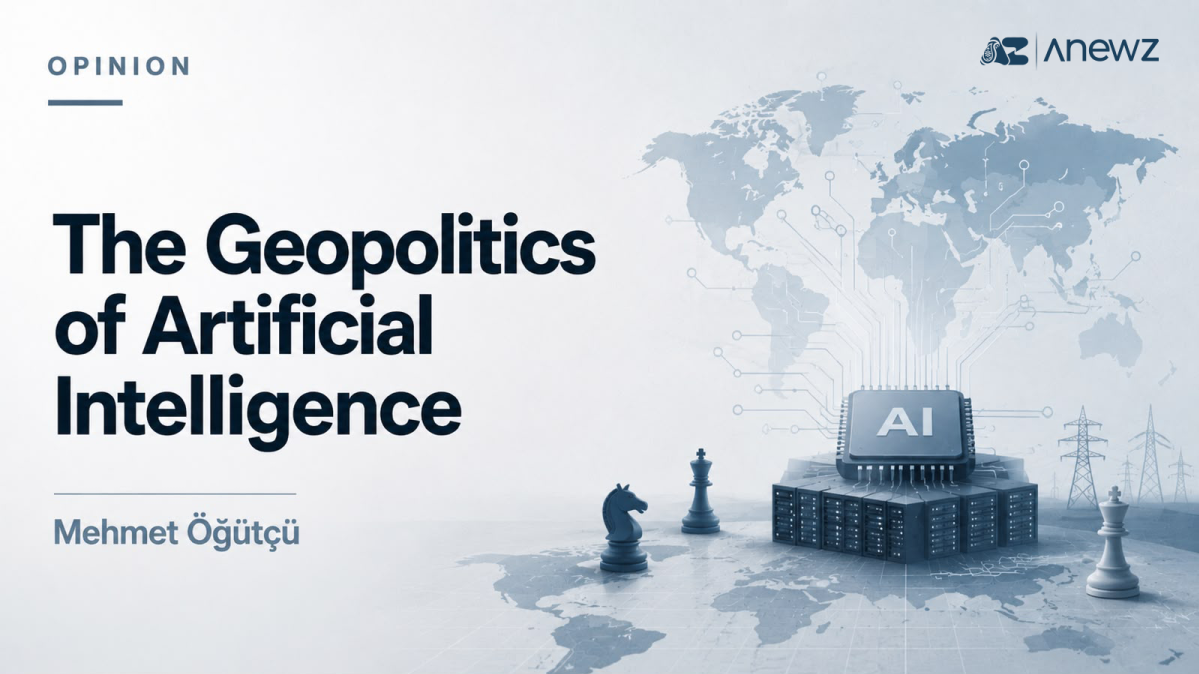
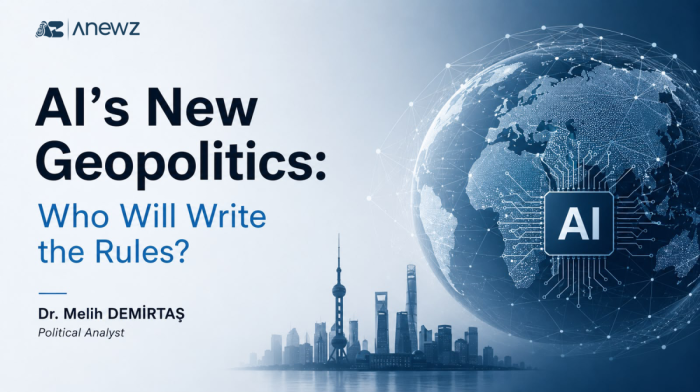
Artificial intelligence is transforming the foundations of global power. Strategic competition is no longer defined solely by territory, military strength or natural resources, but increasingly by computing power, semiconductors, energy and digital infrastructure.
For centuries, the language of geopolitics was remarkably stable.
Power was measured by territory, oceans, strategic straits, natural resources, military alliances and trade routes.
Britain dominated the seas.
Russia projected power across the Eurasian landmass.
The U.S. built an unparalleled network of global alliances and military bases.
The Middle East shaped international politics through oil.
The Strait of Hormuz, the Suez Canal and the Strait of Malacca became symbols of strategic leverage.
Today, however, the geography of power is being rewritten.
The new strategic battleground is no longer visible on conventional maps.
It lies inside data centres, semiconductor fabrication plants, cloud infrastructure and artificial intelligence models.
The twenty-first century is witnessing the emergence of a new geopolitics, one in which algorithms matter alongside aircraft carriers, and computing power is becoming as strategic as energy reserves.
Artificial intelligence is no longer simply a technological revolution.
It is becoming a geopolitical one.
Beyond 'data is the new oil'
For years, we have repeated the phrase that 'data is the new oil'.
It is an appealing metaphor.
But it is no longer sufficient.
Oil becomes valuable only after it is refined. Likewise, data creates value only when it can be processed.
The strategic resource today is therefore not merely data, but the capacity to compute.
Training and operating advanced AI systems requires powerful semiconductors, sophisticated software, high-speed networks, vast data centres and, above all, reliable electricity.
The countries that lead in AI will therefore possess not only strong scientific talent, but also resilient energy systems, advanced digital infrastructure and secure semiconductor supply chains.
In this new era, computing capacity has become a strategic asset.
Chips become strategic chokepoints
Semiconductors have become one of the twenty-first century's most important strategic chokepoints.
Without advanced chips, there is no advanced artificial intelligence at scale.
This is why Washington's export controls on high-end computing chips and semiconductor manufacturing equipment are not merely commercial measures. They are instruments of national security and geopolitical competition.
It is also why Beijing is mobilising vast state-backed capital to strengthen its domestic semiconductor ecosystem and reduce its dependence on foreign technology.
Technology policy has become foreign policy.
Industrial policy has become national security policy.
The dividing lines are disappearing.
Energy and artificial intelligence are becoming one strategic system
One of the least appreciated aspects of the AI revolution is its dependence on energy.
Large-scale AI infrastructure consumes extraordinary amounts of electricity. Hyperscale AI data centres can require more than 100 megawatts of power, comparable to the annual electricity consumption of tens of thousands of households.
The implications are profound.
Countries unable to guarantee abundant, affordable and reliable electricity will struggle to compete at the frontier of AI.
This helps explain renewed interest in nuclear power, small modular reactors, natural gas, grid modernisation and renewable energy, not only as climate or energy policies, but as the foundations of digital competitiveness.
Energy security and AI security are rapidly becoming inseparable.
Azerbaijan: from energy corridor to digital corridor
This transformation also creates opportunities for countries traditionally associated with energy.
Azerbaijan offers an instructive example.
For decades, Baku has been viewed primarily as an oil and natural gas exporter and as a strategic energy corridor connecting the Caspian Basin with Europe.
Today, its ambitions are becoming broader.
Together with Kazakhstan, Georgia and other regional partners, Azerbaijan is advancing the Middle Corridor, green electricity links to Europe, a fibre-optic connection beneath the Caspian, and wider digital infrastructure linking Central Asia with the South Caucasus and European markets.
These projects do not automatically make Azerbaijan an AI power. However, they can provide the physical foundations - electricity, connectivity, logistics and regional access - on which a stronger digital economy can be built.
The strategic objective should be clear: to evolve from being primarily an energy bridge into a corridor for electricity, data and, eventually, artificial intelligence services.
That would represent a significant shift.
In tomorrow's geopolitical landscape, countries that move electrons and data may become as influential as those that once moved oil and gas.
For Türkiye, this also creates an important opportunity.
Working alongside Azerbaijan, the two countries could position themselves as a major digital and energy gateway between Europe, the Caucasus, Central Asia and the Middle East.
Their established energy partnership could evolve into a broader strategic platform encompassing data centres, cyber security, high-capacity fibre networks, clean electricity and applied AI.
But geography alone will not deliver that outcome. It will require investment, regulatory credibility, skilled labour and long-term coordination.
Three broad models
The contest over AI is not only technological.
It is also political and institutional.
The U.S. has built an ecosystem led by private companies, venture capital and world-class research institutions, increasingly reinforced by industrial policy and export controls.
China combines state direction, industrial policy, a vast domestic market and powerful technology companies.
Europe is attempting a third path, combining regulation, fundamental rights and safety standards with public investment in computing capacity, research and adoption.
These are broad models rather than rigid categories. Each is evolving, and each contains internal contradictions.
The competition nevertheless extends beyond technology itself.
It concerns whose standards, governance systems and strategic dependencies will shape the global AI ecosystem.
Where does Türkiye stand?
Türkiye has yet to join the front ranks of AI powers.
But neither is it condemned to remain a spectator.
Its strategic geography, growing defence industry, engineering talent, expanding digital economy and central role in regional energy corridors provide significant advantages.
Türkiye has also expanded its high-performance computing capacity in recent years. Yet the gap with the leading AI powers remains substantial.
It does not yet possess a leading-edge semiconductor manufacturing ecosystem, sufficient domestic computing capacity for frontier-scale AI, or a globally competitive cluster of foundational model companies.
Perhaps most importantly, energy policy, industrial strategy, digital transformation, education and national security are still too often designed in separate silos.
That separation is becoming increasingly costly.
In the AI age, energy, telecommunications, cyber security, industrial policy, research and education must be treated as components of a single national competitiveness strategy.
The new great game
The twentieth century was shaped by the geopolitics of oil.
The next quarter-century will increasingly be shaped by the geopolitics of intelligence.
- Semiconductors.
- Electricity.
- Cloud infrastructure.
- Critical minerals.
- Quantum technologies.
- Cyber security.
- Data.
- Algorithms.
These are becoming the strategic resources and infrastructure of the twenty-first century.
The great powers of tomorrow will not necessarily be those with the largest armies or the biggest hydrocarbon reserves.
They will be those capable of developing, powering, securing and governing artificial intelligence, and of denying strategic rivals access to its most critical components.
The question facing every nation is therefore no longer simply whether it has an AI strategy.
It is whether artificial intelligence has become an integral part of its energy, industrial and national security strategies.
Because in the emerging geopolitical order, AI is no longer just another technology.
It is becoming an instrument of power itself.













What is your opinion on this topic?
Leave the first comment