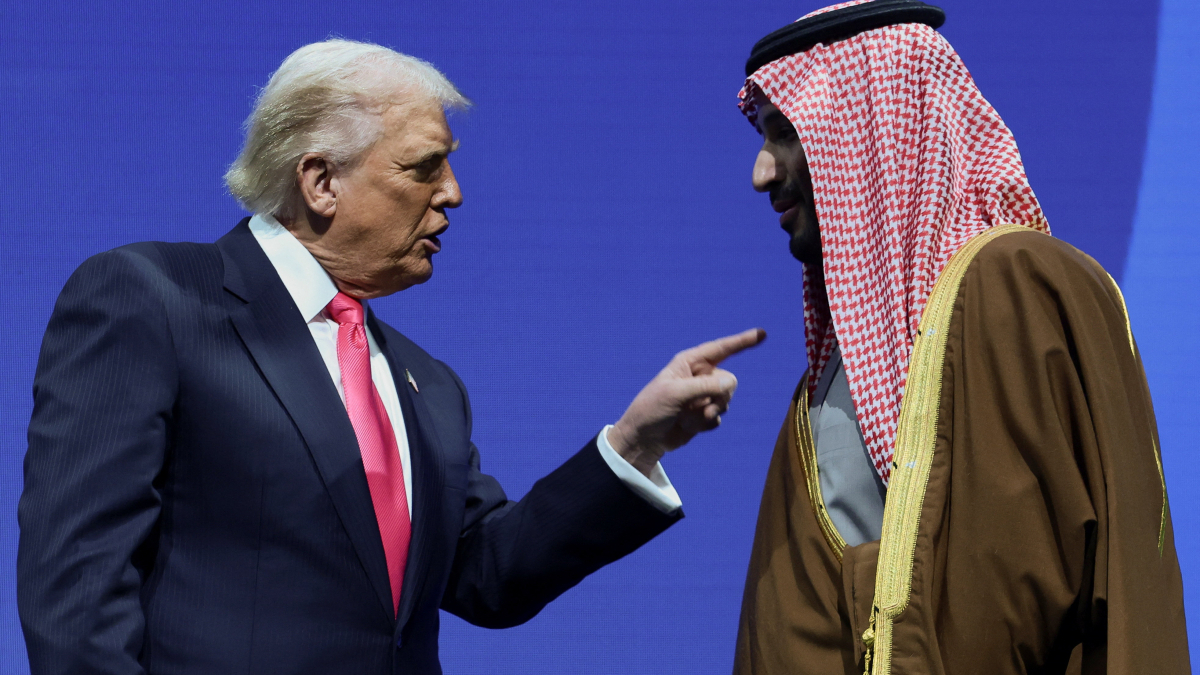
A deal signed by the U.S. and Saudi Arabia which would allow the Gulf kingdom to develop a civilian nuclear programme will only take effect if Riyadh normalises relations with Israel, President Donald Trump has said.
The U.S. leader conditioned the agreement’s implementation on Saudi Arabia joining the Abraham Accords under which several Arab states, such as Bahrain and the United Arab Emirates (UAE), established ties with Israel.
Riyadh has long rejected joining the accords without a clear pathway emerging for Palestinian statehood.
Speaking on Thursday, White House Press Secretary Karoline Leavitt said Trump had spoken with Gulf and Arab allies many times about pegging the Saudi nuclear deal to the Abraham Accords and that if the kingdom does not join them "the deal is off."
In a post on Truth Social on Thursday, Trump wrote: "The Civil Nuclear Deal (There will be no enrichment of material!)... pertains only to non-military use such as the ones that Iran and UAE (and others) already have, will be approved, but is totally subject to Saudi Arabia joining the very respected and successful Abraham Accords."
The Saudi Embassy in Washington did not respond to a request for comment on Trump's post.
The U.S. and Saudi Arabia announced the agreement on Wednesday, allowing Riyadh to enrich uranium and build nuclear reactors using U.S. technology.
The deal, which would involve a decades-long, multi-billion dollar partnership between American firms and the Saudi nuclear energy programme, still must be reviewed by the U.S. congress before coming into force.
Years of negotiations
The two countries spent years discussing a deal that would provide Saudi Arabia with access to U.S. nuclear technology while creating opportunities for American companies to participate in the construction and operation of future Saudi nuclear facilities.
Nuclear cooperation has long been one of the most sensitive areas of the U.S.-Saudi relationship because of concerns over weapons proliferation and regional security.
According to sources familiar with the discussions, the proposed framework does not include the so-called "gold standard" restrictions that would explicitly bar Saudi Arabia from enriching uranium or reprocessing spent nuclear fuel. Both activities can have civilian uses but can also be part of processes associated with nuclear weapons development.
The reported absence of those provisions is expected to draw scrutiny from members of Congress and from regional partners concerned about the possibility of a wider nuclear competition in the Middle East.
Why Riyadh wants nuclear power
Saudi Arabia says nuclear energy is a key component of its long-term economic strategy.
Although the kingdom is one of the world's largest oil exporters, much of its electricity is generated using oil and natural gas. Saudi officials argue that nuclear power would allow more crude oil to be exported while helping meet energy demand and supporting efforts to reduce emissions.
Nuclear energy could also support industries such as water desalination and other energy-intensive sectors that are critical to the country's development plans.
At the same time, Saudi Arabia has previously stated that it would consider matching Iran if Tehran were ever to acquire a nuclear weapon, comments that have contributed to international concerns about the future direction of the region's nuclear programmes.
Strategic benefits for Washington
For the United States, the agreement offers both commercial and geopolitical advantages.
A formal cooperation framework could position American companies to compete for lucrative contracts linked to Saudi Arabia's planned nuclear infrastructure. It also provides Washington with greater visibility into the development of the kingdom's civilian nuclear programme.
The agreement comes amid growing international competition for Saudi Arabia's nuclear business. China, Russia, France and South Korea have all been viewed as potential partners for the kingdom's atomic energy ambitions.
The proposed arrangement is still expected to face congressional review under U.S. law, where lawmakers are likely to focus on safeguards, uranium enrichment provisions and broader non-proliferation commitments.
Questions also remain about whether future cooperation could eventually extend to more sensitive areas of the nuclear fuel cycle, including uranium enrichment, an issue that has remained at the center of discussions between Washington and Riyadh.
















What is your opinion on this topic?
Leave the first comment