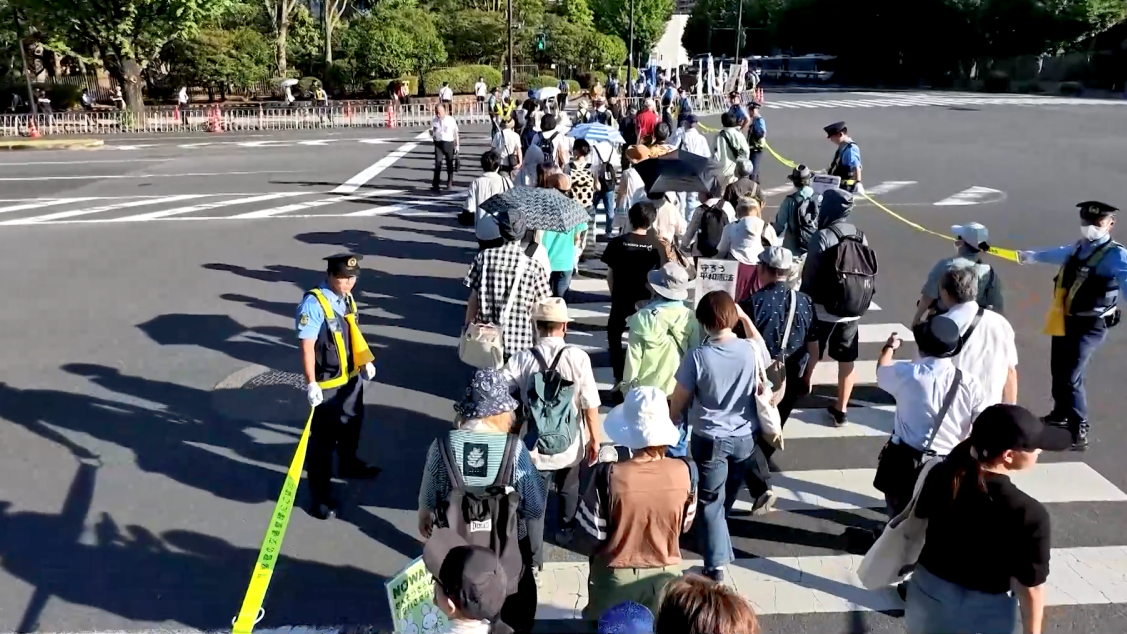
Nearly 25,000 people gathered outside Japan's National Diet building in Tokyo on Sunday to protest the government's defence policies and proposed changes to the country's pacifist constitution, as Prime Minister Sanae Takaichi's approval rating fell to its lowest level since taking office.
Participants carried anti-war placards and called on the government to abandon plans to revise Article 9 of the constitution, ease restrictions on arms exports and reconsider Japan's long-standing non-nuclear principles.
Takaichi, Japan's first female prime minister, has made strengthening national security and expanding the country's defence capabilities central to her political agenda.
Protesters oppose revision of Article 9
Article 9 of Japan's post-war constitution renounces war as a sovereign right and rejects the threat or use of force as a means of settling international disputes.
One rally participant said revising the constitution could allow Japan to initiate or participate more directly in military conflicts.
The protester also accused the government of prioritising defence expansion over the financial pressures faced by ordinary households.
Another participant said the government's measures to curb rising consumer prices had not significantly improved living conditions and called for Article 9 to remain unchanged.
Demonstrators held signs reading "No war" and "Takaichi must resign" as they marched near the parliament building.
Similar demonstrations have taken place in Tokyo in recent months, with protesters opposing increased defence spending, expanded arms exports and constitutional revision.
Concerns over arms exports and nuclear policy
Rally participants also criticised moves to ease Japan's arms export restrictions and warned against changes to the country's Three Non-Nuclear Principles.
The principles commit Japan to not possessing or producing nuclear weapons and not permitting them to be introduced into Japanese territory.
One participant said Japan had moved towards military expansion at an "unbelievable speed" during the previous six months and called for public action to prevent further policy changes.
The CCTV+ report did not include a response from the Japanese government to the protesters' claims.
Cabinet disapproval overtakes support
The demonstration coincided with a decline in public support for Takaichi's administration.
A nationwide survey reported by Japan's Mainichi Shimbun on Sunday put the cabinet's approval rating at 41%, down 10 percentage points from the previous month.
The result marked the administration's lowest approval rating since Takaichi took office.
The poll put the cabinet's disapproval rating at 44%, marking the first time opposition to the government had exceeded support for it.
Other polls conducted in July have also indicated weakening support, although the results vary between polling organisations. A Jiji Press survey published earlier this month put cabinet approval at 49%, down 5.3 percentage points from the previous month.
Read more:

















What is your opinion on this topic?
Leave the first comment