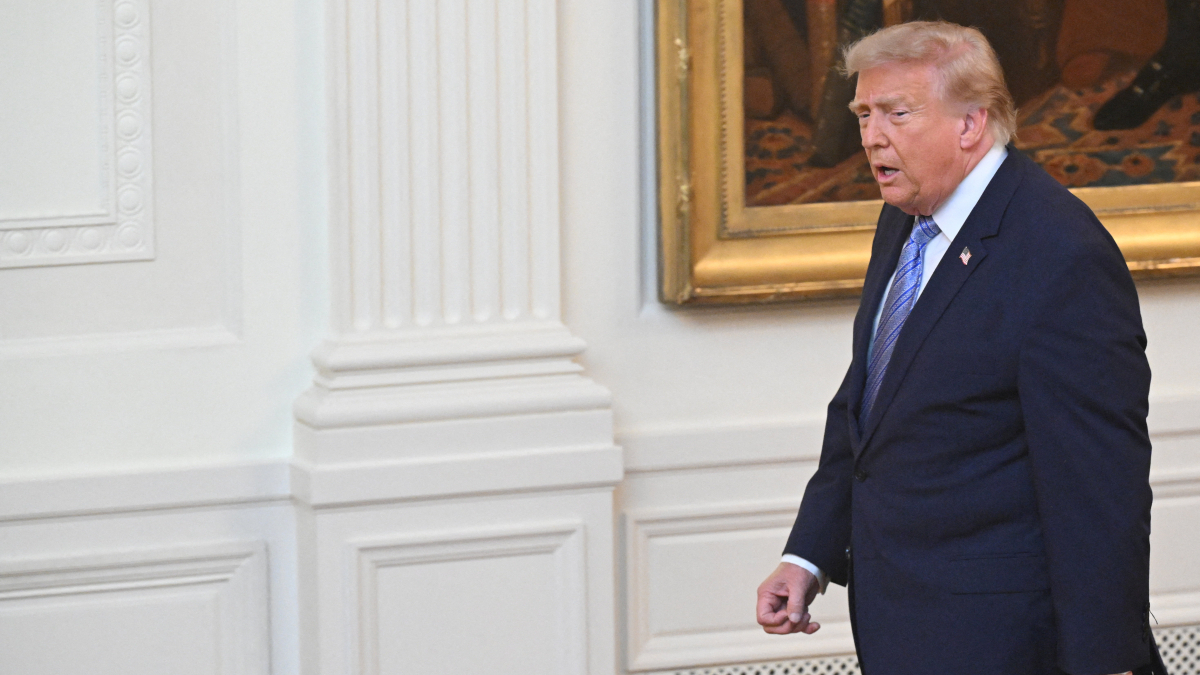
In a prime-time speech on Thursday, President Donald Trump renewed his claims on the integrity of the 2020 elections, alleging fraud and foreign interference while exposing weaknesses in the country's election system. Here are five takeaways from his speech.
“America is back and doing really well, but we still have a major challenge that must be urgently addressed, because no country can be great without fair and honest elections,” Trump said as he began his speech.
U.S. President Donald Trump declassified a tranche of intelligence documents that he said exposed election fraud and foreign interference.
1. Renewed claims over Chinese inteference
Trump accused China of carrying out "the largest compromise of election data in history" by attempting to influence the 2018 midterm elections to undermine Republican candidates and damage his 2020 re-election bid.
“Starting during the 2020 election cycle, the People’s Republic of China carried out what is believed to be the largest compromise of election data in history,” Trump said.
However, a 2021 U.S. intelligence assessment reached a different conclusion, finding that although China had considered conducting influence operations ahead of the 2020 election, it ultimately decided against them.
The assessment also found that Beijing had collected publicly available information on U.S. voters, political parties and public opinion dating back to at least 2008, but concluded the data was not confidential and was not used to alter election results.
In response to his speech, the Chinese Embassy in Washington told Reuters that Beijing "has never and will never interfere in the presidential elections".
2. Claims over voting machine vulnerabilities
Trump cited newly declassified CIA intelligence on Venezuela to argue that electronic voting systems can be manipulated.
"They're vulnerable and they're easily compromised, and people within our government knew that," the president said.
He pointed to intelligence suggesting the government of former Venezuelan president Nicolás Maduro had the capability to to digitally alter vote totals.
He said the findings highlighted vulnerabilities in electronic voting technology.
However, there is no evidence that similar interference has occurred in U.S. elections, and Trump did not claim the alleged Venezuelan techniques had been used in any American vote.
A separate theory promoted by some of his supporters that Venezuela hacked U.S. voting machines during the 2020 election has been widely debunked.
3. Claims of widespread non-citizen voter registrations
Trump claimed his administration had identified more than 275,000 non-citizens registered to vote across four states, although he did not say how many had actually cast ballots.
Studies have found instances of non-citizens voting are extremely rare, while previous citizenship verification systems have incorrectly identified some naturalised U.S. citizens as non-citizens.
4. Democrats reject election fraud allegations
Leading Democrats accused Trump of attempting to undermine confidence in the electoral system ahead of November's midterm elections.
Senate Democratic leader Chuck Schumer said voters, not politicians, should decide elections and pledged to oppose any efforts that could restrict Americans' ability to cast their ballots.
While Democratic Senator Mark Warner of Virginia called Trump’s claims “totally bogus.”
“The fact is our intelligence agencies unanimously agreed that China did not even try to change a single vote in the 2020 election,” Warner said in a statement on X.
“A single concurring opinion suggested China may have tried to sway voters’ opinions … but that’s been public knowledge since 2021.”
5. U.S. broadcasters split over airing Trump speech
Major U.S. television networks took different approaches to Donald Trump's White House address, with several declining to broadcast it live because it centred on disputed claims about the 2020 election.
CNN, ABC and NBC chose not to carry the speech in full, while CBS, Fox News and MSNBC aired all or part of the address.
Instead of broadcasting the speech, CNN hosted a panel discussion and displayed an on-screen banner describing it as an address delivered "after years of false claims".
NBC continued with its scheduled programming rather than interrupting for a special report.
Trump's communications director, Steven Cheung, criticised NBC and ABC for not airing the speech live, accusing the networks of trying to prevent viewers from hearing "the truth".
Read more:


















What is your opinion on this topic?
Leave the first comment