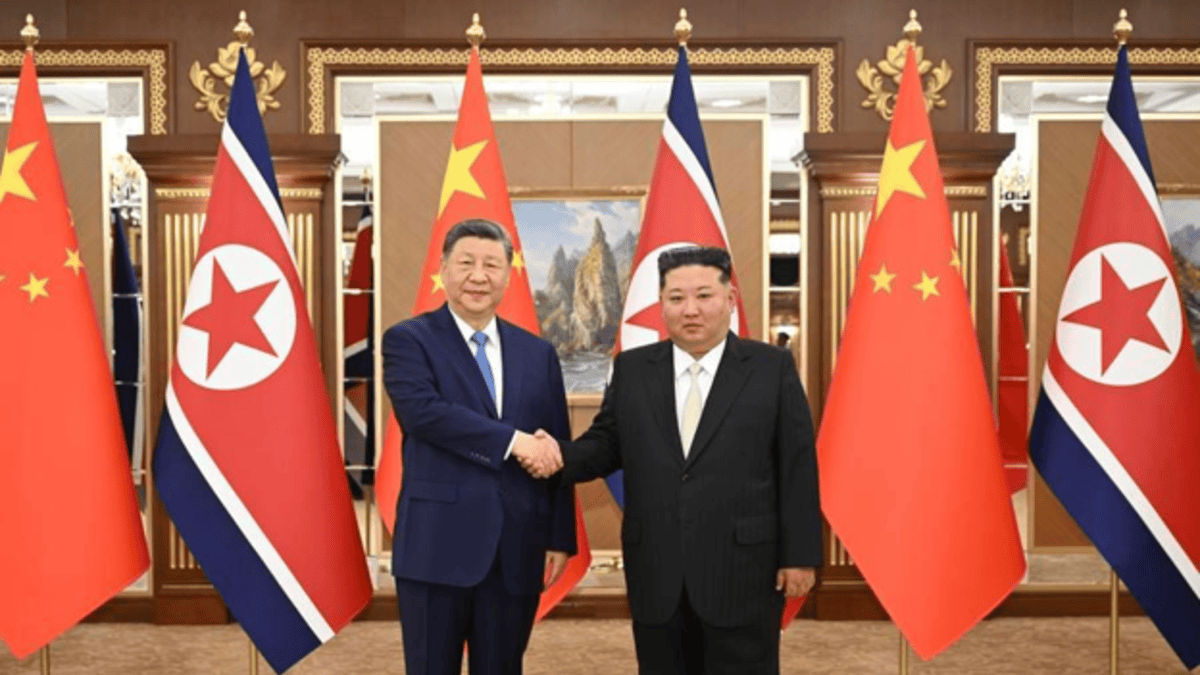
Chinese President Xi Jinping is wrapping up a two-day state visit with North Korean leader Kim Jong Un in Pyongyang. It was his first trip to the country since 2019, and a visit that carries more strategic weight than its carefully choreographed ceremonies might suggest.
Thousands of North Korean workers and schoolchildren lined the streets waving flags, bouquets and balloons as Xi and his wife Peng Liyuan were driven to the Kumsusan State Guest House. Honor guards from North Korea's three armed services were inspected by both leaders, shouting "wishing Comrade Xi Jinping good health" - the kind of grand welcome that Pyongyang reserves for its most valued guests.
A signal of Beijing's priorities
The visit marks Xi's first overseas trip of 2026. When a leader chooses where to go first in a year, it signals where priorities lie. The fact that Xi chose Pyongyang and not a European capital, not a regional ally, not a major economic partner - it tells you something about how seriously Beijing is taking its relationship with North Korea right now.
China, North Korea and the Russia factor
To understand why, it helps to look at what has changed in recent years. North Korea and China have long been bound together by geography, ideology and a 1961 mutual defence treaty - China's only formal military alliance, which commits Beijing to defend North Korea if it is attacked, and which was renewed for another 20 years in 2021.
For decades, that relationship gave China significant influence over Pyongyang. But something has been shifting. North Korea has been deepening its military and economic ties with Russia at a striking pace, underpinned by a Comprehensive Strategic Partnership Agreement signed in 2024 that includes a commitment to joint defence.
Kim has sent troops to fight alongside Russian forces in Ukraine, received weapons technology in return and built a relationship with Putin that has grown visibly warmer. For Beijing, which has long seen itself as Pyongyang's indispensable patron, that growing closeness between its neighbour and its ally represents a quiet but real challenge to its regional influence.
Xi and Kim emphasise enduring ties
Xi's visit is, at least in part, a response to that challenge. During the talks, Xi told Kim that no matter how the international situation changes, China's commitment to the traditional friendship between the two countries will not change.
He described the relationship as rooted in shared ideals and beliefs, backed by a profound historical foundation, a solid political basis and strong emotional bonds, and said that friendship passed down from generation to generation has always been a defining feature of China-North Korea relations. The language was warm and even effusive.
Kim said Xi's choice of Pyongyang as his first overseas destination this year clearly demonstrates how unbreakable the China-North Korea relationship is, and one that has stood the test of time and always stands on the right side of history. He also noted that since their last meeting in Beijing in September 2025, the bilateral relationship had made positive progress across a range of areas, delivering tangible benefits to both peoples.
Xi said China was ready to expand cooperation across economics, trade, agriculture, health, construction, and science and technology, and called on both sides to inject powerful momentum into their ties.
The nuclear issue remains unresolved
The nuclear question hung over the visit without being openly addressed. Just days before Xi's arrival, North Korean state media reported that Kim had inspected a major munitions company and was briefed on expanding the capacity to produce ballistic and cruise missiles.
Kim also visited a new plant manufacturing weapons-grade nuclear material, saying Pyongyang plans to dramatically accelerate its nuclear forces. Both Trump and Xi have publicly committed to the goal of denuclearising the Korean Peninsula, and the two leaders reaffirmed that position during Trump's Beijing summit last month. But North Korea shows no sign of slowing its weapons development, and Xi's visit produced no public statement on the nuclear issue.
A treaty anniversary and wider diplomacy
The visit also coincides with the 65th anniversary of the China-North Korea mutual defence treaty, signed in 1961, a symbolic milestone that both sides have used to frame this as a moment of historical reaffirmation rather than crisis management. Whether it is one or both of those things simultaneously is the question analysts are debating.
What is clear is that Xi's trip to Pyongyang fits into the pattern of robust Chinese diplomacy that has defined the past few months. Beijing hosted Trump in May, received Putin days later, welcomed Pakistan's prime minister, and is now in Pyongyang. Each visit is different in character. Together, they paint a picture of a China that is actively and deliberately positioning itself at the centre of the world's most consequential relationships and also maintaining ties with Washington, Moscow and Pyongyang simultaneously.



















What is your opinion on this topic?
Leave the first comment