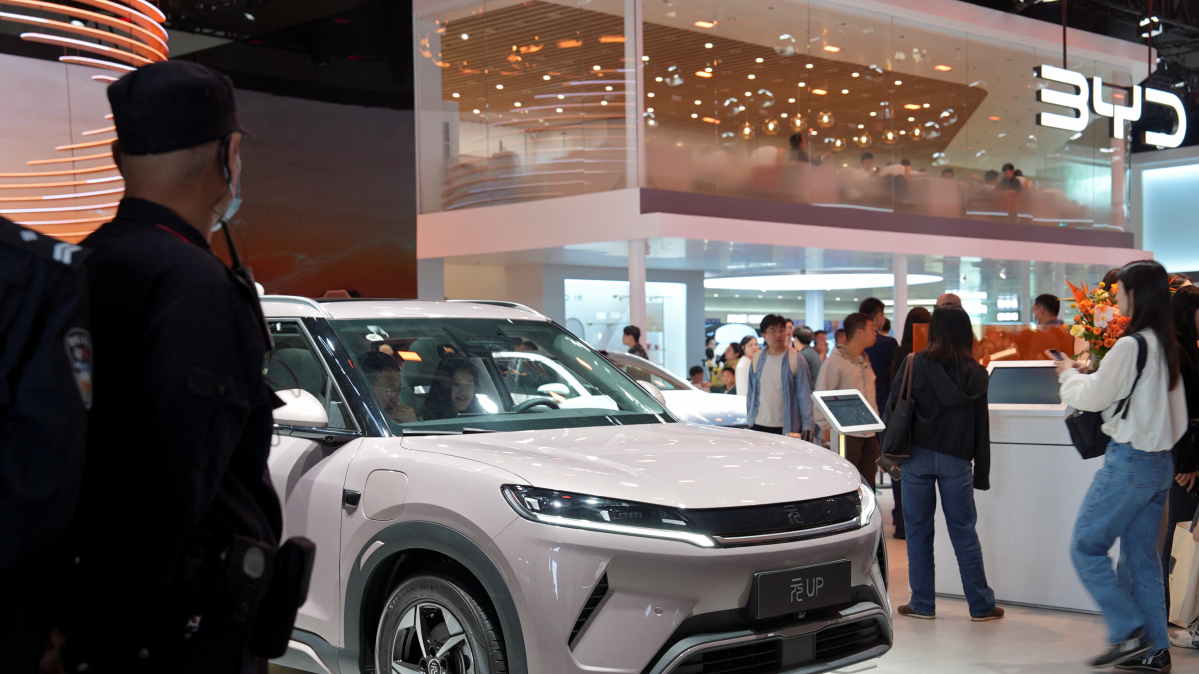
The United States has added some of China's biggest technology and automotive companies, including Alibaba, Baidu, BYD and Nio, to a Pentagon list of firms it believes are linked to Beijing's military.
Major Chinese firms added
The move, announced by the Pentagon on Monday (8 June), is likely to increase tensions between the world's two largest economies just weeks after U.S. President Donald Trump and Chinese President Xi Jinping sought to preserve a fragile trade truce during talks.
The updated list, known as the Chinese Military Companies (CMC) list, now includes a broad range of Chinese technology, artificial intelligence, semiconductor and robotics firms that Washington believes support China's military and industrial ambitions.
Among the newly added companies are memory chipmakers CXMT and YMTC, biotechnology company WuXi AppTec, robotics firms Unitree and RoboSense, and telecommunications equipment maker Baicells.
The Pentagon said the companies "qualify for designation as 'Chinese military companies'" and operate in the United States.
While inclusion on the list does not trigger sanctions, it carries significant consequences. From later this month, the U.S. Department of Defense will be barred from contracting directly with listed firms. From 2027, the restrictions will extend to products and services purchased through third parties.
Companies reject designation
Several of the companies strongly denied any military links.
Alibaba said there was "no basis" for its inclusion.
"Alibaba is not a Chinese military company nor part of any military-civil fusion strategy. We will take all available legal action against attempts to misrepresent our company," the company said.
Baidu also rejected the designation.
"The suggestion that Baidu is a military company is entirely baseless. We will not hesitate to use all options available to us to have the company removed from the list," it said.
WuXi AppTec described its inclusion as "incorrect" and said it would "take immediate actions to challenge and correct this erroneous designation".
Nio told investors the restrictions would not affect its business because it does not supply the U.S. military.
Beijing hits back
China criticised Washington's decision and accused the United States of unfairly targeting Chinese businesses.
"The U.S. should stop its wrong practice and create a fair, just and non-discriminatory environment for Chinese companies," a spokesperson for China's embassy in Washington said.
The embassy also said Chinese companies operating overseas comply with local laws and regulations.
Growing U.S.-China tensions
The latest update reflects growing U.S. concerns about China's technological development and its potential military applications.
Craig Singleton, a China expert at the Foundation for Defense of Democracies, said the move showed that Washington increasingly views China's technology sector as part of a broader strategic challenge.
"Washington is no longer treating these as isolated companies. It is treating the entire technology stack as strategically contested," he said.
The decision underscores how competition between the United States and China continues to extend beyond trade and tariffs into technology, artificial intelligence, semiconductors and national security.



















What is your opinion on this topic?
Leave the first comment