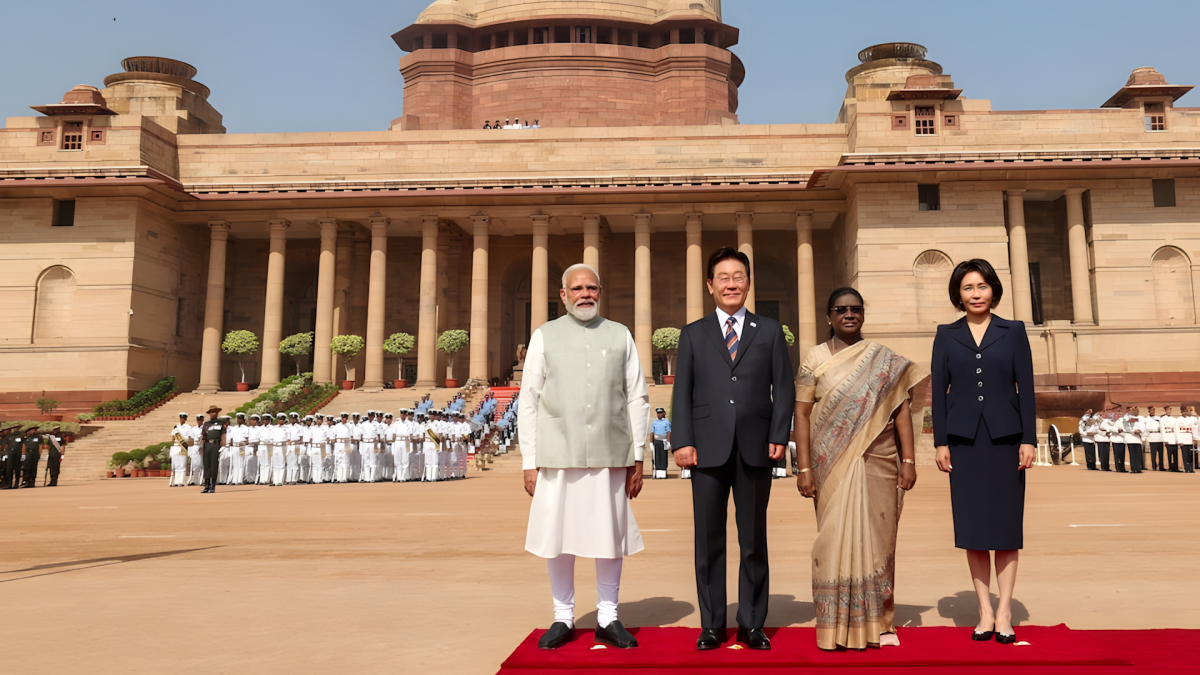
South Korean President Lee Jae Myung begins crucial bilateral talks with Indian Prime Minister Narendra Modi in New Delhi on Monday, marking the first South Korean state visit to India in eight years.
The visit signals Seoul’s renewed focus on strengthening strategic partnerships in the Indo-Pacific.
“The level of economic cooperation between South Korea and India is still very low,” President Lee said on Sunday at a dinner with the Korean expatriate community in New Delhi. “Going forward, we will expand that space and make the relationship between South Korea and India completely different from what it is now.”
Central to this effort is a planned upgrade of the Comprehensive Economic Partnership Agreement (CEPA). Officials from both countries aim to nearly double bilateral trade to $50 billion by 2030, up from $25.7 billion last year, according to presidential adviser Wi Sung-lac.
President Lee is also expected to attend business events with senior corporate leaders. Discussions will extend beyond manufacturing to sectors such as finance, artificial intelligence (AI) and advanced defence technology.
Energy concerns amid Middle East tensions
Seoul’s outreach to India is partly driven by growing economic pressures linked to instability in the Middle East.
President Lee said the ongoing conflict involving Iran has disrupted supply chains and heightened the importance of closer ties with India, describing the two countries as “the most important strategic partners” for each other’s economic security.
India is increasingly seen not only as a consumer market but as a key partner in global production and supply chains.
This shift is evident in the energy sector. Last month, South Korea asked India to increase exports of naphtha, a crucial feedstock for its petrochemical industry, as tensions in the Persian Gulf threatened shipping routes.
India accounted for about 8 per cent of South Korea’s naphtha imports last year. Trade Minister Yeo Han-koo said expanding imports would help secure supply while addressing trade imbalances between the two countries.
Tackling trade imbalance and expanding cooperation
Trade imbalance remains a persistent issue. Data from the Korea International Trade Association shows South Korea recorded a $12.8 billion trade surplus with India last year, exporting $19.2 billion in goods and importing $6.4 billion.
At a recent policy seminar in Seoul, Maeng Hyun-chul of Seoul National University’s Asia Center said India has frequently raised concerns about the widening deficit. He noted that political ties have not kept pace with economic engagement.
Maeng suggested focusing on sectors with mutual benefits, including shipbuilding. Cooperation in maritime construction aligns with Prime Minister Modi’s “Make in India” initiative and job creation goals, while drawing on South Korea’s industrial expertise.
He added that food and consumer goods also offer growth potential, driven by the popularity of Korean culture, known as the “Hallyu” wave, in India.
Broader regional strategy
After the summit in New Delhi, President Lee will travel to Vietnam as part of a wider effort to strengthen and diversify South Korea’s supply chains across Asia.











What is your opinion on this topic?
Leave the first comment