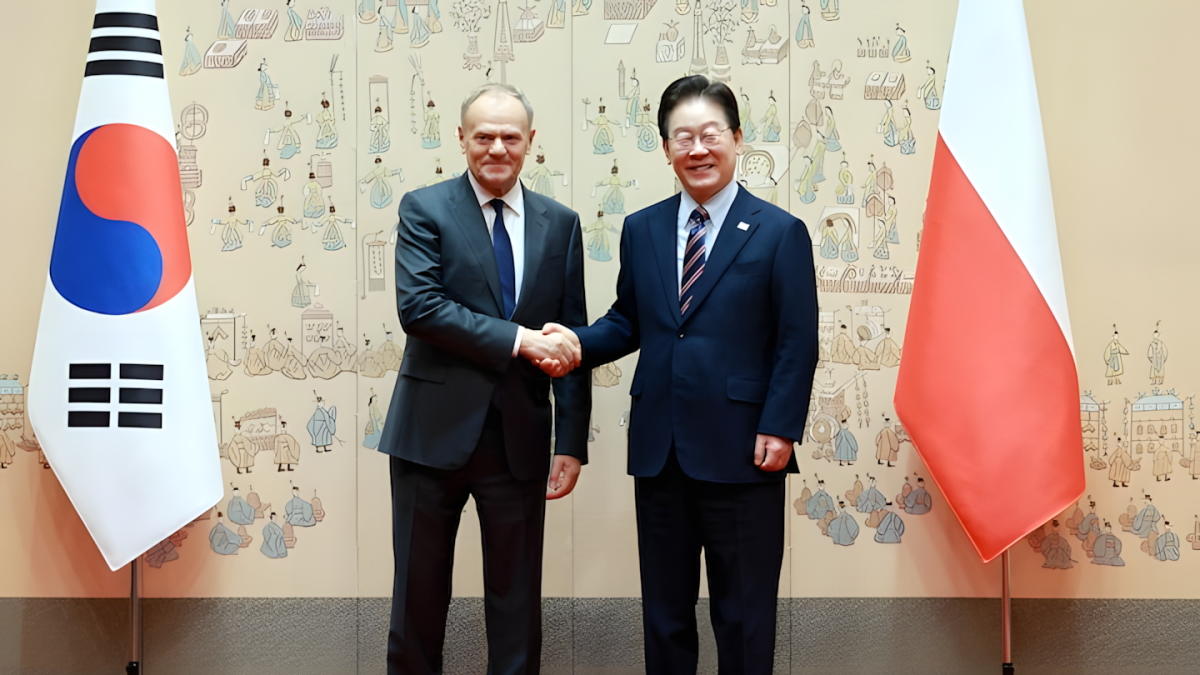
South Korean President Lee Jae Myung and Polish Prime Minister Donald Tusk agreed on Monday to upgrade bilateral relations to a “comprehensive strategic partnership”, placing defence cooperation at its core.
The move, announced after talks at Seoul’s presidential office, reflects shifting global security dynamics following Russia’s invasion of Ukraine. Poland, seeking to modernise its military and strengthen NATO’s eastern flank, has turned to South Korea as a key defence partner capable of rapid, large-scale arms production.
In opening remarks, President Lee said the two countries would expand defence industry cooperation, building on a $44.2 billion framework agreement signed in 2022.
“K2 tanks, K9 self-propelled howitzers, FA-50 light-attack aircraft, and Chunmoo multiple rocket launchers - bearing South Korea's technology and pride - are now safeguarding Poland’s territory and its people across its vast lands,” Lee said.
He added that cooperation had evolved beyond arms sales to include joint production, technology transfer and military training.
Warsaw's key ally after Washington
Prime Minister Tusk underscored the importance of the relationship, describing South Korea as Poland’s “most important ally after the United States, especially in the defence industry.”
He said he would personally oversee expanded defence cooperation, adding that both countries now shared responsibility for strengthening deterrence and contributing to global stability.
The partnership marks a shift for Poland, which has traditionally relied on U.S. and Western European suppliers. Facing urgent rearmament needs, Warsaw has increasingly looked to South Korea’s fast and efficient defence manufacturing sector.
Expanding contracts and joint production
South Korea has become a major arms supplier to Poland, helping elevate its position in the global defence export market.
The 2022 framework agreement set out plans not only for arms purchases but also for joint production in Poland. This approach allows Warsaw to strengthen its domestic defence industry while deploying advanced systems.
Since then, companies including Hanwha Aerospace and Hyundai Rotem have secured further multi-billion-dollar contracts to supply tanks, artillery and missile systems.
Both leaders stressed that the partnership extends beyond defence. The agreement includes cooperation on energy security, infrastructure, science and technology, advanced manufacturing and space development.
It also provides for expanded cultural and people-to-people exchanges, reflecting a broader effort to deepen ties across multiple sectors.















What is your opinion on this topic?
Leave the first comment