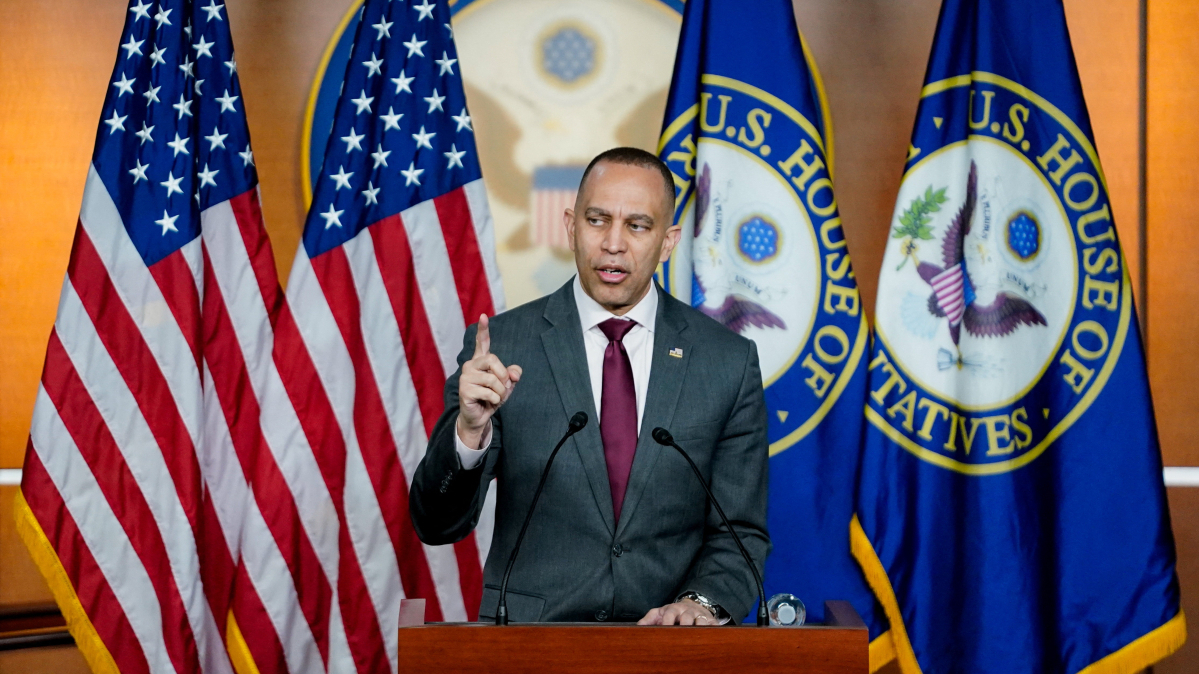
U.S. President Donald Trump’s fellow Republicans in the House of Representatives have blocked an attempt led by House Minority Leader Hakeem Jeffries to restrict presidential war powers over military action involving Iran.
The move took place during a brief procedural session on Thursday (9 April), when Republican Representative Chris Smith brought proceedings to an early close before Democrats could force a vote on a war powers resolution.
The proposed measure would have required congressional approval to continue U.S. military operations and effectively sought to halt current strikes linked to the Iran conflict.
Although largely symbolic, the decision underlines deep divisions in Washington over the limits of presidential authority in military action.
Political standoff over war powers
Democrats have repeatedly tried to pass resolutions to restrict Trump’s ability to launch or continue military operations without congressional consent, including actions involving Iran and Venezuela. So far, those efforts have been blocked.
Party leaders have said they intend to bring similar measures back for a vote once Congress returns from recess next week.
The dispute comes after Trump’s recent warning that Iran faced devastating consequences if it did not comply with U.S. demands, remarks that have drawn strong criticism from the Democrats.
Some lawmakers accused the president of dangerously escalating rhetoric, while others raised concerns about the legality and oversight of military action.
The White House has maintained that the operations are lawful and fall within the president’s authority as commander-in-chief, arguing they are necessary to protect U.S. national security.
Republicans, who hold narrow majorities in both chambers of Congress, have largely continued to support Trump’s foreign policy approach.
The conflict has also reignited broader constitutional questions about war powers, which are formally held by Congress but in practice often exercised by the president during limited or fast-moving military operations.
Democrats argue that recent actions go beyond those limits, while Republicans insist the president retains authority to respond to threats without immediate congressional approval.
The political divide has become sharper in recent weeks, with some Democrats even raising the prospect of impeachment or use of the 25th Amendment, though such moves remain unlikely to gain bipartisan support.
Rising tensions in Washington
Democrats are also attempting to link the military debate to domestic economic concerns, arguing that conflict-related disruptions are driving up energy and food prices in the United States.
They say increased spending on military operations is also placing pressure on public services, while Republicans accuse them of politicising national security issues.
With Congress still in recess, further votes on war powers are expected when lawmakers return next week, ensuring the dispute over Trump’s military authority is set to continue.















What is your opinion on this topic?
Leave the first comment