Zelenskyy rejects FT’s May 2026 election report, cites need for ceasefire
Ukrainian President Volodymyr Zelenskyy said on Wednesday that his government will only hold national elections once a ceasefire with Russia is in pla...
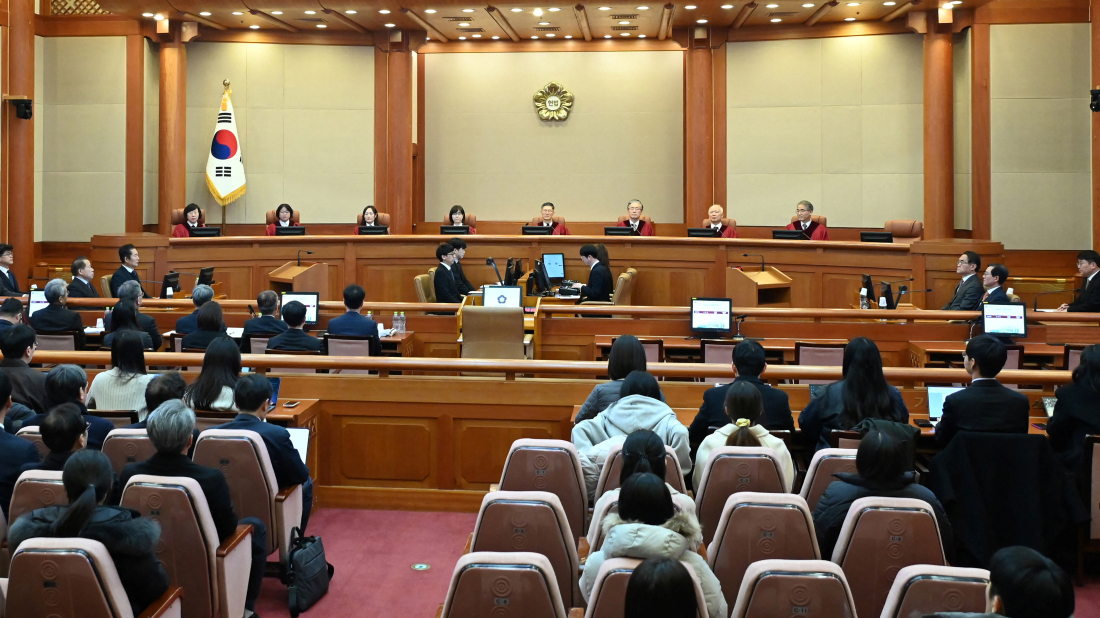
The impeachment trial of South Korean President Yoon Suk Yeol began today, but the president was absent from the Constitutional Court.
The impeachment trial of South Korea’s suspended President Yoon Suk Yeol commenced today with a brief session, as Yoon failed to appear at the Constitutional Court. The trial follows Yoon’s impeachment by the National Assembly over his controversial declaration of martial law on December 3, 2024.
Yoon’s absence from the trial has raised concerns, with his lawyer explaining that the president’s inability to attend was due to authorities attempting to detain him, preventing him from presenting his case. "The president will decide whether to attend the court in person on Thursday after discussions on his defense strategy," said Yoon's lawyer, Yoon Kab-keun, outside the court.
The next trial session is scheduled for Thursday, January 16. Acting Chief Justice Moon Hyung-bae has stated that if President Yoon does not attend, his legal team will represent him in court.
Yoon’s impeachment came after his controversial declaration of martial law, which the National Assembly deemed unconstitutional. The proceedings mark a significant moment in South Korean politics as the nation grapples with the aftermath of the decision and its implications for the future of the presidency.

The United States and Azerbaijan signed a strategic partnership in Baku on Tuesday (10 February) encompassing economic and security cooperation as Washington seeks to expand its influence in a region where Russia was once the main power broker.
Greek Prime Minister Kyriakos Mitsotakis arrived in Ankara on Wednesday, where Turkish President Recep Tayyip Erdoğan held an official welcoming ceremony at the Presidential Palace, marking the start of high-level talks between the two NATO allies.
Europe heads into the Munich Security Conference, 13 February, amid deepening unease over U.S. policy, as President Donald Trump’s hard-line stance on defence, trade and territory fuels doubts about Washington’s long-term commitment to transatlantic security.
The European Union is preparing a further expansion of its sanctions against Russia, with Central Asia emerging for the first time as a distinct point of focus.
A senior adviser to Iran’s Supreme Leader said on Tuesday that negotiations with the United States must remain focused on the nuclear issue and be grounded in realism, as Washington and Tehran prepare to resume talks mediated by Oman.
Stalled U.S.–Iran talks and mounting regional tensions are exposing a growing strategic rift between Washington and Tel Aviv over how to confront Tehran, political analyst James M. Dorsey says, exposing stark differences in approach at a critical moment.
A Republican lawmaker accused on Wednesday (11 February) Attorney General Pam Bondi of concealing the names of Jeffrey Epstein’s powerful associates. The claim was made during a heated House hearing on the Justice Department’s handling of the files.
Start your day informed with AnewZ Morning Brief: here are the top news stories for the 12th of February, covering the latest developments you need to know.
The Ukrainian capital came under a “massive” Russian missile attack early Thursday (12 February), with explosions heard across the capital according to authorities. The assault unfolded as uncertainty lingers over upcoming U.S.-brokered peace talks.
The U.S. House of Representatives narrowly backed a measure on Wednesday (11 February) disapproving President Donald Trump's tariffs on Canada, a rare rebuke of the president and leaders of his party in the Republican-majority House.
You can download the AnewZ application from Play Store and the App Store.
What is your opinion on this topic?
Leave the first comment