Erdogan hosts leader of Niger, signalling interest in Africa’s Sahel region
Turkish President Recep Tayyip Erdoğan hosted Nigerien President Abdourahamane Tchiani in Ankara on Thursday, underscoring Türkiye’s growing engag...
Two 15-year-olds have asked Australia’s High Court to strike down a forthcoming ban on social media use by under-16s, arguing the law breaches the country’s implied freedom of political communication ahead of its 10 December start.
The Digital Freedom Project, a campaign group, said on Wednesday it had filed proceedings with the High Court on behalf of Noah Jones and Macy Neyland, aiming to stop what it called a “grossly excessive” law. Australia has no explicit constitutional right to free speech, but the High Court has recognised a limited implied freedom tied to political communication.
More than one million accounts held by Australians under 16 are due to be deactivated when the ban takes effect. The restrictions apply to platforms including YouTube, TikTok, Snapchat and Meta’s Facebook and Instagram.
Neyland said the measure would prevent young people from expressing views online.
“Young people like me are the voters of tomorrow … we shouldn’t be silenced. It’s like Orwell’s book 1984, and that scares me,” she said.
The Digital Freedom Project is led by John Ruddick, a Libertarian Party member of the New South Wales Parliament. Australian media have also reported that YouTube has considered a separate High Court challenge on grounds the law burdens political communication.
Communications Minister Anika Wells told Parliament that the government, led by Prime Minister Anthony Albanese, “would not be intimidated” by threats or legal action.
“The Albanese Labor government remains steadfastly on the side of parents, and not of platforms,” she said.
Companies that fail to comply could face penalties of up to A$49.5 million (about $32.2 million). Governments and technology firms worldwide are watching the case closely, as Australia prepares to implement one of the most far-reaching controls on minors’ access to social media.

Iran’s Revolutionary Guards (IRGC) said in a statement that its Aerospace Force did not strike the Kuwait Airport passenger terminal on Wednesday, and that the destruction was instead caused by a failed U.S. Patriot missile.
Israel and Lebanon have agreed to implement a ceasefire after U.S.-backed talks in Washington. The deal requires Hezbollah to halt attacks and withdraw from southern Lebanon, while both sides will resume direct talks later this month aimed at reaching a broader agreement.
Five Azerbaijani citizens have been killed and three others injured following drone attacks on two cargo vessels in the Sea of Azov, Azerbaijan's Foreign Ministry said on Friday.
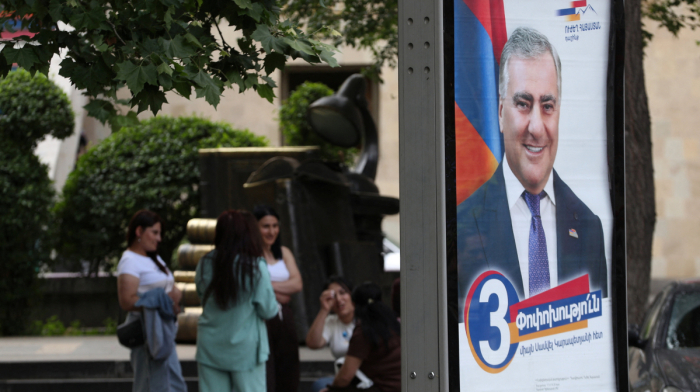
As Armenia heads toward parliamentary elections on 7 June, the country's relationship with Azerbaijan is emerging as one of the defining issues of the campaign, with analysts and international observers highlighting the role of regional politics in shaping voters’ mindsets.
The U.S. House of Representatives has approved legislation that would provide new aid to Ukraine and impose additional sanctions on Russia, marking the latest instance of Republican lawmakers breaking ranks with President Donald Trump and party leaders.
People across Gaza are facing a worsening humanitarian crisis, with millions struggling to access food, clean water, shelter and medical care as the conflict continues.
An ageing, poorly insured shadow armada now accounts for around one-sixth of the world's tanker fleet. Hidden by design and fraught with risk, it operates beyond conventional oversight. A maritime law expert explains how it works, who profits, and why much of the world looks the other way.
Turkish President Recep Tayyip Erdoğan hosted Nigerien President Abdourahamane Tchiani in Ankara on Thursday, underscoring Türkiye’s growing engagement with Africa’s Sahel region as geopolitical alliances continue to shift.
Germany has failed to secure a rotating seat on the United Nations Security Council, ending decades of successful bids and prompting fresh debate about the country's diplomatic standing on the global stage.
Chinese President Xi Jinping will visit North Korea on 8-9 June, marking his first trip to the country in nearly seven years as Beijing seeks to strengthen relations with its long-time ally.
You can download the AnewZ application from Play Store and the App Store.
What is your opinion on this topic?
Leave the first comment