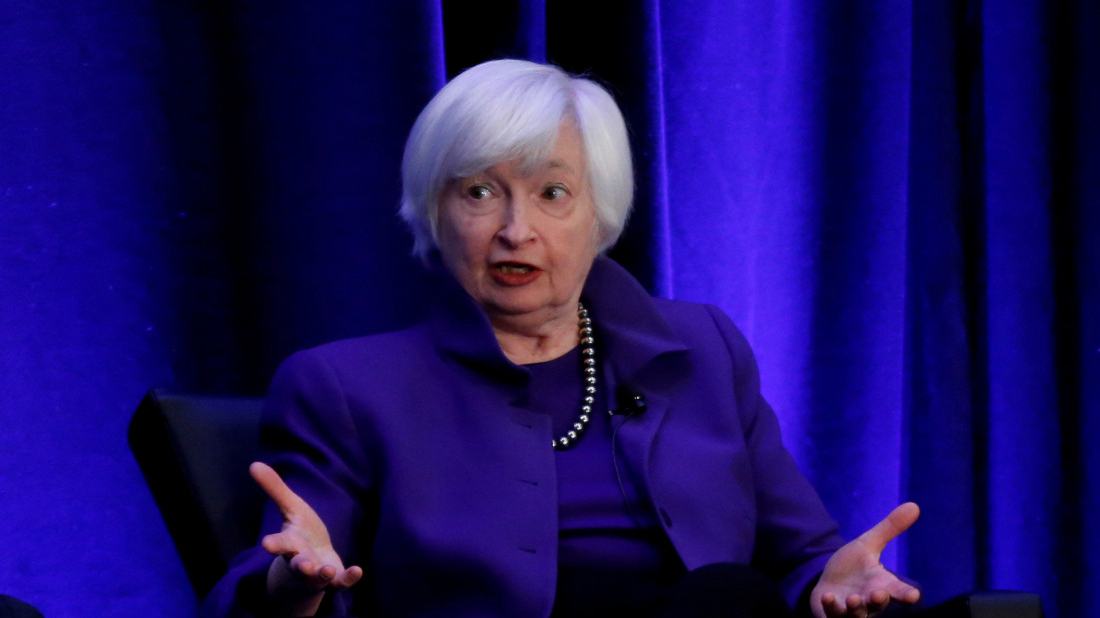
U.S. Treasury Secretary Janet Yellen announced that G7 and EU partners are nearing a $50 billion loan to Ukraine backed by frozen Russian assets, with the U.S. contributing $20 billion.
On Tuesday, U.S. Treasury Secretary Janet Yellen reported that G7 and EU allies are approaching the finalization of a $50 billion loan to Ukraine, which will be secured by frozen Russian assets. The U.S. is projected to contribute roughly $20 billion to this effort.
During a news conference at the beginning of the International Monetary Fund and World Bank annual meetings, Yellen expressed confidence that the Russian sovereign assets, primarily located in Europe, will stay immobilized despite the EU's need to renew the freeze every six months.
Republican presidential candidate Donald Trump pledged to "get out" of the Russia-Ukraine war, highlighting the urgency for G7 allies to finalize the loan ahead of the Nov. 5 U.S. elections.
Earlier on Tuesday, EU lawmakers approved the bloc's plan to utilize frozen Russian assets for a loan of up to 35 billion euros ($38 billion).
Yellen indicated that the U.S. is ready to contribute about $20 billion to the loan and that there are "nothing significant that still needs to be worked out."
The U.S. pushed for stronger assurances from the EU that the funds, primarily held by Euroclear in Belgium, would remain frozen for an extended period, even if a truce in Ukraine is reached. This would minimize the risk of U.S. taxpayers being responsible for repaying the loan.
Yellen stated that the U.S. is willing to accept the EU's commitment to maintaining the long-term freeze on the assets, particularly in light of the current situation of the war. "I think the assurances are already there. We asked for some mild strengthening, but feel good that this is a secure loan that will be serviced by Russian assets, by Russia and not by American taxpayers," Yellen noted.
In her prepared remarks, she mentioned that the U.S. would introduce strong new sanctions as early as next week, targeting entities that support Russia's military efforts in Ukraine, including "intermediaries in third countries that are supplying Russia with critical inputs for its military."













What is your opinion on this topic?
Leave the first comment