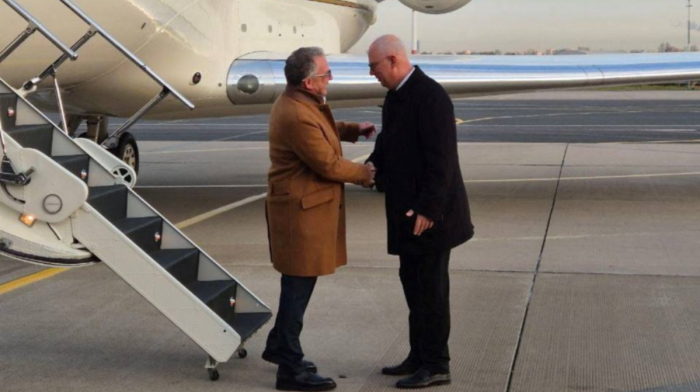
OSCE Chair welcomes Azerbaijan-Armenia peace process, hails closure of Minsk Group
OSCE Chairperson-in-Office, Minister of Foreign Affairs of Finland, Elina Valtonen told the press that "the end of the conflict between Azerbaijan and...
Afghans living in Europe said on Tuesday they were nervous with no news from their families after internet and mobile phone services were cut by the Taliban in Afghanistan, according to diplomatic and industry sources.
Residents and monitoring services reported no connectivity and disruption to flights and financial services. The Taliban administration offered no immediate explanation for the outage and could not be reached for comment.
Atif Solozi, originally from Laghman in eastern Afghanistan but visiting friends in Paris from Brussels, said that he had last spoken to his parents on Saturday but that since Monday connections had been cut.
"It was Monday, last Monday from five o'clock, the internet, everything was closed. No one has contact with their family. No one knows about their families, it's closed. What happened, we don't know anything."
Wali Ahmadzai, originally from Logar but now living in Paris, said that all his friends living in France had the same issue.
"The families are too far. Having no news is tiring, it's really so hard for us," he said.
"For the moment I don't have any news from my family and it's the same for my friends here whom I know. It's the same," Wali added.
In the past, the Taliban have voiced concern about online pornography, and authorities cut fibre-optic links to some provinces in recent weeks, with officials citing morality concerns.
The internet blackout comes as Afghanistan is grappling with the aftermath of an earthquake that hit the east of the country, the return of millions of refugees expelled from neighbouring countries, and a drought in the north.

For nearly three decades following the dissolution of the Soviet Union, the international system was defined by a singular, overwhelming reality: American unipolarity.
Chinese scientists have unveiled a new gene-editing therapy that they say could lead to a functional cure for HIV, making it one of the most promising developments in decades of global research.
As the year comes to an end, a new initiative bringing civil society actors and regional analysts from Armenia and Azerbaijan together is steadily gaining ground.
Faced with mounting public outrage following one of the deadliest environmental disasters in the nation’s recent history, the Indonesian government has pledged to investigate and potentially shut down mining operations found to have contributed to the catastrophic flooding on Sumatra.
Uzbekistan has reopened its border with Afghanistan for the first time since 2021, the country’s Chamber of Commerce and Industry announced on Tuesday.
Britain has imposed new sanctions on Russia, targeting the entire GRU military intelligence agency, which was highlighted in a UK public inquiry into the 2018 poisoning of Dawn Sturgess, caused by the nerve agent Novichok.
Afghanistan’s foreign minister, Amir Khan Muttaqi, has said distanced the Afghan government from recent incidents involving Afghan nationals on U.S. soil.
Russia has warned that any "illegal action" by the European Union regarding its frozen assets will provoke "the harshest reaction," with Moscow already preparing its response.
Families of 153 Chinese passengers aboard the missing MH370 flight are once again hopeful as a fresh search for the plane is announced.
Residents of Darfur are being systematically held for ransom by the Sudanese paramilitary force that overran a city in the western part of the country in late October.
You can download the AnewZ application from Play Store and the App Store.
What is your opinion on this topic?
Leave the first comment